
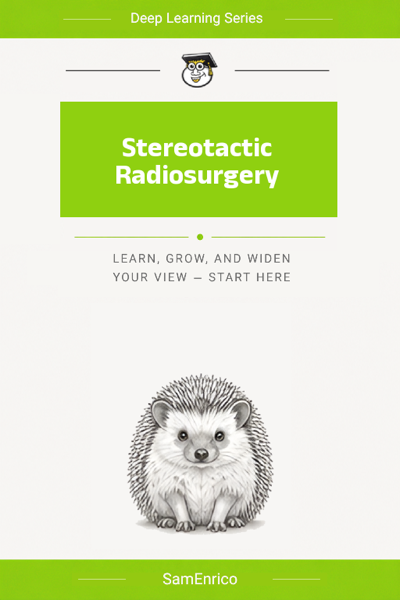
Non-FictionInformativeEducational
Stereotactic Radiosurgery Audiobook
A Coursebook on Stereotactic Radiosurgery
A Coursebook on Stereotactic Radiosurgery
Formats
Free sample
Chapter 1: The Bloodless Scalpel...--The morning of October 5, 1951, was unseasonably cold in Stockholm. Inside the Karolinska Institute’s radiation therapy department, a forty-four-year-old Swedish neurosurgeon named Lars Leksell prepared to do something that many of his colleagues would later describe as either madness or genius. He was about to treat a patient with trigeminal neuralgia—a condition of excruciating, lightning-like facial pain often called the "suicide disease" because of its relentless severity—using not a steel scalpel, not an electrocautery device, not even a laser, but intersecting beams of ionizing radiation directed through a modified dental x-ray unit. There would be no incision. No blood.
No hospital admission. And yet, if Leksell was correct, the patient would wake from the procedure with the same therapeutic effect as if a neurosurgeon had opened the skull, retracted the temporal lobe, and mechanically lesioned the trigeminal nerve root. Leksell called this concept radiosurgery. The term seemed paradoxical—radio from radiation, surgery from the Greek kheirourgia, literally "hand-work." How could the absence of hands, of instruments, of tissue dissection, constitute surgery at all?The answer, which would take decades to fully materialize, required a fundamental reimagining of what surgery means. Traditional surgery relies on mechanical access: incision, retraction, visualization, excision, and closure.
The surgeon’s hand is the primary effector, guided by the eye and the tactile feedback of tissue resistance. Radiosurgery, by contrast, relies on mathematical precision, physical principles of beam intersection, and a radically different biological intent. The target is not retracted or exposed; it remains buried deep within the brain or body, surrounded by critical structures that must be preserved. The surgeon does not see the target directly but rather through fusion of computed tomography, magnetic resonance imaging, and angiographic data—a virtual topography rendered in voxels and isodose lines. The effector is not a blade but a high-energy photon beam that deposits lethal doses of radiation with submillimeter accuracy.
And the therapeutic mechanism is not mechanical transection but radiobiologic ablation: vascular endothelial apoptosis, direct DNA damage beyond repair, and eventual tumor necrosis or axonal degeneration over weeks to months.This chapter traces the intellectual and technical lineage of stereotactic radiosurgery (SRS) from its obscure origins in functional neurosurgery to its current status as a primary oncologic tool for brain tumors, arteriovenous malformations, functional disorders, and, through its extracranial extension known as Stereotactic Body Radiation Therapy (SBRT), for lung, liver, spine, and…
This is the end of the free sample. Get the Audiobook to keep going. Buy now
About this book
Details
- Author
- Jackson Alfonso
- Publisher
- SamEnrico
- Language
- English
- Genre
- Non-Fiction, Informative, Educational
- Released
- 2026-05-11
- Pages (approx.)
- 160
- Available as
- eBook, Audiobook

Listen in the VoxFlicks app
Audiobooks and audio dramas wherever you go. Sign in with your SamEnrico account and press play.
More by Jackson Alfonso
 Red Tail Angels MemoirJackson Alfonso$11.99
 LSE Online Group ProjectsJackson Alfonso$11.99
 Body Scan Induction GuideJackson Alfonso$11.99
 The Ambassador's TailorJackson Alfonso$11.99
 The Opium Kingpins: How Europe's Drug Lords Laundered MillionsJackson Alfonso$11.99
 How to Produce Bicycle ToolsJackson Alfonso$11.99
 Travel Employee Attack GuideJackson Alfonso$12.99
 How to Start a Hobby in ChessJackson Alfonso$11.99
You may also like
 Hong Kong Handover 1997Dunn Johnnie$11.99
 Zumba For Postnatal Recovery CourseNeal Christian$11.99
 Zumba for BeginnersLadner Nikia$11.99
 YouTube Comment Mining GuideHumes Pandora$12.99
 Worry Box MeditationCarlin Rudy$11.99
 Workplace Stress MeditationNguyen Lynn$11.99
 Workplace Stress and Sleep RepairHawley Ivory$11.99
 Workplace Perfectionism CureDelaney Jeffry$11.99
 Workplace Injustice Anger GuideWallen Isabelle$11.99
 Work Addiction and Burnout LinkGreenwood Ester$11.99
 Women in Yoga and WellnessBeattie Galina$11.99
 Women in Stand Up ComedyChun Evangeline$11.99