
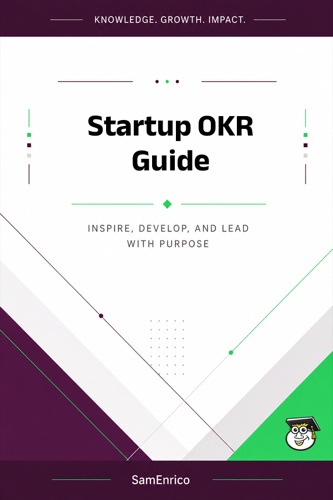
Non-FictionSelf-HelpStartup OKRs
Startup OKR Guide eBook
Set rapid iteration goals for early stage companie
Set rapid iteration goals for early stage companies.
Formats
Free sample
Chapter 1: The Google Delusion--–- In the winter of 2019, a well-intentioned venture capitalist sat across from a founding team and said the six words that would eventually kill their company: “You need to implement OKRs. Like Google.”The founders nodded. They had read Measure What Matters. They had highlighted passages. They believed, with the fervor of converts, that if they just installed the same goal-setting system that had turned a search engine into a trillion-dollar empire, their own startup would somehow catch the same magic.Eleven months later, the company was dead.Not because they ran out of money.
Not because the product was bad. Not because the market was small. Because their new VP of Operations—a very nice, very organized man named Steven—had read the same book and decided to implement “world-class OKRs” with religious precision.Steven introduced quarterly planning cycles. He asked every department to “cascade” their goals down to individual contributors. He built a beautiful dashboard in Asana with color-coded progress bars and automated reminder emails.
He scheduled hour-long “OKR alignment meetings” every Tuesday at 10 AM.Within thirty days, the engineers were gaming their Key Results—delivering exactly 90% of easy targets rather than stretching for hard ones. The sales team stopped talking to customers because they were too busy updating spreadsheets. The CEO spent eight hours a week in alignment meetings and zero hours talking to users.On week eleven, their lead investor called. “Why has your velocity dropped seventy percent?” Steven couldn’t answer. The metrics looked perfect.
The dashboards were green. And the company was dying.This book exists because of Steven. And because of the thousands of founders just like him who have been sold a lie: that what works for Google at scale will work for your startup at seed stage.The truth is the opposite.The Core Tension You Need to Understand Right Now Here is the single most important sentence in this entire book, and if you remember nothing else, remember this:Standard OKRs assume stability. Startups are chaos machines.Let me unpack that.When John Doerr introduced OKRs to Google in 1999, Google was not a tiny startup in the way you are a tiny startup. Google had already raised significant capital.
They had a working search engine that was demonstrably better than anything else on the market. They had a clear product-market fit trajectory. What they needed was discipline—a way to keep a rapidly growing organization aligned as they scaled from forty people to four hundred.Your startup, by contrast, is probably still trying to figure out what product to build. Your “market” might be three people in a Slack channel who said they’d maybe pay for something someday. Your “strategy” changes every time you talk to a customer.
You don’t need discipline. You need speed. You need learning. You need the ability to change direction on a dime without a committee meeting.The OKR framework was designed for the first problem—scaling alignment. It was not designed for the second problem—finding product-market fit in a hurricane of uncertainty.And yet, founders keep reading Measure What Matters, keep watching the You Tube videos of Larry Page explaining how OKRs transformed Google, and keep implementing quarterly planning cycles that are guaranteed to slow them down at exactly the moment they need to speed up.This chapter is going to explain why that happens, how to spot the warning signs before it’s too late, and—most importantly—how to reset your relationship with goal-setting before your own “Steven” arrives.The Anatomy of a Corporate OKR (And Why It Breaks at 10 People)Before we can fix the problem, we need to understand exactly what breaks when you transplant corporate OKRs into a startup.A standard OKR—the kind John Doerr teaches, the kind Google uses, the kind that every Big Tech company has adopted in some form—has three characteristics that make it deadly for early-stage companies.Characteristic One: The Quarterly Time Horizon Corporate OKRs run on a ninety-day cycle.
The logic is sound for a large company: markets move slowly enough that a quarter is a reasonable planning unit. Sales cycles are predictable. Product roadmaps are locked three months in advance. Marketing campaigns are booked.For a startup, ninety days is an eternity. Your market can change in ninety days.
Your competitors can launch in ninety days. Your runway can shrink in ninety days. More importantly, your understanding of the problem you’re solving can change completely in ninety days.Consider what happens when you commit to a quarterly OKR. On day one, you set a goal based on what you know today. By day thirty, you’ve talked to ten more customers and learned that your initial assumption was wrong.
But you’re already locked into a quarterly plan. Your team is already executing against the old hypothesis. Your dashboard is already tracking progress toward a goal that no longer makes sense.You face a choice: ignore the new learning and keep executing (which feels productive but is actually wasting time), or abandon the quarterly OKR and admit failure (which feels embarrassing and demoralizing). Most teams choose the first option. They keep marching toward a target they no longer believe in, because the system punishes course correction.This is not a hypothetical.
This is the story of Maya, whose edtech startup we will follow throughout this book. In her first month of implementing quarterly OKRs, Maya’s team set a goal to “Increase weekly active users by 300%.” By week three, they had discovered that their users didn’t actually want weekly activity—they wanted a tool they could use intensively for one week each month. The quarterly OKR had locked them into a weekly engagement metric that was fundamentally misaligned with customer needs. But they kept chasing it. For ten more weeks.
Because “that’s what OKRs require.”Characteristic Two: The Top-Down Cascade In a corporate OKR system, goals flow downward. The company sets its objectives. Then each department sets objectives that align with the company objectives. Then each team sets objectives that align with the department objectives. Then each individual sets objectives that align with the team objectives.This is called “cascading,” and it is the heart of Doerr’s alignment model.
Done well, it ensures that every person in a large organization is rowing in the same direction.Done in a startup, it creates two problems.First, the cascade takes too long. By the time the CEO’s objective has been translated down through three layers of management to the individual contributor, weeks have passed. The market has shifted. The original objective is already stale.Second, and more importantly, the cascade destroys ownership. When a goal is handed down from above, it feels like an assignment, not a commitment.
Engineers stop asking “What’s the right thing to build?” and start asking “How do I check this box?” Salespeople stop asking “What do customers actually need?” and start asking “How do I hit my number?”This is what happened to Maya’s engineering team. The CEO set an objective to “Improve platform reliability.” That cascaded to the CTO as “Reduce system downtime to 99.9% uptime.”…
This is the end of the free sample. Get the eBook to keep going. Buy now
About this book
Details
- Author
- Sharkey Vinita
- Publisher
- SamEnrico
- Language
- English
- Genre
- Non-Fiction, Self-Help, Startup OKRs
- Released
- 2026-06-07
- Pages (approx.)
- 150
- Available as
- eBook, Audiobook

Read better in the ZLOADR app
Your eBooks on your phone or tablet. Sign in with your SamEnrico account and start reading.
More by Sharkey Vinita
 Beginner Fitness MasterSharkey Vinita$11.99
 Burnout Recovery For DispatchersSharkey Vinita$11.99
 Teamster Boss Hoffa Union Reforms AttemptedSharkey Vinita$11.99
 Guilt Of Moving AwaySharkey Vinita$11.99
 Craving Reshaping BlueprintSharkey Vinita$11.99
 RateMyProfessor Status AnxietySharkey Vinita$11.99
 The Last Stand of the Iron Horse: A Forgotten Olympic LegendSharkey Vinita$11.99
 The Architects of the Sun: Nubia's Lost Pyramids of MeroëSharkey Vinita$11.99
 How to Produce Sliced Herbal MedicineSharkey Vinita$11.99
 EU VAT for Non-EU BusinessesSharkey Vinita$12.99
 AI for Segment Reporting under IFRS 8Sharkey Vinita$12.99
 Growing Brassolaeliocattleya (Trigeneric Hybrid Orchids)Sharkey Vinita$11.99
You may also like
 Hong Kong Handover 1997Dunn Johnnie$11.99
 Zumba For Postnatal Recovery CourseNeal Christian$11.99
 Zumba for BeginnersLadner Nikia$11.99
 YouTube Comment Mining GuideHumes Pandora$12.99
 Worry Box MeditationCarlin Rudy$11.99
 Workplace Stress MeditationNguyen Lynn$11.99
 Workplace Stress and Sleep RepairHawley Ivory$11.99
 Workplace Perfectionism CureDelaney Jeffry$11.99
 Workplace Injustice Anger GuideWallen Isabelle$11.99
 Work Addiction and Burnout LinkGreenwood Ester$11.99
 Women in Yoga and WellnessBeattie Galina$11.99
 Women in Stand Up ComedyChun Evangeline$11.99