
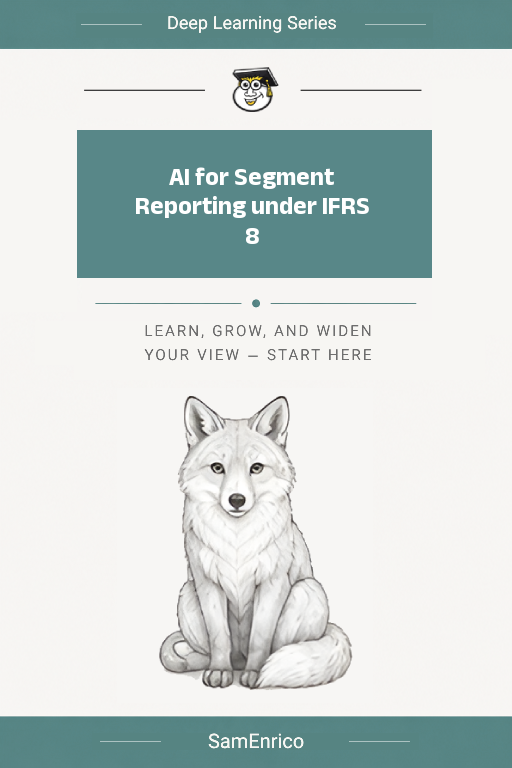
AI for Segment Reporting under IFRS 8
Identify reportable segments using AI that aggrega
Identify reportable segments using AI that aggregates data by operating segment, meeting quantitative thresholds and disclosure requirements.
Formats
About this book
Free sample
Chapter 1: The Fragmentation Trap--–- On a Tuesday morning in March, the Chief Financial Officer of a $12 billion manufacturing conglomerate received an email that would consume the next 72 hours of her life. The external auditor had flagged a material inconsistency in the company’s segment reporting. According to the audit team, the company’s reported operating segments—carefully crafted over years of investor communications—did not fully align with the internal reports reviewed by the Chief Operating Decision Maker. The discrepancy was not large in dollar terms, but it was existential in regulatory terms. Restatement was likely.
Shareholder confidence was at risk. And the root cause was not fraud, not incompetence, but something far more mundane and far more pervasive: the company’s ERP system, its budgeting software, and its monthly board pack simply did not speak the same language.This scenario plays out thousands of times each year across publicly traded companies worldwide. The problem is not new, but it has become dramatically worse in the era of digital transformation. As organizations have adopted best-of-breed systems for finance, sales, supply chain, and human resources, they have inadvertently created a fragmented data ecosystem where the same business unit might be called “North American Consumer Electronics” in the CODM’s quarterly review, “BU_NA_789” in the general ledger, and “Region 1 - Consumer” in the consolidation software. The accounting team, caught in the middle, manually reconciles these differences using spreadsheets that multiply in number and complexity with each passing quarter.
And somewhere in that labyrinth of VLOOKUPs and pivot tables, the connection between what management sees and what the company discloses begins to fray.This chapter introduces the central problem that the rest of this book exists to solve: the fragmentation trap. We will explore how IFRS 8’s “management approach” created an elegant accounting principle that became an operational nightmare, why traditional manual methods of segment reporting are collapsing under their own weight, and how a new paradigm—one that harnesses artificial intelligence to dynamically align financial data with fluid management structures—offers the only scalable path forward. By the end of this chapter, you…
This is the end of the free sample. Get the eBook to keep going. Buy now
Contents
- Chapter 1
- Chapter 2
- Chapter 3
- Chapter 4
- Chapter 5
- Chapter 6
- Chapter 7
- Chapter 8
- Chapter 9
- Chapter 10
- Chapter 11
- Chapter 12
Details
- Author
- Sharkey Vinita
- Publisher
- SamEnrico
- Language
- English
- Genre
- Non-Fiction, AI Operator
- Released
- 2026-05-30
- Pages (approx.)
- 160
- Available as
- eBook, Audiobook

Read better in the ZLOADR app
Your eBooks on your phone or tablet. Sign in with your SamEnrico account and start reading.
More by Sharkey Vinita
 Beginner Fitness MasterSharkey Vinita$11.99
 Burnout Recovery For DispatchersSharkey Vinita$11.99
 Teamster Boss Hoffa Union Reforms AttemptedSharkey Vinita$11.99
 Startup OKR GuideSharkey Vinita$11.99
 Guilt Of Moving AwaySharkey Vinita$11.99
 Craving Reshaping BlueprintSharkey Vinita$11.99
 RateMyProfessor Status AnxietySharkey Vinita$11.99
 The Last Stand of the Iron Horse: A Forgotten Olympic LegendSharkey Vinita$11.99
 The Architects of the Sun: Nubia's Lost Pyramids of MeroëSharkey Vinita$11.99
 How to Produce Sliced Herbal MedicineSharkey Vinita$11.99
 EU VAT for Non-EU BusinessesSharkey Vinita$12.99
 Growing Brassolaeliocattleya (Trigeneric Hybrid Orchids)Sharkey Vinita$11.99
You may also like
 Hong Kong Handover 1997Dunn Johnnie$11.99
 Zumba For Postnatal Recovery CourseNeal Christian$11.99
 Zumba for BeginnersLadner Nikia$11.99
 YouTube Comment Mining GuideHumes Pandora$12.99
 Worry Box MeditationCarlin Rudy$11.99
 Workplace Stress MeditationNguyen Lynn$11.99
 Workplace Stress and Sleep RepairHawley Ivory$11.99
 Workplace Perfectionism CureDelaney Jeffry$11.99
 Workplace Injustice Anger GuideWallen Isabelle$11.99
 Work Addiction and Burnout LinkGreenwood Ester$11.99
 Women in Yoga and WellnessBeattie Galina$11.99
 Women in Stand Up ComedyChun Evangeline$11.99