
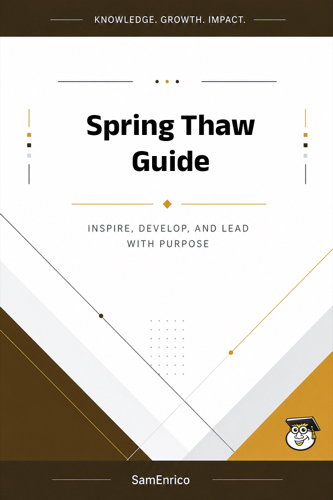
Spring Thaw Guide eBook
Watch imagined ice melt into stream as new green a
by Pina Nestor
Watch imagined ice melt into stream as new green appears.
Formats
Free sample
Chapter 1: The Weight of Stillness--–- You wake up tired of tired. Not the good tired—not the earned exhaustion of a long hike or a day spent making something with your hands. This is the tired that sleeps eight hours and wakes up already calculating how soon you can go back to bed. This is the tired that has forgotten what it feels like to be curious, to be eager, to be anything other than heavy. You check your phone.
Nothing urgent. Nothing new. Just the same small weight pressing on your chest that you have learned to call "fine."This chapter is not about fixing that tired. Not yet. First, it is about noticing it without running away.The central metaphor of this book—spring thaw—begins in a place most people skip.
We want the drip. We want the first green shoot pushing through mud. We want the satisfying moment when ice surrenders and water remembers how to move. But before any of that, there is a longer, quieter, less photogenic stage: the stillness before anything happens at all. The ice does not crack at first light.
It sits. It holds. It waits. And so do you.This chapter teaches you to recognize that waiting as something other than failure. It introduces three distinct forms of frozenness—mental, emotional, environmental—that masquerade as personality traits, permanent conditions, or moral failings.
It offers a one-minute practice that requires nothing but closed eyes and the permission to feel heavy. And it ends with a question, not an answer, because the thaw cannot be rushed.The Lie of Constant Thaw We live in a culture that worships breakthrough. The late-night epiphany. The tearful apology. The dramatic before-and-after photograph.
Social media feeds us images of people who lost fifty pounds, left toxic relationships, launched successful businesses, and found enlightenment—all in neatly packaged timelines with satisfying conclusions. We have been taught to believe that change announces itself with trumpets, that transformation looks like lightning, that if you are not actively melting, you are failing.This is a lie.Most change begins in almost total silence. The first sign of spring is not the crocus. It is the slight lengthening of light that you notice only if you are paying very close attention. It is the moment when the lowest edge of a frozen puddle turns translucent instead of opaque.
It is the sound—not of dripping, not yet—but of the ice settling, of pressure redistributing, of something deep beneath the surface deciding that it might, eventually, be willing to move.In the natural world, thaw is not an event. It is a gradient. The top layer of ice melts before the middle. North-facing slopes stay frozen long after south-facing ones have turned to mud. A single log in a stream can create a pocket of open water while everything around it remains locked.
Thaw is uneven, unpredictable, and almost always invisible until it has already been happening for days or weeks.Your inner life is no different.The tired you woke up with—the one that feels like a permanent condition—might actually be the first sign of thaw. Not the thaw itself, but the stillness that precedes it. Because ice that is actively melting makes noise. Ice that is about to melt is perfectly silent. The silence is not emptiness.
It is density. It is the holding pattern before release.Three Kinds of Frozenness Before you can recognize thaw, you must learn to name the ice. Most of us carry multiple forms of frozenness at once, layered like winter pavement: black ice beneath fresh snow beneath compacted sleet. We cannot melt what we cannot see.Mental Ice: The Loop That Passes for Thinking Mental ice looks like productivity. It looks like planning, analyzing, strategizing, and preparing.
But there is a difference between useful thinking and frozen thinking. Useful thinking leads to action. Frozen thinking loops endlessly over the same ground, generating heat without light, energy without movement.You know mental ice by its symptoms:Replaying a conversation from three days ago, imagining what you should have said.Making lists of lists you need to make.Researching the same problem for the sixth time without trying any solution.Telling yourself that you are "being thorough" when you are actually being afraid.Feeling exhausted after an hour of thinking without having moved a single thing in the physical world.Mental ice is seductive because it feels like work. Your brain is active. Your to-do list is long.
You are not scrolling mindlessly—you are thinking. But thinking that never becomes doing is not preparation. It is a hamster wheel painted to look like a road.The ecological equivalent: a frozen waterfall. Spectacular. Dramatic.
Immobilized. The water is all there, visible, powerful, but locked in place by cold that shows no sign of lifting. You can admire a frozen waterfall. You cannot drink from it.Emotional Ice: The Numb That Protects Emotional ice is harder to recognize because it often wears the mask of competence. You are not crying at work.
You are not losing your temper with your children. You are not falling apart in public. These are good things, yes. But when emotional regulation becomes emotional elimination—when you stop feeling difficult emotions by stopping feeling anything at all—you have frozen.Emotional ice includes:Numbness that you call "calm."Suppressed anger that you call "patience."Unwept grief that you call "moving on."A sense of being fine that is technically true because you have forgotten what not-fine feels like.Laughter that stops exactly at the surface of your skin and never reaches your chest.The problem with emotional ice is not that it feels bad. The problem is that it does not feel much at all.
And numbness, left long enough, becomes a habit. Your nervous system learns that the safest response to any stimulus is no response. You become very good at not reacting. You become very good at being fine. You become very good at being someone other people do not have to worry about.The ecological equivalent: permafrost.
Ground that never thaws, even in summer, because the cold has gone too deep. Life can exist on top of permafrost—trees grow, birds nest, flowers bloom in the thin active layer above the frozen depth. But nothing roots deeply. Nothing draws from the deep water. The permafrost does not scream.
It simply refuses.Environmental Ice: The Life You No Longer Fit This is the hardest frozenness to name because it is external. You look around and see a perfectly acceptable life. A job that pays the bills. A home that is warm enough. Relationships that are not abusive.
By any objective measure, you should be fine. And yet you are not.Environmental ice is the mismatch between who you have become and where you still live. It includes:A career you chose ten years ago that no longer fits the person you are now.A city you moved to for reasons that have expired.A relationship that is not bad enough to leave and not good enough to feed you.A daily routine that was designed by a previous version of yourself.A…
This is the end of the free sample. Get the eBook to keep going. Buy now
About this book
Details
- Author
- Pina Nestor
- Publisher
- SamEnrico
- Language
- English
- Genre
- Non-Fiction, Self-Help, Spring, Thaw
- Released
- 2026-06-08
- Pages (approx.)
- 125
- Available as
- eBook, Audiobook

Read better in the ZLOADR app
Your eBooks on your phone or tablet. Sign in with your SamEnrico account and start reading.
More by Pina Nestor
 Name Recall Mnemonic WorkbookPina Nestor$11.99
 Project Status Meeting AgendaPina Nestor$11.99
 Alcohol Recovery App ToolkitPina Nestor$11.99
 Standing Body Scan Technique GuidePina Nestor$11.99
 The Hollow King's Last Stand: A Beast of BlackmoorPina Nestor$11.99
 How to Start a Osteopath (registered Medical Practitioner) Business (Beginners Guide)Pina Nestor$11.99
 College Essay Length OptimizerPina Nestor$12.99
 Snap On ManufacturingPina Nestor$12.99
 Understanding Noonan SyndromePina Nestor$17.99
 Rulebook LawyerPina Nestor$11.99