
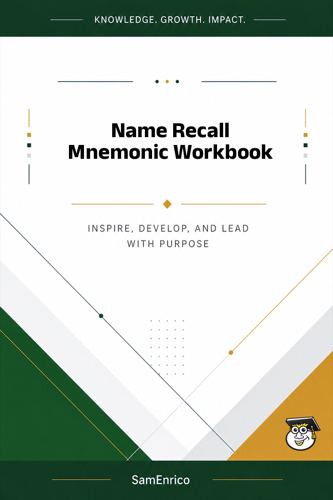
Non-FictionSelf-HelpSocial Memory
Name Recall Mnemonic Workbook
Use association, repetition, and visualization to
by Pina Nestor
Use association, repetition, and visualization to remember new names despite age-related slowing.
Formats
About this book
Free sample
Chapter 1: The Encoding Lie...--–- You are standing at a networking event, a cold glass of white wine in your hand, the ambient hum of conversation pressing in from all sides. A pleasant-looking woman in a blue blouse extends her hand and says, "Hi, I'm Margaret." You shake her hand, smile, and say, "Nice to meet you, Margaret." By the time you turn around to introduce her to your colleague fifteen seconds later, the name is gone. Completely. Not fuzzy, not on the tip of your tongue—simply erased, as if someone opened the back of your skull and pulled the plug on that single file. You know you heard it.
You know you repeated it. But somewhere between your ear and your memory, the name vanished into smoke.If you are over forty, you have lived this moment hundreds of times. If you are over sixty, you may have stopped counting because the tally is too depressing. And if you are like most people, you have explained it away with a shrug and the standard-issue excuse: "I'm just terrible with names."That excuse is a lie. Not a harmless lie, either—a destructive, neurologically expensive lie that has been robbing you of social confidence for decades.
The truth is far more interesting and far more liberating: you do not have a bad memory. You have a bad filing system. And filing systems can be rebuilt at any age.The Great Misdiagnosis: Senior Moments vs. Encoding Errors Let us start with a radical proposition. You do not forget names.
You never forget names. What you actually do is fail to record them in the first place. This distinction is not semantic gymnastics; it is the difference between believing your brain is broken and understanding that your attention simply wandered for the two seconds that mattered.The scientific literature on memory makes an ironclad distinction between three processes: encoding, storage, and retrieval. Encoding is the act of taking incoming sensory information—the sound of someone saying "Margaret," the sight of her blue blouse, the feel of her handshake—and converting it into a…
This is the end of the free sample. Get the eBook to keep going. Buy now
Contents
- Chapter 1
- Chapter 2
- Chapter 3
- Chapter 4
- Chapter 5
- Chapter 6
- Chapter 7
- Chapter 8
- Chapter 9
- Chapter 10
- Chapter 11
- Chapter 12
Details
- Author
- Pina Nestor
- Publisher
- SamEnrico
- Language
- English
- Genre
- Non-Fiction, Self-Help, Social Memory
- Released
- 2026-06-07
- Pages (approx.)
- 100
- Available as
- eBook, Audiobook

Read better in the ZLOADR app
Your eBooks on your phone or tablet. Sign in with your SamEnrico account and start reading.
More by Pina Nestor
 Spring Thaw GuidePina Nestor$11.99
 Project Status Meeting AgendaPina Nestor$11.99
 Alcohol Recovery App ToolkitPina Nestor$11.99
 Standing Body Scan Technique GuidePina Nestor$11.99
 The Hollow King's Last Stand: A Beast of BlackmoorPina Nestor$11.99
 How to Start a Osteopath (registered Medical Practitioner) Business (Beginners Guide)Pina Nestor$11.99
 College Essay Length OptimizerPina Nestor$12.99
 Snap On ManufacturingPina Nestor$12.99
 Understanding Noonan SyndromePina Nestor$17.99
 Rulebook LawyerPina Nestor$11.99
You may also like
 Hong Kong Handover 1997Dunn Johnnie$11.99
 Zumba For Postnatal Recovery CourseNeal Christian$11.99
 Zumba for BeginnersLadner Nikia$11.99
 YouTube Comment Mining GuideHumes Pandora$12.99
 Worry Box MeditationCarlin Rudy$11.99
 Workplace Stress MeditationNguyen Lynn$11.99
 Workplace Stress and Sleep RepairHawley Ivory$11.99
 Workplace Perfectionism CureDelaney Jeffry$11.99
 Workplace Injustice Anger GuideWallen Isabelle$11.99
 Work Addiction and Burnout LinkGreenwood Ester$11.99
 Women in Yoga and WellnessBeattie Galina$11.99
 Women in Stand Up ComedyChun Evangeline$11.99