
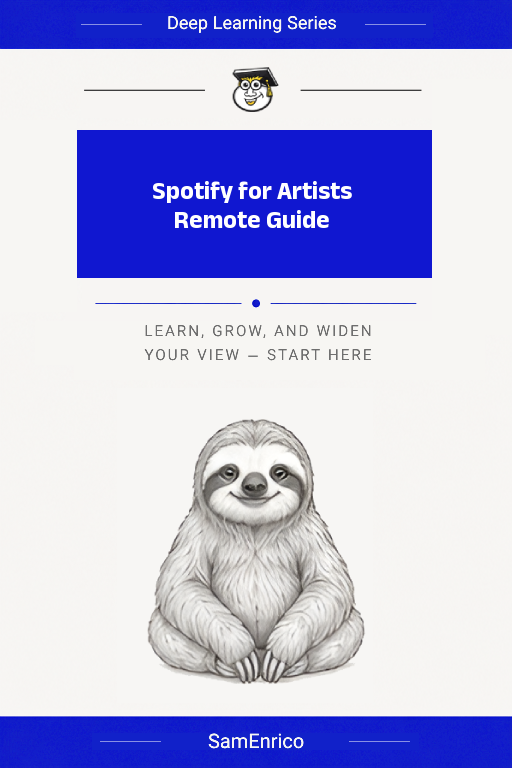
Non-FictionStudent's ShortcutMusic
Spotify for Artists Remote Guide eBook
Land remote internships at Spotify's artist relati
Land remote internships at Spotify's artist relations, playlist curation, or music analytics.
Formats
Free sample
Chapter 1: The 10,000-Hour Myth--The day I submitted my forty-seventh application to Spotify, I was sitting on a cracked leather couch in a shared apartment, wearing headphones that had been held together by electrical tape for three months. I had spent four years in music school learning about chord progressions and recording techniques. I had interned at a small label where my primary responsibility was fetching coffee and updating a spreadsheet that no one ever opened. I had a playlist called "Intern Hopeful" with three hundred carefully curated tracks that I believed proved my taste was immaculate. And I had absolutely nothing to show for it except forty-six rejection emails, most of which arrived at 2:47 AM, time-stamped and automated, as if the algorithm that rejected me couldn't even be bothered to wait until business hours.The forty-seventh rejection came faster than the others.
I submitted on a Tuesday. The rejection arrived on Wednesday. Twenty-two hours. I remember staring at the screen and realizing that no human being had read my application. A bot had scanned my resume, found none of the keywords it was programmed to recognize, and discarded me before my cover letter even loaded on a server.
That was the moment I stopped blaming Spotify and started blaming myself for not understanding what Spotify actually wanted.Here is what I learned in the months that followed, after I stopped applying and started studying. Spotify does not hire music fans. It does not hire people who "love music" in the vague, consuming way that music fans describe themselves. Spotify hires ecosystem engineers. It hires people who can read a skip rate and diagnose a retention problem.
It hires people who can look at a playlist with forty thousand followers and identify the seven songs that are killing its growth. It hires people who can speak to artists with empathy but back every recommendation with data. Spotify does not care about your taste. It cares about your ability to understand, manipulate, and communicate about its platform. Taste is subjective.
Data is not. And the gap between those two things is where internships are won and lost.This chapter exists to dismantle the most expensive myth in the music industry: that deep passion for music and a well-curated personal playlist are enough to land a remote internship at Spotify. That myth has cost thousands of qualified candidates their dream jobs, not because they lacked talent, but because they were solving the wrong problem. They were trying to prove they loved music. Spotify was trying to find people who could prove they understood the machine.The Passion Trap Let me name the enemy at the outset.
I call it the Passion Trap. It is the belief that enthusiasm for music is a sufficient condition for employment in the music industry. This belief is not merely incorrect. It is predatory. It allows companies like Spotify to pay interns less than they are worth, because the intern is told they should be grateful for the opportunity to "live their passion." It allows hiring managers to dismiss qualified candidates who lack industry connections, because those candidates are told they "didn't seem passionate enough." And it allows thousands of young people every year to spend months crafting the perfect playlist as a resume attachment, when that playlist will be deleted without being opened.The Passion Trap has a specific psychological structure.
First, you fall in love with music as a listener. This is natural and good. Music is one of the great joys of human existence. Second, you decide you want to work in music because you cannot imagine spending forty hours a week doing something that does not involve the thing you love. This is also natural.
Third, you assume that because you love music, you must be qualified to work in music. This is where the trap closes.Here is the truth that no one told me in music school. Loving music makes you a fan. Understanding Spotify makes you a candidate. The two are not the same.
You can love music with every fiber of your being and still have no idea how to increase an artist's save-to-listener ratio from three percent to eight percent. You can have a playlist with ten thousand followers and still not understand why Spotify's algorithm promotes songs with low skip rates over songs with high stream counts. You can attend every concert in your city and still be unable to explain the difference between editorial curation and algorithmic curation.The Passion Trap is seductive because it feels like a moral virtue. You are not just applying for a job. You are pursuing your dream.
This framing makes rejection feel like a personal failure rather than a skill gap. It makes you double down on the wrong activities—making more playlists, attending more concerts, posting more about music on social media—when you should be learning how to calculate a retention curve or audit an artist's metadata.I spent six months in the Passion Trap. I applied to forty-seven internships. I revised my resume thirty-two times. I wrote cover letters that bled sincerity.
And every rejection taught me the same lesson in a different font: they were not looking for my passion. They were looking for proof.The Music-Tech Hybrid The term "Music-Tech Hybrid" sounds like buzzword garbage, and I apologize for that. But it describes a real and necessary skillset. A Music-Tech Hybrid is someone who can operate at the intersection of three domains: creative artist relations, data literacy, and platform-specific knowledge. This person can sit in a meeting with an artist who is anxious about declining streams and explain, with kindness and precision, that the decline is concentrated in the first thirty seconds of three specific songs, which suggests an intro problem, not a career problem.
This person can look at a playlist with falling engagement and identify exactly which tracks are causing listeners to skip, then recommend replacements that fit the energy arc of the playlist. This person can speak to labels and artists and data scientists in their own languages, translating between them without losing meaning.Spotify does not publish a job description for "Music-Tech Hybrid," but every internship posting describes one. Consider the language that appears repeatedly in actual internship requirements from the past twelve months. "Experience with backend updates." That means you understand how metadata flows through Spotify's system and can correct errors without being walked through every click. "Familiarity with playlist submission tools." That means you know the difference between pitching to editorial playlists versus optimizing for algorithmic playlists, and you understand the timing constraints of Release Radar.
"Data-driven recommendations." That means you can look at a spreadsheet of streaming metrics and extract a narrative that leads to an actionable decision.These are not requests for music fans. These are requests for people who have taken the time to understand how Spotify works as a machine. The machine has inputs (song metadata, Canvas loops, pitch timing) and outputs (streams, saves, skip rates, playlist adds). The machine has rules (skip rates above thirty-five percent trigger algorithmic demotion, save-to-listener ratios below five percent indicate low loyalty, release radar requires seven to fourteen days of lead…
This is the end of the free sample. Get the eBook to keep going. Buy now
About this book
Details
- Author
- Houle Merilyn
- Publisher
- SamEnrico
- Language
- English
- Genre
- Non-Fiction, Student's Shortcut, Music
- Released
- 2026-05-29
- Pages (approx.)
- 142
- Available as
- eBook, Audiobook

Read better in the ZLOADR app
Your eBooks on your phone or tablet. Sign in with your SamEnrico account and start reading.
More by Houle Merilyn
 Tiger Woods Father ImpactHoule Merilyn$11.99
 HVAC Service Precedent GuideHoule Merilyn$11.99
 Nomad Friendly Banks AccountHoule Merilyn$11.99
 Creative Strategy for Business AnalystsHoule Merilyn$11.99
 The Diamond Mine SurvivorHoule Merilyn$11.99
 Sobriety Skin Recovery GuideHoule Merilyn$11.99
 Intrusive Thoughts OCDHoule Merilyn$11.99
 Filler Selection in Lineup FairnessHoule Merilyn$11.99
 The Phantom Passenger: The DEA’s Undercover Sting on the High SeasHoule Merilyn$11.99
 Oscar Niemeyer: The Architect Who Defied Gravity in ConcreteHoule Merilyn$11.99
 How to Produce a ThinnerHoule Merilyn$11.99
 How to Produce Hot SauceHoule Merilyn$11.99
You may also like
 Hong Kong Handover 1997Dunn Johnnie$11.99
 Zumba For Postnatal Recovery CourseNeal Christian$11.99
 Zumba for BeginnersLadner Nikia$11.99
 YouTube Comment Mining GuideHumes Pandora$12.99
 Worry Box MeditationCarlin Rudy$11.99
 Workplace Stress MeditationNguyen Lynn$11.99
 Workplace Stress and Sleep RepairHawley Ivory$11.99
 Workplace Perfectionism CureDelaney Jeffry$11.99
 Workplace Injustice Anger GuideWallen Isabelle$11.99
 Work Addiction and Burnout LinkGreenwood Ester$11.99
 Women in Yoga and WellnessBeattie Galina$11.99
 Women in Stand Up ComedyChun Evangeline$11.99