
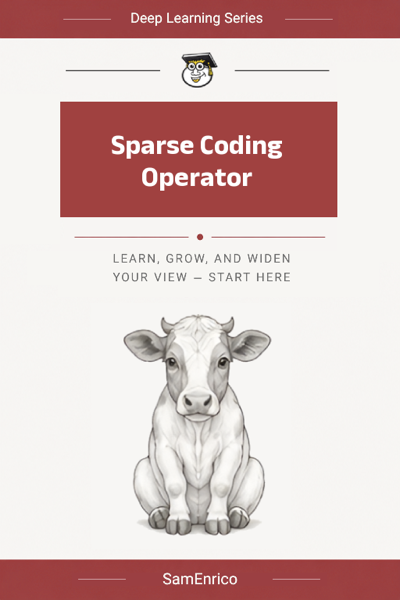
Sparse Coding Operator eBook
A Coursebook on Sparse Coding Operator
A Coursebook on Sparse Coding Operator
Formats
Free sample
Chapter 1: Why Less Is More...--–- In the summer of 1948, a mathematician named Claude Shannon published a paper that would forever change how humanity thinks about information. Working at Bell Laboratories, Shannon asked a deceptively simple question: What is the minimum number of symbols required to transmit a message without loss? His answer, now known as information theory, gave birth to the digital age. But buried within Shannon's work was a secret that took decades to fully appreciate—a secret about the nature of reality itself.The secret is this: meaningful information is almost always sparse.Think about it. A photograph of your face contains millions of pixels, yet the underlying structure—your eyes, nose, mouth, the unique geometry of your features—can be described with astonishingly few parameters.
A symphony consists of thousands of measures, yet the musical ideas that generate it can be written on a single page. The human genome comprises three billion base pairs, yet the differences that make you who you are amount to a tiny fraction of that total.The universe, it turns out, is a master of compression. Every natural signal—every image, every sound, every measurement—lives in a space of impossibly high dimension, yet it occupies only a thin sliver of that space. This is the central fact upon which this entire book rests: Natural signals are sparse when represented appropriately.But what does "sparse" actually mean? And more importantly, how can we turn sparsity from a philosophical observation into a practical tool—an operator that transforms noisy, high-dimensional data into clean, interpretable representations?This chapter answers those questions.
You will learn why sparsity is not merely a mathematical convenience but a fundamental property of the physical world. You will understand why the brain evolved to exploit sparsity, why modern machine learning is rediscovering this ancient trick, and why the Sparse Coding Operator might be the most important tool you have never heard of.By the end of this chapter, you will never look at data the same way again.The Cat, The Electrode, and The Discovery That Changed Neuroscience Let us begin where the science of sparsity began: in a laboratory at Johns Hopkins University in 1959, with an anesthetized cat and a very patient postdoctoral fellow.David Hubel and Torsten Wiesel had inserted a microelectrode into the primary visual cortex of a cat. The electrode was so fine that it could record the electrical activity of a single neuron. For hours, they projected patterns of light onto a screen in front of the cat—spots, diffuse light, dark shadows—and listened through a loudspeaker for the distinctive crackle of neural firing.Nothing. Silence.
The neuron remained stubbornly quiet.Then, by accident, one of them slid a glass slide into the projector's light path. The edge of the slide cast a sharp line—an oriented edge—across the screen.Crackle. Crackle. Crackle.The loudspeaker erupted. The neuron was firing like a machine gun.They had discovered something profound.
This neuron, and thousands like it in the cat's visual cortex, was not responding to light intensity. It was responding to a feature—specifically, an edge at a particular orientation in a particular location. Other neurons responded to horizontal edges, or vertical edges, or edges at 45 degrees. Together, these neurons formed a sparse representation of the visual world: at any given moment, only a small fraction of them were active, and that pattern of activity encoded everything the cat could see.For this discovery, Hubel and Wiesel would later receive the Nobel Prize. But the deeper implication—the one that would take another thirty years to fully surface—was this: the brain does not represent the world pixel by pixel.
It represents the world feature by feature, using a small set of specialized detectors that activate sparsely in response to natural scenes.Why would evolution converge on such a strategy? The answer lies in efficiency and robustness.Imagine trying to represent every possible image as a unique combination of individual pixels. The space of possibilities is astronomically large—for a modest 1024x1024 image, the number of possible images is 2561,048,576256^{1,048,576}2561,048,576, a number so vast that it dwarfs the number of atoms in the universe. No brain, no computer, no conceivable system could enumerate that space.But natural images are not arbitrary. They are highly structured.
They contain edges, textures, surfaces, and objects—not random noise. This means that a relatively small set of feature detectors can cover most of the probability mass of natural images. And because the detectors are overcomplete (more detectors than input dimensions), they can represent a wider variety of structures than a minimal basis. Yet because only a few detectors are active at any time (sparsity), the representation remains efficient.The cat's brain solved a problem that engineers have been struggling with for decades: how to build a system that is simultaneously expressive (can represent many different inputs) and efficient (uses little energy). The answer is sparse coding.The Mathematics of Sparsity: From Pixels to Features Now let us translate this biological insight into mathematical language.
We need a way to describe signals not as raw measurements but as combinations of meaningful building blocks.Let yyy be a signal—an image patch, a snippet of audio, a vector of sensor readings. In raw form, yyy is just a list of numbers. For an image patch of 8x8 pixels, yyy is a 64-dimensional vector. For a second of CD-quality audio, yyy is a 44,100-dimensional vector.We want to represent yyy as a linear combination of atoms—the feature detectors. Collect these atoms into a matrix DDD, called the dictionary, where each column of DDD is an atom.
The representation is:y=Dxy = Dxy=Dx Here, xxx is a vector of coefficients. If we have exactly as many atoms as dimensions in yyy, and the atoms are linearly independent, then xxx is uniquely determined. This is the familiar case of a basis, like Fourier or wavelet bases.But the brain does not use a basis. It uses an overcomplete dictionary—more atoms than dimensions. In Hubel and Wiesel's cat, there are far more orientation-selective neurons than photoreceptors.
In our mathematical formulation, DDD has more columns than rows.Why overcompleteness? Because a basis is too rigid. A Fourier basis represents periodic signals beautifully but represents edges poorly. A wavelet basis represents edges beautifully but represents textures poorly. An overcomplete dictionary can contain both Fourier atoms and wavelet atoms and edge detectors and texture detectors—a diverse set of building blocks that can handle whatever the signal throws at it.But overcompleteness creates a problem: the equation y=Dxy = Dxy=Dx is underdetermined.
For a given yyy, there are infinitely many xxx that satisfy it. Which one should we choose?This is where sparsity enters. Among all possible representations, we want the sparsest one—the one with the fewest non-zero coefficients. Intuitively, this corresponds to using the fewest building blocks to explain the signal. And because the building blocks are meaningful (edges, textures, etc.), the sparse representation is not just efficient but interpretable.Let us formalize this.
Define the ℓ0\ell_0ℓ0 pseudo-norm:∥x∥0=number of non-zero entries in x\|x\|_0 = \text{number of non-zero entries in } x∥x∥0=number of non-zero entries in x This is not a true norm (it violates…
This is the end of the free sample. Get the eBook to keep going. Buy now
About this book
Details
- Author
- Wheaton Corie
- Publisher
- SamEnrico
- Language
- English
- Genre
- Non-Fiction, Informative, Educational
- Released
- 2026-06-02
- Pages (approx.)
- 160
- Available as
- eBook, Audiobook

Read better in the ZLOADR app
Your eBooks on your phone or tablet. Sign in with your SamEnrico account and start reading.
More by Wheaton Corie
 Validating Emotions While ListeningWheaton Corie$11.99
 Peer Support for Self DoubtWheaton Corie$11.99
 Affirmations for EmbarrassmentWheaton Corie$11.99
 TM for Exercise AddictionWheaton Corie$11.99
 The Genetic Roots of PsychopathyWheaton Corie$11.99
 Mozart’s Musical Cosmos: The Genius Who Defined HarmonyWheaton Corie$11.99
 Cross Currency Factoring GuideWheaton Corie$12.99
 Blender Replaces Maya GuideWheaton Corie$12.99
 Understanding Toluene Antenatal InfectionWheaton Corie$17.99
 How to Become a Drying-machine TenderWheaton Corie$11.99