
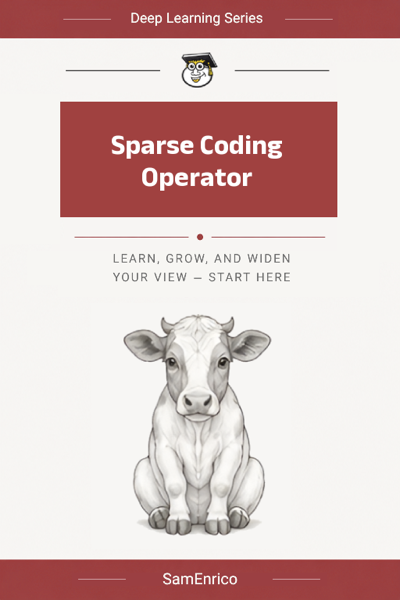
Sparse Coding Operator Audiobook
A Coursebook on Sparse Coding Operator
A Coursebook on Sparse Coding Operator
Formats
Free sample
Chapter 1: Why Less Is More...--–- In the summer of 1948, a mathematician named Claude Shannon published a paper that would forever change how humanity thinks about information. Working at Bell Laboratories, Shannon asked a deceptively simple question: What is the minimum number of symbols required to transmit a message without loss? His answer, now known as information theory, gave birth to the digital age. But buried within Shannon's work was a secret that took decades to fully appreciate—a secret about the nature of reality itself.The secret is this: meaningful information is almost always sparse.Think about it. A photograph of your face contains millions of pixels, yet the underlying structure—your eyes, nose, mouth, the unique geometry of your features—can be described with astonishingly few parameters.
A symphony consists of thousands of measures, yet the musical ideas that generate it can be written on a single page. The human genome comprises three billion base pairs, yet the differences that make you who you are amount to a tiny fraction of that total.The universe, it turns out, is a master of compression. Every natural signal—every image, every sound, every measurement—lives in a space of impossibly high dimension, yet it occupies only a thin sliver of that space. This is the central fact upon which this entire book rests: Natural signals are sparse when represented appropriately.But what does "sparse" actually mean? And more importantly, how can we turn sparsity from a philosophical observation into a practical tool—an operator that transforms noisy, high-dimensional data into clean, interpretable representations?This chapter answers those questions.
You will learn why sparsity is not merely a mathematical convenience but a fundamental property of the physical world. You will understand why the brain evolved to exploit sparsity, why modern machine learning is rediscovering this ancient trick, and why the Sparse Coding Operator might be the most important tool you have never heard of.By the end of this chapter, you will never look at data the same way again.The Cat, The Electrode, and The Discovery That Changed Neuroscience Let us begin where the science of sparsity began: in a laboratory at Johns Hopkins University in 1959, with an anesthetized cat and a very patient postdoctoral fellow.David Hubel and Torsten Wiesel had inserted a microelectrode into the primary visual cortex of a cat. The electrode was so fine that it could…
This is the end of the free sample. Get the Audiobook to keep going. Buy now
About this book
Details
- Author
- Wheaton Corie
- Publisher
- SamEnrico
- Language
- English
- Genre
- Non-Fiction, Informative, Educational
- Released
- 2026-06-02
- Pages (approx.)
- 160
- Available as
- eBook, Audiobook

Listen in the VoxFlicks app
Audiobooks and audio dramas wherever you go. Sign in with your SamEnrico account and press play.
More by Wheaton Corie
 Validating Emotions While ListeningWheaton Corie$11.99
 Peer Support for Self DoubtWheaton Corie$11.99
 Affirmations for EmbarrassmentWheaton Corie$11.99
 TM for Exercise AddictionWheaton Corie$11.99
 The Genetic Roots of PsychopathyWheaton Corie$11.99
 Mozart’s Musical Cosmos: The Genius Who Defined HarmonyWheaton Corie$11.99
 Cross Currency Factoring GuideWheaton Corie$12.99
 Blender Replaces Maya GuideWheaton Corie$12.99
 Understanding Toluene Antenatal InfectionWheaton Corie$17.99
 How to Become a Drying-machine TenderWheaton Corie$11.99