
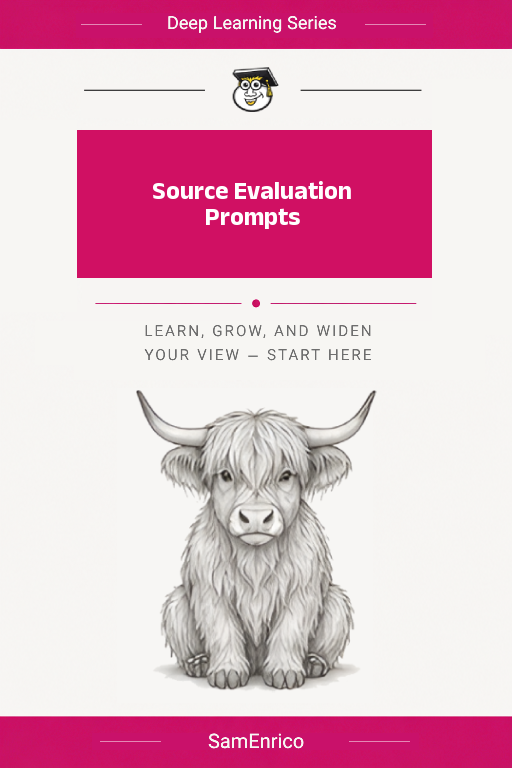
Non-FictionStudent's ShortcutResearch Skills
Source Evaluation Prompts eBook
Assess credibility, bias, and relevance of researc
Assess credibility, bias, and relevance of research sources using GPT prompts for critical source analysis.
Formats
Free sample
Chapter 1: The Authority Trap–- In 2018, a study made global headlines. Researchers had allegedly proven that moderate wine consumption extended human lifespan. The lead author was a tenured professor at a prestigious European university. The journal was peer-reviewed. The sample size was over 1.5 million people.
News outlets from CNN to the BBC ran stories with titles like “A Glass a Day Keeps the Doctor Away.” Even doctors shared the study with patients.Eighteen months later, the paper was retracted.The problem was not fraud. The problem was a tiny methodological error buried in the statistical code: the researchers had accidentally included former heavy drinkers who had quit due to illness in the “non-drinker” control group. Those former heavy drinkers were, unsurprisingly, sicker and died younger than the moderate drinkers. The entire finding—the apparent longevity benefit of wine—vanished when the error was corrected. But by then, the myth had become fact in the public mind.
Google “red wine health benefits” today, and you will still find the retracted study cited as evidence.This story reveals a devastating truth about how we evaluate sources. We don’t actually evaluate them. We take shortcuts. We see a professor, a journal, a headline, and we stop thinking. That shortcut—trusting the badge instead of examining the evidence—is what I call the Authority Trap.
It is the single most common reason intelligent people believe false things. And until you learn to escape it, no amount of GPT prompting will save you.This chapter dismantles the Authority Trap piece by piece. You will learn why credentials deceive, how to build a more reliable framework for credibility, and how to use GPT as a systematic partner in that work—not a shortcut around it.Why Your Brain Craves Authority Before we fix the problem, we need to understand why it exists. Your brain evolved in an environment where information was scarce and trust was local. If someone in your tribe said the watering hole was safe, you drank.
If an elder said the berries were poisonous, you avoided them. Questioning authority was not a survival advantage; it was a death sentence.That evolutionary legacy lives in you. When you see a Harvard logo, a Ph D after a name, or a citation in a prestigious journal, your brain releases a small amount of dopamine—the same neurotransmitter involved in reward and trust. You feel good about the source before reading a single word. That feeling is not a rational assessment.
It is a neurochemical shortcut.The problem is that the modern information environment has weaponized this shortcut. Bad actors know that you trust authority. So they manufacture it. Pay-to-play journals let anyone publish peer-reviewed-looking papers for a few hundred dollars. Media training teaches spokespeople to sound confident and credible even when they are lying.
Retraction is slow; the headline is forever.The Authority Trap, then, is not a failure of intelligence. It is a failure of system. You are not stupid for falling into it. You are human. But you can build a system that catches you before you fall.The Credibility Framework: Five Pillars, Not One Badge Most source evaluation checklists treat authority as a binary: is the author an expert or not?
This is worse than useless—it is actively misleading. Authority is not a switch. It is a spectrum. And it is only one part of a much larger picture.After synthesizing dozens of best-selling works on critical thinking, information literacy, and research methods—including Factfulness, Calling Bullshit, The Craft of Research, and Weapons of Math Destruction—I have distilled credibility down to five pillars. Each pillar answers a specific question.
Each can be assessed independently. And each can be evaluated using a GPT prompt designed to force systematic thinking rather than intuitive shortcutting.Pillar One: Provenance Where did this information come from? Not just the author—the entire chain of custody. A fact that started in a leaked internal memo, was summarized by a journalist, then turned into a tweet, then cited by a politician has a long and fragile chain. The closer you can get to the original source, the stronger the provenance.
Provenance is weak when the source is anonymous, when the original data is missing, or when you cannot trace how the author arrived at their claims.Pillar Two: Verifiability Can you check the claims against independent evidence? A source that says “studies show” without naming the studies fails this pillar. A source that says “according to Smith et al. 2023 in Nature” passes the first test—you can now go find that paper. But verifiability goes deeper: does the source provide enough detail (data, code, methods) for someone else to replicate the finding?
If the answer is no, treat the source as provisional at best.Pillar Three: Peer Recognition How have other qualified experts received this work? Peer recognition is not just formal peer review (which is flawed but useful). It includes citation counts, replication attempts, critical commentaries, and awards. A paper that has been cited 500 times in follow-up studies is more credible than one cited twice. A book that has been debunked in three journal reviews is less credible than one that has stood unchallenged for a decade.
Peer recognition is a slow signal, which makes it terrible for breaking news but essential for settled knowledge.Pillar Four: Consistency Does the source agree with itself and with well-established facts? Internal consistency means the source does not contradict its own claims. External consistency means the source does not contradict widely accepted background knowledge without extraordinary evidence. Consistency is not proof of truth—revolutionary ideas are, by definition, inconsistent with prior consensus. But inconsistency is a red flag that demands explanation.Pillar Five: Timeliness Is the source current enough for your specific question?
For the history of ancient Rome, a source from 1950 is fine. For COVID-19 treatment protocols, a source from 2020 is dangerously outdated. Timeliness is the most situational pillar. It depends entirely on the half-life of knowledge in your domain. The key is to match the source’s age to the question’s urgency.These five pillars are not a checklist to be completed and forgotten.
They are a framework for situational judgment. A breaking news article might score high on timeliness and low on verifiability. That does not make it “not credible.” It makes it credible for some purposes (knowing what officials just said) and not for others (determining the definitive truth). This situationality is crucial, and we will return to it throughout the book.The GPT Prompt That Changes Everything Now let me show you how to operationalize these five pillars using GPT. The following prompt is designed to force systematic analysis, ground conclusions in evidence from the source itself, and prevent the kind of hand-waving that usually passes for source evaluation.Copy this prompt exactly, then paste your source text where indicated:“You are a forensic credibility analyst.
Your job is to evaluate the following source against five pillars of credibility: provenance, verifiability, peer recognition, consistency, and timeliness. For each pillar, provide a score from 1 (very weak) to 10 (very strong), a one-sentence justification, and a specific quote or observation from the source…
This is the end of the free sample. Get the eBook to keep going. Buy now
About this book
Details
- Author
- Hirsch Vinnie
- Publisher
- SamEnrico
- Language
- English
- Genre
- Non-Fiction, Student's Shortcut, Research Skills
- Released
- 2026-05-30
- Pages (approx.)
- 138
- Available as
- eBook, Audiobook

Read better in the ZLOADR app
Your eBooks on your phone or tablet. Sign in with your SamEnrico account and start reading.
More by Hirsch Vinnie
 Divorce Financial Recovery GuideHirsch Vinnie$11.99
 The Metabolic Adaptation Hope GuideHirsch Vinnie$11.99
 Luxury Brand PositioningHirsch Vinnie$11.99
 Cross Docking AI GuideHirsch Vinnie$11.99
 Grade Disappointment Parent RageHirsch Vinnie$11.99
 Time Constraints for ArtistsHirsch Vinnie$11.99
 MS Anticipatory Grief GuideHirsch Vinnie$11.99
 Assertiveness for NursesHirsch Vinnie$11.99
 The Ballad of the Arab Champions: How Football United a Divided RegionHirsch Vinnie$11.99
 Hippocrates and the Birth of Medicine: The Greek Healing RevolutionHirsch Vinnie$11.99
 Butterflyfishes: Chaetodontidae of Coral ReefsHirsch Vinnie$11.99
 How to Become a Bar And Filler AssemblerHirsch Vinnie$11.99
You may also like
 Hong Kong Handover 1997Dunn Johnnie$11.99
 Zumba For Postnatal Recovery CourseNeal Christian$11.99
 Zumba for BeginnersLadner Nikia$11.99
 YouTube Comment Mining GuideHumes Pandora$12.99
 Worry Box MeditationCarlin Rudy$11.99
 Workplace Stress MeditationNguyen Lynn$11.99
 Workplace Stress and Sleep RepairHawley Ivory$11.99
 Workplace Perfectionism CureDelaney Jeffry$11.99
 Workplace Injustice Anger GuideWallen Isabelle$11.99
 Work Addiction and Burnout LinkGreenwood Ester$11.99
 Women in Yoga and WellnessBeattie Galina$11.99
 Women in Stand Up ComedyChun Evangeline$11.99