
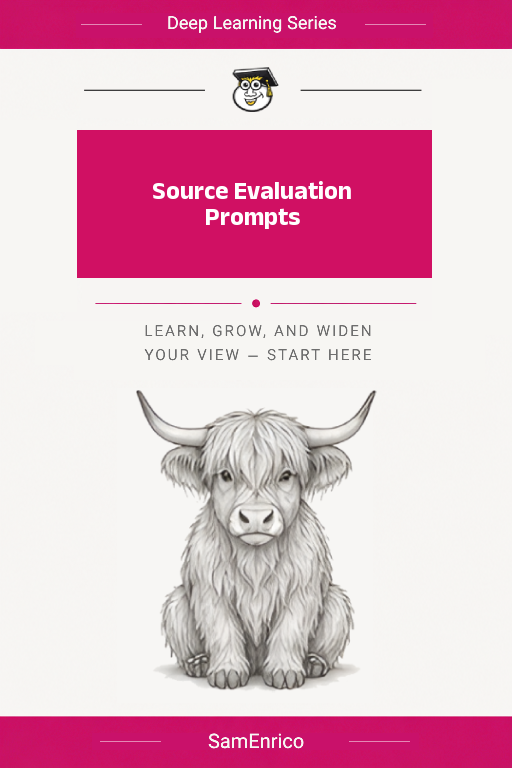
Non-FictionStudent's ShortcutResearch Skills
Source Evaluation Prompts Audiobook
Assess credibility, bias, and relevance of researc
Assess credibility, bias, and relevance of research sources using GPT prompts for critical source analysis.
Formats
Free sample
Chapter 1: The Authority Trap–- In 2018, a study made global headlines. Researchers had allegedly proven that moderate wine consumption extended human lifespan. The lead author was a tenured professor at a prestigious European university. The journal was peer-reviewed. The sample size was over 1.5 million people.
News outlets from CNN to the BBC ran stories with titles like “A Glass a Day Keeps the Doctor Away.” Even doctors shared the study with patients.Eighteen months later, the paper was retracted.The problem was not fraud. The problem was a tiny methodological error buried in the statistical code: the researchers had accidentally included former heavy drinkers who had quit due to illness in the “non-drinker” control group. Those former heavy drinkers were, unsurprisingly, sicker and died younger than the moderate drinkers. The entire finding—the apparent longevity benefit of wine—vanished when the error was corrected. But by then, the myth had become fact in the public mind.
Google “red wine health benefits” today, and you will still find the retracted study cited as evidence.This story reveals a devastating truth about how we evaluate sources. We don’t actually evaluate them. We take shortcuts. We see a professor, a journal, a headline, and we stop thinking. That shortcut—trusting the badge instead of examining the evidence—is what I call the Authority Trap.
It is the single most common reason intelligent people believe false things. And until you learn to escape it, no amount of GPT prompting will save you.This chapter dismantles the Authority Trap piece by piece. You will learn why credentials deceive, how to build a more reliable framework for credibility, and how to use GPT as a systematic partner in that work—not a shortcut around it.Why Your Brain Craves Authority Before we fix the problem, we need to understand why it exists. Your brain evolved in an environment where information was scarce and trust was local. If someone in your tribe said the watering hole was safe, you drank.
If an elder said the berries were poisonous, you avoided them. Questioning authority was not a survival advantage; it was a death sentence.That evolutionary legacy lives in you. When you see a Harvard logo, a Ph D after a name, or a citation in a prestigious journal, your brain releases a small amount of dopamine—the same neurotransmitter involved in reward and trust. You feel good about…
This is the end of the free sample. Get the Audiobook to keep going. Buy now
About this book
Details
- Author
- Hirsch Vinnie
- Publisher
- SamEnrico
- Language
- English
- Genre
- Non-Fiction, Student's Shortcut, Research Skills
- Released
- 2026-05-30
- Pages (approx.)
- 138
- Available as
- eBook, Audiobook

Listen in the VoxFlicks app
Audiobooks and audio dramas wherever you go. Sign in with your SamEnrico account and press play.
More by Hirsch Vinnie
 Divorce Financial Recovery GuideHirsch Vinnie$11.99
 The Metabolic Adaptation Hope GuideHirsch Vinnie$11.99
 Luxury Brand PositioningHirsch Vinnie$11.99
 Cross Docking AI GuideHirsch Vinnie$11.99
 Grade Disappointment Parent RageHirsch Vinnie$11.99
 Time Constraints for ArtistsHirsch Vinnie$11.99
 MS Anticipatory Grief GuideHirsch Vinnie$11.99
 Assertiveness for NursesHirsch Vinnie$11.99
 The Ballad of the Arab Champions: How Football United a Divided RegionHirsch Vinnie$11.99
 Hippocrates and the Birth of Medicine: The Greek Healing RevolutionHirsch Vinnie$11.99
 Butterflyfishes: Chaetodontidae of Coral ReefsHirsch Vinnie$11.99
 How to Become a Bar And Filler AssemblerHirsch Vinnie$11.99
You may also like
 Hong Kong Handover 1997Dunn Johnnie$11.99
 Zumba For Postnatal Recovery CourseNeal Christian$11.99
 Zumba for BeginnersLadner Nikia$11.99
 YouTube Comment Mining GuideHumes Pandora$12.99
 Worry Box MeditationCarlin Rudy$11.99
 Workplace Stress MeditationNguyen Lynn$11.99
 Workplace Stress and Sleep RepairHawley Ivory$11.99
 Workplace Perfectionism CureDelaney Jeffry$11.99
 Workplace Injustice Anger GuideWallen Isabelle$11.99
 Work Addiction and Burnout LinkGreenwood Ester$11.99
 Women in Yoga and WellnessBeattie Galina$11.99
 Women in Stand Up ComedyChun Evangeline$11.99