
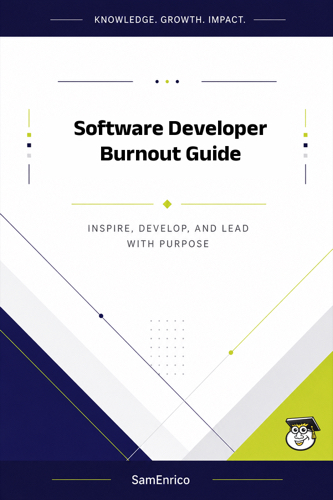
Software Developer Burnout Guide eBook
Manages crunch time and impossible bug pressure.
Manages crunch time and impossible bug pressure.
Formats
Free sample
Chapter 1: The Hero Trap--–- You are reading this because something has gone wrong. Not with your code—with you.The warning signs have been accumulating for months, maybe years. You lie awake at 3:00 AM running through the same stack trace in your head, convinced that if you just think about it one more time, the solution will appear. Your resting heart rate is higher than it was last year, but you haven't checked because you deleted the fitness app to free up storage for another IDE. You have forgotten what it feels like to be bored, because every waking moment is either coding, worrying about coding, or feeling guilty for not coding.The last time someone asked you how you were doing, you said "busy" with a smile that didn't reach your eyes.
Busy is the word exhausted people use when they don't want to admit they're drowning.If any of this sounds familiar, you are not weak. You are not lazy. You are not a bad developer. You are trapped in a system that has lied to you about what success looks like, and this book is your way out.The Question Nobody Asks Out Loud Let us begin with a question that feels dangerous to even think: What if working harder is making you worse at your job?Not just worse in a vague, burnout-y way. Worse in a measurable, data-driven, you-are-actively-creating-more-work-than-you-complete way.
This is not a motivational platitude about "work-life balance" delivered by someone who hasn't touched production code in a decade. This is engineering. This is systems thinking applied to the most important system you will ever manage: your own brain.The software industry runs on a quiet, devastating lie. The lie says that great developers are the ones who work the longest hours, answer the most Slack messages at midnight, and heroically save the day during crunch time. The lie says that sleep is for the weak, that weekends are for catching up, and that if you are not exhausted, you are not trying hard enough.This lie has a name.
It is called the Hero Trap.The Origin Story of a Lie To understand how we arrived at a place where exhaustion is mistaken for excellence, we need to go back to the beginning. The Hero Trap was not invented by your manager or your company's co-founder. It is older than Silicon Valley. It is older than Microsoft. It is older than the personal computer itself.In the 1960s and 1970s, programming was a new discipline, populated largely by mathematicians and electrical engineers who came from academic and research cultures.
These were people who had spent their graduate years pulling all-nighters in labs, fueled by coffee and the romanticism of the lone genius solving impossible problems. The image of the programmer as a nocturnal wizard, hunched over a glowing terminal while the rest of the world slept, was born in this era.The hacker ethic emerged from this culture. It celebrated long hours as a proxy for dedication. It conflated time spent with value produced. It told stories—apocryphal and real—of developers who locked themselves in rooms for days and emerged with elegant solutions that saved entire projects.
What those stories conveniently omitted was the three weeks of bug fixing and mental recovery that followed. The cost was never part of the romance.This culture was reinforced by the startup boom of the 1980s and 1990s, where underdog teams with limited resources used "working around the clock" as a competitive advantage against slower, more bureaucratic companies. The narrative was intoxicating: We work harder than them, so we win. It was true enough, sometimes, in the short term. But short-term wins created long-term expectations, and soon the 80-hour week was not a temporary sprint but a permanent condition.By the time the 2000s arrived, the Hero Trap was fully embedded in software culture.
Job descriptions asked for "passionate developers who will do whatever it takes." Performance reviews rewarded the people who sent emails at 2:00 AM. Managers learned that if they created enough urgency, developers would sacrifice their evenings, weekends, and health to meet impossible deadlines. And the developers themselves wore their exhaustion as a badge of honor, because admitting that you were struggling felt like admitting that you were not cut out for the job.The Data That Destroys the Lie Here is the truth that the Hero Trap hides from you: Working more than 40 hours per week reduces your total output. Not just your output per hour—your total output. You produce less work in 60 hours than you would have produced in 50.
You produce negative work in 55+ hours, meaning you introduce more bugs than you fix.This is not opinion. This is not a guess. This is replicated, peer-reviewed, industrial engineering data that has been confirmed across multiple industries for nearly a century.Let us look at the Unified Productivity Curve, a model that synthesizes research from manufacturing, software engineering, and cognitive neuroscience. The curve has four distinct zones:Zone 1: The Productive Zone (0-40 hours per week)In this zone, each hour of work produces roughly one hour of net output. You are focused, effective, and making reliable progress.
Your error rate is low. Your problem-solving ability is sharp. This is where you want to live.Zone 2: The Diminishing Zone (40-50 hours per week)Somewhere between hour 40 and hour 45, your productivity per hour begins to drop. You are still getting things done, but each additional hour produces less value than the hour before. By hour 48, your output per hour is half of what it was in hour 4.
You are also making more mistakes—not enough to cancel out your output, but enough to notice. The bugs you introduce during hour 45 will need to be fixed later, at a cost you are not tracking.Zone 3: The Negative Zone (50-55 hours per week)This is where the math turns against you. Between hour 50 and hour 55, you are introducing more bugs than you are fixing. Your net output is negative. You are literally making the project worse by working.
The code you write during these hours will require more debugging time later than the time you spent writing it. The meetings you attend are forgotten. The design decisions you make are flawed.Zone 4: The Catastrophic Zone (55+ hours per week)Beyond 55 hours, you are not just unproductive—you are dangerous. Your cognitive function is equivalent to someone who is legally intoxicated. Your error rate is catastrophic.
You are likely to break things that were working, delete things that were needed, and make decisions that will take weeks to unwind. You are also at serious risk of physical or mental collapse: panic attacks, heart palpitations, insomnia, depression, or a full breakdown that takes you out of work entirely.The IBM OS/360 Case Study Let us make this real with a story from the early days of large-scale software development. In the 1980s, IBM was building OS/360, an operating system that was, at the time, the most complex software project ever attempted. The project was behind schedule—it was always behind schedule—and management responded the way management always responds: they demanded overtime.Teams worked 60, 70, even 80-hour weeks. Managers tracked…
This is the end of the free sample. Get the eBook to keep going. Buy now
About this book
Details
- Author
- Briones Almeda
- Publisher
- SamEnrico
- Language
- English
- Genre
- Non-Fiction, Self-Help, Tech Burnout
- Released
- 2026-06-12
- Pages (approx.)
- 132
- Available as
- eBook, Audiobook

Read better in the ZLOADR app
Your eBooks on your phone or tablet. Sign in with your SamEnrico account and start reading.
More by Briones Almeda
 Holiday Traffic Anger GuideBriones Almeda$11.99
 Depression and Psychomotor SymptomsBriones Almeda$11.99
 Titanic's China And GlasswareBriones Almeda$11.99
 PCOS Metformin Side EffectsBriones Almeda$11.99
 Understanding Orotic Aciduria Purines-pyrimidinesBriones Almeda$17.99
 Yukon Graduate Immigration GuideBriones Almeda$12.99
 KKR SWOT GuideBriones Almeda$12.99
 Retail Registry ConsultantBriones Almeda$11.99
 How to Start a Church Missionary Society Business (Beginners Guide)Briones Almeda$11.99
You may also like
 Burnout In Tech IndustryValentine Anitra$11.99
 Software Developer Stress GuideRiggins Denita$11.99Software Developer Stress GuideRiggins Denita$11.99
 Burnout In Tech Workers GuideEngland Maire$11.99
 Tech Industry Burnout GuideFredrickson Lelah$11.99
 Workplace Stress for Tech WorkersEastman Leandra$11.99
 Sex Addiction in TechFolse Nicky$11.99