
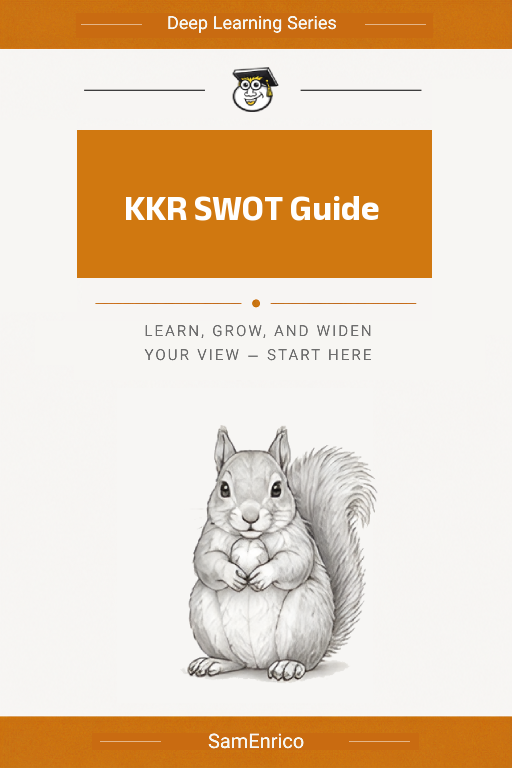
Non-FictionStrategic AtlasPrivate Equity
KKR SWOT Guide
Evaluate private equity giant, global infrastructu
Evaluate private equity giant, global infrastructure, real estate, insurance solutions, and exit environment.
Formats
About this book
Free sample
Chapter 1: The Almost-Death--–- In 1990, Henry Kravis watched his empire begin to die. The man who had conquered RJR Nabisco just two years earlier—whose $31 billion leveraged buyout was splashed across every newspaper as the defining deal of a decadent decade—could not get his bankers to return his phone calls. Seaman Furniture, a portfolio company loaded with debt from a 1987 buyout, was weeks from bankruptcy. Jim Walter Corp, another KKR-backed disaster, was bleeding cash so fast that its auditors had issued a going-concern warning. And the recession of 1990–1991, which nobody on Wall Street had predicted with any accuracy, was squeezing every over-leveraged asset KKR owned.The firm that had defined the 1980s was, by the early 1990s, widely presumed to be finished.
Business Week ran a cover story asking whether the leveraged buyout was dead. The partners at KKR—Kravis, his cousin George Roberts, and a small team of hard-charging financiers—were no longer celebrated as geniuses. They were mocked as relics of an era of excess, their methods exposed as reckless, their returns revealed as illusory. The very phrase "barbarians at the gate," which had once made Kravis smirk with satisfaction, now sounded like an epitaph.But the obituaries were premature. What happened next—the reinvention of KKR from a firm of financial engineers into a firm of operational operators—is the most important and least understood story in modern private equity.
It is also the story that explains everything about the KKR of 2026: its resilience, its complexity, its diversification into infrastructure and insurance, and its ability to survive crises that have killed dozens of competitors.This chapter argues that KKR's greatest strength is not deal-making. It is not access to capital. It is not the legendary negotiating prowess of Kravis and Roberts. It is adaptability—the willingness to burn down the old model and build a new one when the world changes. The firm that nearly collapsed in 1990 has since survived the dot-com crash of 2000, the global financial crisis of 2008, the pandemic disruption of 2020, and the inflation shock of 2022–2023.
Each time, KKR emerged not just intact but stronger, having learned lessons that its competitors ignored.For the investor trying to…
This is the end of the free sample. Get the eBook to keep going. Buy now
Contents
- Chapter 1
- Chapter 2
- Chapter 3
- Chapter 4
- Chapter 5
- Chapter 6
- Chapter 7
- Chapter 8
- Chapter 9
- Chapter 10
- Chapter 11
- Chapter 12
Details
- Author
- Briones Almeda
- Publisher
- SamEnrico
- Language
- English
- Genre
- Non-Fiction, Strategic Atlas, Private Equity
- Released
- 2026-05-29
- Pages (approx.)
- 144
- Available as
- eBook, Audiobook

Read better in the ZLOADR app
Your eBooks on your phone or tablet. Sign in with your SamEnrico account and start reading.
More by Briones Almeda
 Software Developer Burnout GuideBriones Almeda$11.99
 Holiday Traffic Anger GuideBriones Almeda$11.99
 Depression and Psychomotor SymptomsBriones Almeda$11.99
 Titanic's China And GlasswareBriones Almeda$11.99
 PCOS Metformin Side EffectsBriones Almeda$11.99
 Understanding Orotic Aciduria Purines-pyrimidinesBriones Almeda$17.99
 Yukon Graduate Immigration GuideBriones Almeda$12.99
 Retail Registry ConsultantBriones Almeda$11.99
 How to Start a Church Missionary Society Business (Beginners Guide)Briones Almeda$11.99
You may also like
 Hong Kong Handover 1997Dunn Johnnie$11.99
 Zumba For Postnatal Recovery CourseNeal Christian$11.99
 Zumba for BeginnersLadner Nikia$11.99
 YouTube Comment Mining GuideHumes Pandora$12.99
 Worry Box MeditationCarlin Rudy$11.99
 Workplace Stress MeditationNguyen Lynn$11.99
 Workplace Stress and Sleep RepairHawley Ivory$11.99
 Workplace Perfectionism CureDelaney Jeffry$11.99
 Workplace Injustice Anger GuideWallen Isabelle$11.99
 Work Addiction and Burnout LinkGreenwood Ester$11.99
 Women in Yoga and WellnessBeattie Galina$11.99
 Women in Stand Up ComedyChun Evangeline$11.99