
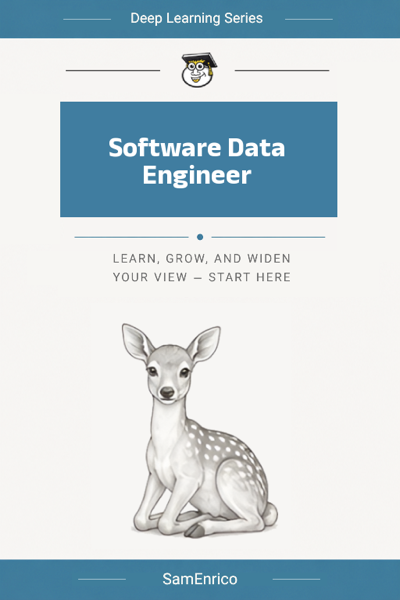
Non-FictionInformativeEducational
Software Data Engineer eBook
A Coursebook on Software Data Engineer
A Coursebook on Software Data Engineer
Formats
Free sample
Chapter 1: The 2 AM Alarm--It was 2:17 AM on a Tuesday when Sarah’s phone buzzed for the fifth time in ten minutes. The dashboard that the executive team checked every morning before their 9 AM standup was showing something impossible: negative revenue for the last eight hours. Not zero. Negative. As if customers were returning more products than they had purchased, but the returns system had been quiet all day. Sarah was the data engineer on call, and she had written that pipeline from scratch six months ago. She knew every line of code, every transformation, every join. And she had absolutely no idea why it was wrong.She pulled up the logs. The pipeline had run successfully. No errors. No warnings. The source data looked clean. The transformations had executed in order. The final table had been written. Everything was green, and everything was wrong.Over the next four hours, Sarah learned a lesson that no textbook had ever taught her. The problem wasn't a bug in her code. The problem was in her assumptions about how data behaves. She had assumed that if a record arrived at 2:00 PM, it belonged to the 2:00 PM hour. She had assumed that if a transaction was marked as "completed", it would never change. She had assumed that running the same pipeline twice would produce the same results. Every single assumption was wrong.By 6:30 AM, she had found the root cause. A separate system had backfilled three months of corrected transaction data, re-issuing records with the same transaction IDs but different amounts. Her pipeline, which processed data in batches every hour, had seen the updated records and dutifully added them to the current day’s revenue. Meanwhile, the original transactions from three months ago remained in the historical tables. The revenue for today was now inflated by transactions that had actually occurred a quarter ago. And the dashboard, which subtracted returns from gross sales, was now subtracting nothing from a number that was already wrong.Sarah fixed the pipeline by making it idempotent—capable of being rerun without creating duplicates or double-counting—and added a check for backfilled data. She pushed the fix, re-ran the last eight hours, and went to bed as the sun came up. The dashboard was correct by 8:45 AM, fifteen minutes before the executive meeting.This book exists because of nights like Sarah’s. Not because her story is unusual—it isn’t—but because the gap between writing code that works and writing code that survives production is vast, and almost no one teaches it. If you are reading this, you already know how to write Python or SQL or both. You might have built a few pipelines. You might have even deployed something to production. But you have also, like Sarah, probably experienced that sickening moment when a pipeline reports success and you know, deep in your gut, that something is terribly wrong.This book is the coursebook you wish you had on your first day as a data engineer. It will not just teach you the tools. It will teach you the principles that make data systems reliable, the patterns that prevent 2 AM alarms, and the mindset that separates a scripter who moves data from an engineer who builds systems that stakeholders trust.The Software Mindset Versus the Scripting Mindset Let us begin with a distinction that will frame everything that follows. There is a difference between writing a script that moves data from point A to point B and engineering a data system that operates reliably over months and years. The scripting mindset asks: “Does this code run without errors right now?” The software engineering mindset asks: “Will this code produce correct results when run at 3 AM, when run on a leap day, when run after a network timeout, when run twice in a row, when run with empty input, when run with ten times the expected data volume, and when run six months from now after three upstream systems have changed?”The scripting mindset is reactive. It solves the problem in front of you. The engineering mindset is proactive. It anticipates the problems that will eventually appear. Every single chapter of this book will return to this distinction, because the single most common failure mode in data engineering is treating a system like a script.Consider the difference between a script and a system. A script is linear. It starts, does one thing, and ends. A system is continuous. It runs on a schedule or responds to events. It interacts with other systems. It handles variability. It degrades gracefully when things go wrong. A script can afford to assume perfect conditions. A system cannot.Here is a concrete example. A scripting approach to reading a CSV file might look like this:python Copy Downloadimport pandas as pd
df = pd.read_csv('sales.csv') df['total'] = df['quantity'] * df['price'] df.to_parquet('sales_processed.parquet')This code works perfectly the first time you run it. It works perfectly the second time. But what happens on the third run, after someone has appended new rows to sales.csv? The script will read all rows again, including the ones it already processed, and double-count them. What happens if the file is missing? The script crashes with a cryptic error. What happens if the file is present but empty? The script creates an empty output file, and downstream dashboards show zero sales, but no one knows that the problem is upstream.An engineering approach to the same task includes idempotency, error handling, and observability:python Copy Downloadimport pandas as pd import hashlib from pathlib import Path
def process_sales(input_path, output_path, checkpoint_file): # Check if we've already processed this exact file file_hash = hashlib.md5(Path(input_path).read_bytes()).hexdigest() if Path(checkpoint_file).exists() and file_hash in open(checkpoint_file).read(): print("File already processed. Skipping.") return
# Handle missing or empty files gracefully if not Path(input_path).exists(): print("Input file not found. Exiting without error.") return
df = pd.read_csv(input_path) if df.empty: print("Input file is empty. Creating empty output.") df.to_parquet(output_path) return
# Process with deterministic ordering df = df.sort_values('transaction_id') df['total'] = df['quantity'] * df['price'] df.to_parquet(output_path)
# Record that we've processed this file with open(checkpoint_file, 'a') as f: f.write(file_hash + '\n')This version is not glamorous. It is not clever. It is, however, resilient. It can be run a hundred times and will produce the same output as running it once. It handles edge cases without crashing. It tells you what it did. This is the difference between a script and a system.The Data Engineering Lifecycle: Your Mental Map Before we go any deeper, you need a map. The rest of this book is organized around a simple but powerful framework: the Data Engineering Lifecycle. Every data system, no matter how simple or complex, moves through four stages. Understanding these stages gives you a mental model for diagnosing problems, designing solutions, and communicating with stakeholders.Stage 1: Generation Data is generated somewhere. A user clicks a button. A sensor records a temperature. A database commits a transaction. A log file…
This is the end of the free sample. Get the eBook to keep going. Buy now
About this book
Details
- Author
- Seiler Roseanne
- Publisher
- SamEnrico
- Language
- English
- Genre
- Non-Fiction, Informative, Educational
- Released
- 2026-06-02
- Pages (approx.)
- 159
- Available as
- eBook, Audiobook

Read better in the ZLOADR app
Your eBooks on your phone or tablet. Sign in with your SamEnrico account and start reading.
More by Seiler Roseanne
 LinkedIn Career Comparison TrapSeiler Roseanne$11.99
 Daily Review for ExecutivesSeiler Roseanne$11.99
 Grip Strength Training GuideSeiler Roseanne$11.99
 Values And Mission Alignment Community EngagementSeiler Roseanne$11.99
 The Codebreakers' Secret: How a 10-Year-Old Solved a 300-Year-Old Math PuzzleSeiler Roseanne$11.99
 Blood Oath of the Amazon QueenSeiler Roseanne$11.99
 Employee Handbook Refresh PrimerSeiler Roseanne$12.99
 Smart Pill Bottle GuideSeiler Roseanne$12.99
 How to Start a Mud Logging Service Business (Beginners Guide)Seiler Roseanne$11.99
You may also like
 Hong Kong Handover 1997Dunn Johnnie$11.99
 Zumba For Postnatal Recovery CourseNeal Christian$11.99
 Zumba for BeginnersLadner Nikia$11.99
 YouTube Comment Mining GuideHumes Pandora$12.99
 Worry Box MeditationCarlin Rudy$11.99
 Workplace Stress MeditationNguyen Lynn$11.99
 Workplace Stress and Sleep RepairHawley Ivory$11.99
 Workplace Perfectionism CureDelaney Jeffry$11.99
 Workplace Injustice Anger GuideWallen Isabelle$11.99
 Work Addiction and Burnout LinkGreenwood Ester$11.99
 Women in Yoga and WellnessBeattie Galina$11.99
 Women in Stand Up ComedyChun Evangeline$11.99