
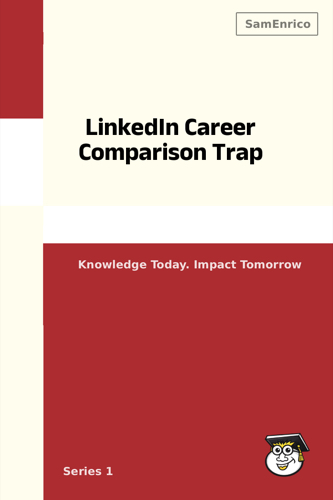
Non-FictionSelf-HelpCareerProfessional
LinkedIn Career Comparison Trap
Stop measuring your professional worth against cur
Stop measuring your professional worth against curated career highlights on LinkedIn.
Formats
About this book
Free sample
Chapter 1: The Sunday Scaries--–- The notification pinged at 7:42 PM. You were clearing the dinner plates, half-watching the news, already dreading Monday morning. You told yourself you would just check messages—see if that recruiter replied, confirm the meeting time for Tuesday. Thirty minutes later, you closed the app feeling smaller, heavier, and vaguely inadequate. You had not spoken to anyone.
You had not applied for anything. You had simply scrolled. And somewhere between the VP of Sales posting from her vacation rental and your former college roommate announcing his third promotion in four years, you lost something you did not even know you were carrying: your sense of enough.This is not a personal failure. It is a predictable psychological response to a machine designed to exploit how your brain measures worth. And until you understand how that machine works—specifically, how Linked In weaponizes a century-old psychological theory called Social Comparison—you will keep losing the same battle every Sunday night.The Mechanism You Did Not Know Was Running In 1954, social psychologist Leon Festinger proposed a theory so simple and so devastating that it has shaped everything from advertising to social media algorithms.
He called it Social Comparison Theory. The idea is this: human beings have an innate drive to evaluate themselves. But objective standards are often unavailable—there is no universal ruler for "good parent" or "successful professional"—so we do the next best thing. We compare ourselves to other people.Festinger identified two types of comparison. Downward comparison is when you look at someone worse off than you to feel better about your situation.
(Think: reading about a corporate scandal and thinking, "At least I am not that guy.") Upward comparison is when you look at someone better off than you to evaluate your own standing. (Think: seeing a peer's promotion announcement and thinking, "Why not me?")Neither is inherently toxic. Downward comparison can boost mood temporarily. Upward comparison can motivate growth. But here is where Linked In changes the game entirely.
On Instagram, you compare vacations, bodies, dinner plates, and family photos. On Facebook, you compare life milestones—weddings, births, graduations. These…
This is the end of the free sample. Get the eBook to keep going. Buy now
Contents
- Chapter 1
- Chapter 2
- Chapter 3
- Chapter 4
- Chapter 5
- Chapter 6
- Chapter 7
- Chapter 8
- Chapter 9
- Chapter 10
- Chapter 11
- Chapter 12
Details
- Author
- Seiler Roseanne
- Publisher
- SamEnrico
- Language
- English
- Genre
- Non-Fiction, Self-Help, Career, Professional
- Released
- 2026-06-08
- Pages (approx.)
- 124
- Available as
- eBook, Audiobook

Read better in the ZLOADR app
Your eBooks on your phone or tablet. Sign in with your SamEnrico account and start reading.
More by Seiler Roseanne
 Daily Review for ExecutivesSeiler Roseanne$11.99
 Grip Strength Training GuideSeiler Roseanne$11.99
 Values And Mission Alignment Community EngagementSeiler Roseanne$11.99
 The Codebreakers' Secret: How a 10-Year-Old Solved a 300-Year-Old Math PuzzleSeiler Roseanne$11.99
 Blood Oath of the Amazon QueenSeiler Roseanne$11.99
 Software Data EngineerSeiler Roseanne$11.99
 Employee Handbook Refresh PrimerSeiler Roseanne$12.99
 Smart Pill Bottle GuideSeiler Roseanne$12.99
 How to Start a Mud Logging Service Business (Beginners Guide)Seiler Roseanne$11.99
You may also like
 Hong Kong Handover 1997Dunn Johnnie$11.99
 Zumba For Postnatal Recovery CourseNeal Christian$11.99
 Zumba for BeginnersLadner Nikia$11.99
 YouTube Comment Mining GuideHumes Pandora$12.99
 Worry Box MeditationCarlin Rudy$11.99
 Workplace Stress MeditationNguyen Lynn$11.99
 Workplace Stress and Sleep RepairHawley Ivory$11.99
 Workplace Perfectionism CureDelaney Jeffry$11.99
 Workplace Injustice Anger GuideWallen Isabelle$11.99
 Work Addiction and Burnout LinkGreenwood Ester$11.99
 Women in Yoga and WellnessBeattie Galina$11.99
 Women in Stand Up ComedyChun Evangeline$11.99