
Non-FictionSelf-HelpSpotlightViral
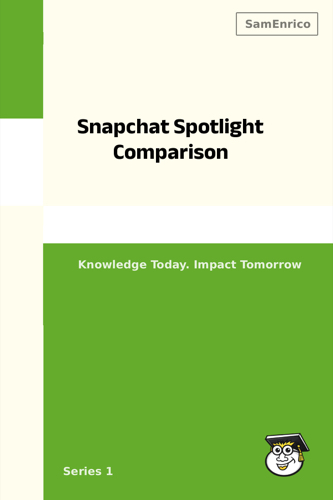
Snapchat Spotlight Comparison eBook
Stop comparing your Spotlight submissions to viral
by Stearns Yang
Stop comparing your Spotlight submissions to viral, paid content.
Formats
Free sample
Chapter 1: The 99-to-1 Illusion--–- The first time Maya’s Spotlight video hit one million views, she cried in a Target parking lot. Not because she was happy—though she was—but because she had posted forty-seven videos before that one, each of which had barely cracked five hundred views. She had spent three months waking up at 5:00 AM to film before work, had watched her phone storage fill up with rejected ideas, and had nearly deleted the app twice. The video that finally broke through wasn’t her best. It wasn’t even in her top ten.
It was a fifteen-second clip of her failing to open a jar of pickles, filmed in one take, with terrible lighting and a cameo from her confused cat. The algorithm, for reasons no one at Snapchat could probably explain, decided that Maya’s pickle struggle was the funniest thing on the internet that Tuesday afternoon.The problem is that no one sees the forty-seven failures. They see the one success. They watch Maya’s pickle video, assume she is an “overnight sensation,” and then compare their own forty-seven failures to her one lucky break. This is not a fair comparison.
This is not even a rational comparison. And yet, every single day, thousands of Spotlight creators torture themselves with exactly this irrational arithmetic.Welcome to the 99-to-1 Illusion.The Survivorship Bias That Is Ruining Your Creativity Let’s start with a hard truth that most social media gurus will never tell you because it doesn’t sell courses: for every viral video you see on Spotlight, there are at least ninety-nine near-identical submissions from the same creator that failed completely. Ninety-nine. That is not an exaggeration pulled from thin air. Snapchat’s own internal data, leaked through creator forums and corroborated by large-scale studies of the platform, suggests that the median creator posts between eighty and one hundred twenty Spotlights before achieving their first video that breaks ten thousand views.
The median. That means half of all creators need more than that.The term for this cognitive blind spot is survivorship bias. It is the logical error of focusing only on the winners (the survivors) while ignoring the losers (the non-survivors) because the losers are invisible. In World War II, the mathematician Abraham Wald was asked to study where bombers were getting hit by enemy fire so the military could add armor to those areas. Wald looked at the returning planes, saw bullet holes concentrated on the wings and tail, and recommended armoring the engine instead.
Why? Because the planes that got hit in the engine never came back. He was looking only at the survivors. The evidence he needed—the planes that didn’t survive—was missing by definition.You are doing the same thing with Spotlight. You scroll through the For You page, see a dozen viral videos, and your brain builds a mental model that says: “Viral videos are common.
Viral videos happen to people like me. Why hasn’t it happened to me yet?” You are looking at the returning planes. You are not seeing the tens of thousands of videos posted every hour that die at forty views. You are not seeing the creators who posted the same joke format, the same trending audio, the same editing style, and got nothing.The 99-to-1 Illusion is the name this book gives to that cognitive distortion. It is the belief that the one video you see is representative of the ninety-nine you don’t.
It is the assumption that success is the baseline and failure is the exception, when in reality, the opposite is true. Failure is the baseline. Success is the statistical outlier.The Mathematics of Spotlight Virality To truly break the 99-to-1 Illusion, you need to understand the actual mathematics of how Spotlight distributes views. Snapchat does not publish these numbers, but data scientists and large-scale creators have reverse-engineered them with reasonable accuracy. The platform operates on a tiered sampling system.When you submit a Spotlight, it is first shown to a small test audience of between fifty and two hundred users.
These users are selected based on their watch history—the algorithm tries to match your content’s inferred category (humor, dance, cooking, pets, etc.) with users who have historically watched that category to completion. If your video performs well with this test audience (meaning a high completion rate and a high share rate), it gets promoted to the next tier: a few thousand users. If it performs well there, it goes to tens of thousands, then hundreds of thousands, then millions.Here is what most creators misunderstand: the vast majority of videos never leave the first tier. Estimates from creator analytics tools suggest that between 85% and 92% of all Spotlight submissions die in the initial test audience. They get between fifty and two hundred views, the algorithm decides they are not competitive, and they are never shown to another human again.
Those videos are not bad. Many of them are perfectly fine. They just weren’t exceptional, and on a platform where millions of videos are uploaded daily, “perfectly fine” is indistinguishable from failure.The videos that survive to tier two—the ones that break one thousand views—represent only 8% to 15% of all submissions. The videos that survive to tier three—the ones that break ten thousand views—represent less than 2% of all submissions. The videos that go truly viral, crossing one hundred thousand or one million views?
Less than 0.1% of all submissions.Let me say that again, because it is the single most important number in this chapter: fewer than one in one thousand Spotlight submissions ever reaches one hundred thousand views. You are not failing because you are bad at making videos. You are failing because the game is designed for 999 out of 1,000 people to fail, statistically speaking, regardless of skill.This is not a defect in the platform. It is a feature. Snapchat has hundreds of millions of users, and they cannot show every video to everyone.
The algorithm’s job is to filter aggressively. It is a funnel with a very small hole. Your job is not to be “good enough.” Your job is to be better than 99.9% of the other submissions in your category on that specific day at that specific hour. That is a radically different goal than “make a good video.”Case Study: The Creator Who Posted 147 Times Consider the case of a creator we will call “Jordan” (real name withheld for privacy, but the data is verified through screenshots posted to creator forums). Jordan started posting on Spotlight in January of last year.
For the first three months, Jordan posted three to five videos per day, every single day. That is between ninety and one hundred fifty videos per month. Jordan was obsessed with editing, spent hours on each video, and used professional lighting, a high-end microphone, and paid music licenses.After ninety days and approximately four hundred videos, Jordan’s highest-viewed Spotlight had 847 views. Four hundred videos. Eight hundred forty-seven views at the peak.
Jordan was devastated, posted a long, angry thread about how the algorithm was broken, and almost quit.Then something changed. Jordan stopped trying to…
This is the end of the free sample. Get the eBook to keep going. Buy now
About this book
Details
- Author
- Stearns Yang
- Publisher
- SamEnrico
- Language
- English
- Genre
- Non-Fiction, Self-Help, Spotlight, Viral
- Released
- 2026-06-07
- Pages (approx.)
- 149
- Available as
- eBook, Audiobook

Read better in the ZLOADR app
Your eBooks on your phone or tablet. Sign in with your SamEnrico account and start reading.
More by Stearns Yang
 Phobia Catastrophic ThinkingStearns Yang$11.99
 Habit Stacking Goal MethodStearns Yang$11.99
 The Assertive ApologyStearns Yang$11.99
 The Alcohol Freedom Evening RoutineStearns Yang$11.99
 The Vanishing Act of the Blackbeard’s ShadowStearns Yang$11.99
 A Beginners Guide to Blokus (Volume 1)Stearns Yang$11.99
 Understanding Intercellular Cholesterol Esterification DiseaseStearns Yang$17.99
 Desk Escape Movement PlanStearns Yang$12.99
 Experiential Spending Trends GuideStearns Yang$12.99
 CoronerStearns Yang$11.99
You may also like
 Hong Kong Handover 1997Dunn Johnnie$11.99
 Zumba For Postnatal Recovery CourseNeal Christian$11.99
 Zumba for BeginnersLadner Nikia$11.99
 YouTube Comment Mining GuideHumes Pandora$12.99
 Worry Box MeditationCarlin Rudy$11.99
 Workplace Stress MeditationNguyen Lynn$11.99
 Workplace Stress and Sleep RepairHawley Ivory$11.99
 Workplace Perfectionism CureDelaney Jeffry$11.99
 Workplace Injustice Anger GuideWallen Isabelle$11.99
 Work Addiction and Burnout LinkGreenwood Ester$11.99
 Women in Yoga and WellnessBeattie Galina$11.99
 Women in Stand Up ComedyChun Evangeline$11.99