
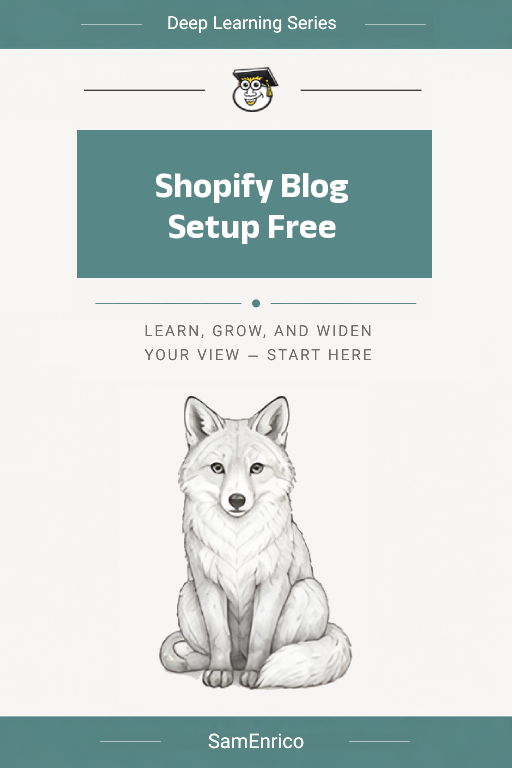
Non-FictionFirst 30 DaysContent Marketing
Shopify Blog Setup Free eBook
Create free blog on Shopify to drive SEO traffic w
by Cohn Merissa
Create free blog on Shopify to drive SEO traffic without paid advertising.
Formats
Free sample
Chapter 1: The Digital Acre...--The first time I lost $3,000 on Facebook ads, I told myself it was a learning experience. The second time, I told myself I needed better targeting. The third time, I sat in my car outside my apartment building and seriously considered whether I was smart enough to run a business.I was selling wool socks. Not complicated socks. Just warm, durable, ethically-sourced wool socks.
My profit margin was 8perpair.Tobreakevenonthat8 per pair. To break even on that 8perpair.Tobreakevenonthat3,000 ad spend, I needed to sell 375 pairs. I sold forty-two.Facebook got paid. I got poorer. And somewhere in Menlo Park, California, an algorithm learned that people who click on sock ads also click on hiking gear ads.
Facebook kept that data. I kept nothing but a credit card bill.That was the moment I realized I was a renter, not an owner.Every time you pay for a Facebook ad, a Google Shopping click, or an Instagram promotion, you are building equity for the ad platform, not your brand. You are paying rent on a property that will never be yours. When you stop paying, the landlord evicts you immediately. The traffic vanishes.
The customers disappear. The algorithm forgets you existed.This book is about buying land. Not physical land—digital land. An asset that you own, that no platform can take from you, and that grows in value every year without requiring you to feed it ad dollars.That asset is a blog on your Shopify store. And contrary to what every "guru" with a course to sell will tell you, it costs exactly zero dollars to set up.The Rental Crisis of Modern Ecommerce Let me be more specific about why paid advertising is a trap.Facebook, Google, Tik Tok, Instagram—these are not your partners.
They are landlords. And like all landlords, they raise rent every year. In 2020, the average cost per click for ecommerce ads was 1.16.By2024,ithadrisento1.16. By 2024, it had risen to 1.16.By2024,ithadrisento2.14. That is an 84% increase in four years.
Your profit margins cannot survive that.But the real problem is not the rising cost. The real problem is what happens when you stop paying.Run a Facebook ad today. Spend $500. You will get some sales. Now stop spending.
What happens tomorrow? Zero sales from that channel. The moment you turn off the tap, the water stops flowing. You have built nothing. You have created no asset.
You have simply rented traffic for a few days.Now consider a different approach. Write a blog post today. Spend five hours researching and writing. Publish it. Next month, it might get 100 visitors.
Six months from now, it might get 1,000 visitors per month. Two years from now, it might get 5,000 visitors per month.And here is the magic: you never pay for any of them.That is the difference between renting and owning. An ad is a rental payment. A blog post is a deed to digital land.The 43% Rule (And Why the Old Statistic Was Wrong)You have probably heard the statistic: "Businesses with blogs generate 55% more website visitors."That number comes from a 2014 Hub Spot study. It has been repeated so many times that it has become gospel, but the data is outdated.
The ecommerce landscape of 2014 barely resembles the landscape of today.The updated figure, from Hub Spot's 2023 State of Marketing Report, is 43%. B2C companies with active blogs generate 43% more monthly visitors than those without. That is still a massive advantage. But the more important statistic comes from a different study entirely.According to a 2022 analysis of 1.2 million Shopify stores, stores with blogs that published at least once per week had an average conversion rate from organic search that was 3.2x higher than stores without blogs. Not 43% more visitors—more than three times the conversion rate.Why?
Because visitors who find you through a blog post are different. They are not being interrupted by an ad. They are not being chased by a retargeting pixel. They typed a question into Google, found your answer, and decided you were trustworthy. By the time they click through to a product page, they already like you.That is the difference between a cold lead and a warm lead.
Ads produce cold leads. Blogs produce warm leads. Warm leads convert at dramatically higher rates.The Mindset Shift: From ABC to ABHBefore we touch a single setting in your Shopify dashboard, we need to rewire your brain.Most ecommerce entrepreneurs operate on a sales floor mindset. They believe in ABC: Always Be Closing. Every piece of content should end with a purchase.
Every email should push a discount code. Every social media post should drive to the checkout page.This is why most ecommerce blogs fail. They are not blogs. They are catalogs wearing a costume.A real blog does not exist to close sales. It exists to help people.
That is the mindset shift: from Always Be Closing to Always Be Helping (ABH).Let me give you a concrete example.Imagine you run a pet supply store. A customer is searching for "how to stop a puppy from biting." They do not want to buy anything yet. They want to solve a problem. Their puppy is teething, their hands are covered in tiny bite marks, and they are exhausted.An ABC approach would write a blog post titled "10 Chew Toys That Stop Puppy Biting"—a thinly disguised product list. The reader feels sold to.
They bounce.An ABH approach would write a blog post titled "The Complete Guide to Puppy Biting: Why It Happens and How to Stop It in 3 Days." The post would explain teething, redirecting behavior, bite inhibition training, and yes—at the very end—mention that certain chew toys can help. The reader feels helped. They trust you. When they finally need to buy a chew toy, they come back to your store.That is not a slower sales cycle. That is a different sales cycle entirely.
You are not selling to a stranger. You are selling to someone who already considers you an expert.The Math of the Digital Acre Let me show you why this matters in dollars and cents.Take that pet supply store. The owner wants to rank for the keyword "how to stop a puppy from biting." According to Google Keyword Planner, that phrase gets 600 searches per month. Not massive. Not tiny.
Exactly the kind of long-tail question that big competitors ignore.The average cost per click for "puppy chew toys" (a related commercial keyword) is 1.80.Thatmeansifthepetstoreownerwantedtobuythattrafficthrough Google Ads,theywouldpay1.80. That means if the pet store owner wanted to buy that traffic through Google Ads, they would pay 1.80.Thatmeansifthepetstoreownerwantedtobuythattrafficthrough Google Ads,theywouldpay1.80 for every visitor who clicked an ad.Now imagine the blog post ranks #1 for "how to stop a puppy from biting." Let's assume a conservative 15% click-through rate from the search results. That means 90 visitors per month from that single post.If the store owner had bought those 90 visitors through ads, they would have paid 162.Inonemonth.Thatis162. In one month. That is 162.Inonemonth.Thatis1,944 per year.
For one blog post.But here is where the math gets exciting. That blog post does not stop working after a…
This is the end of the free sample. Get the eBook to keep going. Buy now
About this book
Details
- Author
- Cohn Merissa
- Publisher
- SamEnrico
- Language
- English
- Genre
- Non-Fiction, First 30 Days, Content Marketing
- Released
- 2026-06-01
- Pages (approx.)
- 115
- Available as
- eBook, Audiobook

Read better in the ZLOADR app
Your eBooks on your phone or tablet. Sign in with your SamEnrico account and start reading.
More by Cohn Merissa
 TM Anxiety ManagementCohn Merissa$11.99
 Emotional Intelligence for BPDCohn Merissa$11.99
 First Responder Naloxone GuideCohn Merissa$11.99
 Async Investor Update GuideCohn Merissa$11.99
 Workplace Imposter Syndrome GuideCohn Merissa$11.99
 The Sleepwalking Spy: How a Secret Agent’s Dreams Changed Cold War EspionageCohn Merissa$11.99
 Echoes of the Cosmic Pioneers: The Lost Transmissions of Pioneer 10Cohn Merissa$11.99
 Understanding Coxoauricular SyndromeCohn Merissa$17.99
 Director of Revenue Cycle ManagementCohn Merissa$11.99
 Security Deposit Reduction GuideCohn Merissa$12.99
 How to Start a Prepared Waxes Business (Beginners Guide)Cohn Merissa$11.99
You may also like
 Hong Kong Handover 1997Dunn Johnnie$11.99
 Zumba For Postnatal Recovery CourseNeal Christian$11.99
 Zumba for BeginnersLadner Nikia$11.99
 YouTube Comment Mining GuideHumes Pandora$12.99
 Worry Box MeditationCarlin Rudy$11.99
 Workplace Stress MeditationNguyen Lynn$11.99
 Workplace Stress and Sleep RepairHawley Ivory$11.99
 Workplace Perfectionism CureDelaney Jeffry$11.99
 Workplace Injustice Anger GuideWallen Isabelle$11.99
 Work Addiction and Burnout LinkGreenwood Ester$11.99
 Women in Yoga and WellnessBeattie Galina$11.99
 Women in Stand Up ComedyChun Evangeline$11.99