
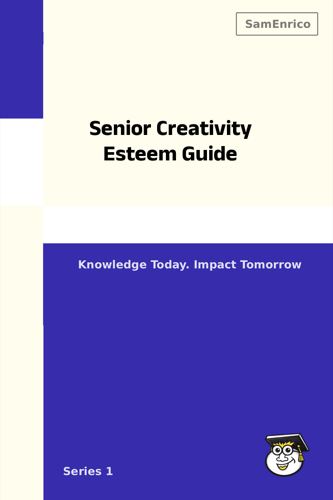
Non-FictionSelf-HelpCreativityExpression
Senior Creativity Esteem Guide eBook
Express yourself through art, writing, or music wi
Express yourself through art, writing, or music without fear of judgment.
Formats
Free sample
Chapter 1: The Permission Pause...–- Every morning at 7:15, Eleanor lifted her coffee mug to her lips and stared at the empty easel in the corner of her living room. She had bought the easel three years ago, on her seventy-second birthday, with the honest intention of learning to paint. The easel still had the price tag on it. Eleanor had become an expert at looking at the easel, an expert at feeling the familiar ache of longing, and an expert at telling herself the same story: I’m too old to start something new. That was for the younger version of me.
That woman is gone.What Eleanor did not know—what this entire book exists to tell you—is that the story she was telling herself was not wisdom. It was not realism. It was not the gentle acceptance of aging’s natural limits. It was a lie, polished smooth by decades of cultural conditioning, and it was the single greatest obstacle between her and the rest of her life.This chapter is about why you believe you have missed your chance. It is about the toxic myth that creativity belongs to the young, the embarrassed half-smile seniors give when they admit they are “trying” art, and the quiet grief of the impossible dream left unrealized.
More importantly, this chapter is about why every single one of those beliefs is demonstrably, scientifically, and spiritually false. The only legitimate time to start creating is now. And you have been given permission by no one but yourself.The Weight of the Unmade Thing There is a particular kind of sadness that comes from carrying an unrealized creative impulse for decades. Psychologists call it “latent potential”—the gap between what you sense you might be capable of and what you have actually done. For seniors, this gap is often cavernous.
You have had fifty or sixty years of adult life during which the message was clear: creativity is for children, for professionals, for the gifted, for the young. You raised families, built careers, paid mortgages, survived losses. Somewhere along the way, the easel went into the corner. The guitar stayed in the closet. The notebook remained blank.This chapter names that grief.
It does not dismiss it or rush past it. Because before you can build anything new, you must recognize what you have been carrying. The “permission pause” is that moment of hesitation—the split second between wanting to create and deciding not to—that has repeated itself thousands of times across your life. Eleanor had a permission pause every single morning. She would think, I should move the easel into the light.
And then she would think, But what’s the point? I’m seventy-two. Seventy-three. Seventy-four.The point, as you will discover, is everything.Why We Believe Creativity Expires Let us be precise about the lie. The belief that creativity belongs to the young is not a natural human instinct.
Young children do not instinctively believe that creativity expires; they simply draw, sing, and build without a second thought. The belief that you are “too old” is a learned cultural script, and it comes from three specific sources.First, the cult of the prodigy. Western culture is obsessed with early achievement. Mozart composed at five. Picasso painted masterfully as a teenager.
We tell the stories of young geniuses over and over, creating the implicit message that if you haven’t done something remarkable by age thirty, you never will. This is called “chronological snobbery”—the assumption that earlier is better and younger is more capable. It is a logical fallacy, not a biological truth. For every Mozart who bloomed early, there are hundreds of artists who found their voice late in life. Grandma Moses began painting in her seventies and became one of America’s most beloved artists.
Harry Bernstein published his first book at ninety-six. You have never heard of the prodigies who burned out at twenty-five; you have heard of the late bloomers because their persistence was extraordinary. But persistence is available to everyone.Second, the conflation of physical decline with creative decline. It is true that some physical capacities diminish with age. You may not have the hand speed of a twenty-year-old guitarist or the eyesight of a teenager.
But creativity is not hand speed. Creativity is pattern recognition, emotional depth, patience, and the ability to hold complexity—all of which improve with age. As we will explore in Chapter 2, the aging brain is not a declining brain; it is an integrating brain. You have more to say, not less. The mistake is assuming that the tool (your hands, your eyes) is the same as the source (your mind, your memory, your heart).Third, the embarrassment of the amateur.
There is a deeply ingrained social rule that older people should be competent. You have spent decades mastering your profession, your household, your relationships. The idea of being a beginner again—clumsy, uncertain, making obvious mistakes—feels humiliating. We see this in retirement communities across the country: seniors who will happily discuss their golf handicap or their bridge game but who would never admit they tried to write a poem. The amateur status feels like a regression, not a liberation.
But this is the cruelest irony of all. The freedom to be a beginner is one of the great gifts of age. You are not trying to get into a gallery. You are not auditioning for a record label. You have nothing to prove and no career to protect.
The amateur is the only true artist, because the amateur creates for love, not for survival.The Matty Kahn Principle In the small town of Ashland, Oregon, an eighty-nine-year-old woman named Matty Kahn walked into a music store and asked to rent a cello. The clerk, assuming she was buying for a grandchild, asked what size the child needed. Matty said, “It’s for me. I’ve always wanted to play.” The clerk later admitted he almost laughed. He didn’t, but he thought about it.Matty took the cello home.
She could not read music. She had never held a bow. Her fingers were stiff with arthritis. She began taking lessons from a local college student, practicing thirty minutes a day. Her neighbors complained about the screeching.
She kept going. Two years later, at age ninety-one, Matty entered a local art competition—not for music, but for painting. She had also taken up watercolors. She won third place. When a reporter asked her how it felt to start so late, Matty said something that became the thesis of this book: “I didn’t start late.
I started when I was ready. The only time you can start is now.”The Matty Kahn Principle is simple: mastery is not the goal; expression is. You do not need to be good. You do not need to impress anyone. You do not need to produce a masterpiece.
You need only to make the thing, say the thing, play the thing that is inside you. The value is in the act itself. This is the first of our Core Principles, which will appear throughout this book:Core Principle 1: Process Over Product.…
This is the end of the free sample. Get the eBook to keep going. Buy now
About this book
Details
- Author
- Cantwell Cecily
- Publisher
- SamEnrico
- Language
- English
- Genre
- Non-Fiction, Self-Help, Creativity, Expression
- Released
- 2026-06-08
- Pages (approx.)
- 135
- Available as
- eBook, Audiobook

Read better in the ZLOADR app
Your eBooks on your phone or tablet. Sign in with your SamEnrico account and start reading.
More by Cantwell Cecily
 Assertive Relationship CommunicationCantwell Cecily$11.99
 The Joy of PetsCantwell Cecily$11.99
 Work Boots DilemmaCantwell Cecily$11.99
 The Noting Technique Meditation GuideCantwell Cecily$11.99
 Spice Wars: The Culinary Clash That Reshaped EmpiresCantwell Cecily$11.99
 Understanding Myoclonus Progressive Epilepsy of Unverricht and LundborgCantwell Cecily$17.99
 How to Become a Nickel-plant OperatorCantwell Cecily$11.99
 Accrual Formula Study GuideCantwell Cecily$12.99
 Oracle SWOT Library GuideCantwell Cecily$12.99
 Brokerage CoordinatorCantwell Cecily$11.99
You may also like
 Hong Kong Handover 1997Dunn Johnnie$11.99
 Zumba For Postnatal Recovery CourseNeal Christian$11.99
 Zumba for BeginnersLadner Nikia$11.99
 YouTube Comment Mining GuideHumes Pandora$12.99
 Worry Box MeditationCarlin Rudy$11.99
 Workplace Stress MeditationNguyen Lynn$11.99
 Workplace Stress and Sleep RepairHawley Ivory$11.99
 Workplace Perfectionism CureDelaney Jeffry$11.99
 Workplace Injustice Anger GuideWallen Isabelle$11.99
 Work Addiction and Burnout LinkGreenwood Ester$11.99
 Women in Yoga and WellnessBeattie Galina$11.99
 Women in Stand Up ComedyChun Evangeline$11.99