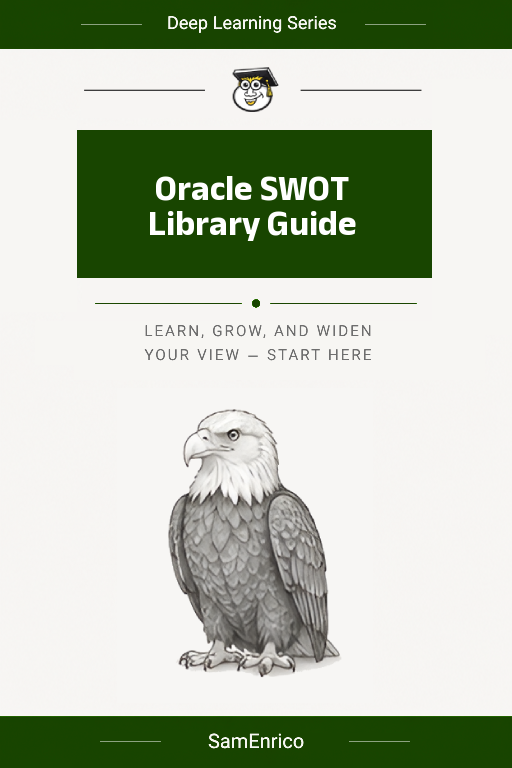
Oracle SWOT Library Guide
Analyze database legacy, cloud infrastructure grow
Analyze database legacy, cloud infrastructure growth (OCI), Cerner acquisition, and SaaS migration challenges.
Formats
About this book
Free sample
Chapter 1: The Velvet Rope...--–- In the winter of 2019, a Fortune 50 manufacturing company signed a 100millionenterpriseagreementwith Oracletomodernizeitsdatainfrastructure.Eighteenmonthslater,the CIOstoodbeforetheboardwithaconfession:theyhadspent100 million enterprise agreement with Oracle to modernize its data infrastructure. Eighteen months later, the CIO stood before the board with a confession: they had spent 100millionenterpriseagreementwith Oracletomodernizeitsdatainfrastructure.Eighteenmonthslater,the CIOstoodbeforetheboardwithaconfession:theyhadspent42 million on licensing, $11 million on consultants, and migrated exactly zero production workloads to the cloud. The company was trapped not by technology, but by a contract structure so intricate that no one—including Oracle’s own account team—could fully explain the financial consequences of moving a single database from on-premises Exadata to Oracle Cloud Infrastructure. This is the Velvet Rope problem, and it is the single most misunderstood dynamic in enterprise technology today.The story of that manufacturing company is not an outlier. It is the rule.
Across financial services, healthcare, retail, and telecommunications, thousands of organizations find themselves in a paradoxical relationship with Oracle. They pay hundreds of millions of dollars annually in maintenance and licensing fees. They endure aggressive audit cycles that demand retroactive payments for what auditors claim were under-licensed deployments. They watch as competitors migrate to cloud-native architectures on AWS, Azure, and Google Cloud. And yet, when their architects propose moving Oracle workloads to the cloud—even to Oracle’s own cloud—the response is often a hesitant "not yet." The reasons range from fear of contractual penalties to uncertainty about technical compatibility to a deep-seated institutional fatigue with Oracle’s complex commercial terms.This chapter dismantles the outdated perception of Oracle as merely a proprietary database vendor.
It introduces the core SWOT framework that underpins this entire book—Strengths, Weaknesses, Opportunities, and Threats—as a strategic lens for understanding Oracle’s current ecosystem. More importantly, this chapter reframes one of the most persistent misconceptions in enterprise architecture: that multi-cloud is an existential threat to Oracle. In reality, multi-cloud is a threat only to pure, single-vendor OCI adoption. Oracle’s strategic response, which we will explore in depth in Chapter 11, is not to fight multi-cloud but to enable it on Oracle’s terms through the Oracle-Azure…
This is the end of the free sample. Get the eBook to keep going. Buy now
Contents
- Chapter 1
- Chapter 2
- Chapter 3
- Chapter 4
- Chapter 5
- Chapter 6
- Chapter 7
- Chapter 8
- Chapter 9
- Chapter 10
- Chapter 11
- Chapter 12
Details
- Author
- Cantwell Cecily
- Publisher
- SamEnrico
- Language
- English
- Genre
- Non-Fiction, Strategic Atlas, Database
- Released
- 2026-05-30
- Pages (approx.)
- 153
- Available as
- eBook, Audiobook

Read better in the ZLOADR app
Your eBooks on your phone or tablet. Sign in with your SamEnrico account and start reading.
More by Cantwell Cecily
 Assertive Relationship CommunicationCantwell Cecily$11.99
 The Joy of PetsCantwell Cecily$11.99
 Senior Creativity Esteem GuideCantwell Cecily$11.99
 Work Boots DilemmaCantwell Cecily$11.99
 The Noting Technique Meditation GuideCantwell Cecily$11.99
 Spice Wars: The Culinary Clash That Reshaped EmpiresCantwell Cecily$11.99
 Understanding Myoclonus Progressive Epilepsy of Unverricht and LundborgCantwell Cecily$17.99
 How to Become a Nickel-plant OperatorCantwell Cecily$11.99
 Accrual Formula Study GuideCantwell Cecily$12.99
 Brokerage CoordinatorCantwell Cecily$11.99