
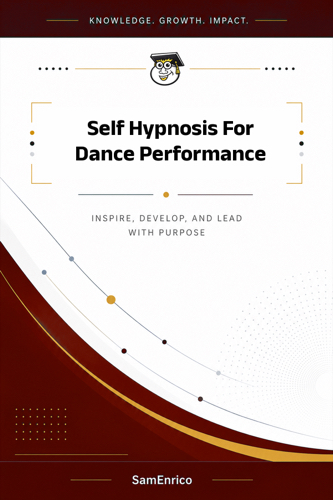
Self Hypnosis For Dance Performance eBook
Enhances musicality and choreography recall.
by Spann Ebonie
Enhances musicality and choreography recall.
Formats
Free sample
Chapter 1: Twofold Trance--–- Every dancer knows the feeling. The music swells, the body moves without thinking, and for a few precious seconds, you are no longer executing steps but becoming the movement. Time dissolves. Effort vanishes. You are utterly present and strangely absent all at once.
That, you have been told, is flow state. That, you may assume, is the ultimate goal of any performance practice.But here is the question this book dares to ask: what if the same feeling that makes you brilliant on stage also makes you mediocre in the rehearsal studio? What if the very trance that unlocks your greatest performances secretly sabotages your ability to learn, correct, and grow? And what if the difference between a dancer who plateaus and a dancer who evolves is not talent or hours logged, but the ability to consciously switch between two distinct modes of trance?This chapter will fundamentally change how you understand your own mind during dance. You will learn why traditional muscle memory is a myth that has held you back.
You will discover the critical difference between hypnosis and sleep—a distinction most dancers unknowingly blur every single day. Most importantly, you will be introduced to the Twofold Trance Model: Performing Trance and Practice Trance, two radically different hypnotic states that require opposite mental habits. By the end of this chapter, you will have taken the first self-hypnosis induction and will know, with certainty, which mode you are in at any given moment.The Myth of Pure Muscle Memory Let us begin by dismantling a beloved assumption. For generations, dancers have been told that repetition builds muscle memory—that if you run a combination enough times, your body will simply “know” what to do. The muscles, the story goes, remember the sequence independently of the conscious mind.
This is comforting. It is also dangerously incomplete.What we call muscle memory is actually procedural memory, encoded not in the muscles but in the basal ganglia and cerebellum of the brain. When you repeat a movement pattern, your brain gradually shifts control from the conscious prefrontal cortex (slow, deliberate, energy-intensive) to these deeper structures (fast, automatic, efficient). This is real and powerful. A professional dancer does not need to think “contract right hamstring, extend left leg, rotate hip externally” to execute a développé.
The movement simply happens.However, the myth of muscle memory contains a hidden poison: the assumption that automaticity is always good. In a performance, automaticity is everything. It frees your conscious mind to feel the music, connect with an audience, or recover from an unexpected slip. But in a rehearsal, automaticity is the enemy of improvement. When a movement becomes automatic, you stop noticing its flaws.
The slightly turned-in standing leg, the rushed preparation for a turn, the drooping elbow in fifth position—these errors become encoded into the automation. You do not feel them anymore because your brain has stopped sending conscious error signals. Your muscles are not stubborn; your brain has simply decided that the movement is solved.This is the first great paradox of dance: the same neural mechanism that enables breathtaking performance also locks in technical imperfections. And the only way out is not more repetition, but deliberate, conscious, corrective attention—the exact opposite of automatic flow.Hypnosis Is Not Sleep (And Why That Matters)Before we can distinguish between two types of trance, we must clear up a pervasive misunderstanding about hypnosis itself. If you have ever seen a stage hypnotist make a volunteer cluck like a chicken or fall into a “deep sleep,” you have been misled.
Stage hypnosis is entertainment, not education. The dramatic “you are getting very sleepy” routine has nothing to do with how self-hypnosis works for serious performers.Here is the clinical truth: hypnosis is a state of hyper-focused attention accompanied by reduced peripheral awareness. You are not asleep. You are not unconscious. You are not under anyone’s control.
In fact, brain imaging studies show that hypnotized individuals have increased activity in the anterior cingulate cortex—the region associated with focused attention and error monitoring. You are actually more alert to the task at hand, not less.Sleep, by contrast, is characterized by global reductions in cortical activity, loss of conscious awareness, and complete disconnection from the external environment. In deep sleep (delta waves), you cannot process suggestions, form new episodic memories, or maintain a coherent sense of self. This is why the popular notion of “sleep-learning” is pseudoscience. You cannot learn a dance combination while unconscious.
We will revisit this in Chapter 9, where we discuss the hypnagogic state (the twilight zone between waking and sleep), but for now, anchor this distinction: hypnosis = focused waking attention. Sleep = unconscious rest.Why does this matter for dancers? Because many dancers unknowingly drift into a drowsy, low-attention state during long rehearsals—particularly at the end of a demanding week—and mistake it for a hypnotic trance. They feel relaxed, vaguely disconnected, and assume this is “deep practice.” In reality, they are simply fatigued. Their brains are under-aroused, their error monitoring is suppressed, and they are encoding sloppy movement patterns without realizing it.
This is not hypnosis. This is exhaustion disguised as transcendence.A properly induced self-hypnosis state for dance is energized, alert, and laser-focused. Your eyes may be closed or open. Your breathing may slow. But your mind is sharp, your attention is narrow, and you are more sensitive to errors, not less.
Throughout this book, every script and technique will maintain this alert quality. If you feel yourself becoming truly sleepy during practice, stop. That is not the state you are training.The Natural Trance of Flow State Now let us examine the state that every dancer craves: flow. Originally described by psychologist Mihaly Csikszentmihalyi, flow is characterized by complete absorption in an activity, loss of self-consciousness, distorted time perception, and intrinsic reward. When you are in flow, the dance dances you.
There is no inner critic, no second-guessing, no desperate counting. There is only movement.Flow is absolutely a trance state. It meets all the criteria: hyper-focused attention (on the music, the spatial pattern, the partner), reduced peripheral awareness (you do not notice the audience member coughing), and altered time perception (the three-minute variation felt like thirty seconds). Moreover, flow is highly desirable during performance. You want to be in flow when the curtain rises.
You want the automation. You want the freedom from self-monitoring.However—and this is the critical insight that most dance psychology books miss—flow is only one type of trance. And it is the wrong type for large portions of training.Consider what happens when you are in flow during a rehearsal. You are not noticing that your supporting ankle wobbles on the landing. You are not catching that you rushed the transition between the pirouette and the chassé.
You are not aware of the tension in your jaw or the dropped shoulder. Flow, by its very nature, silences the error-detection systems of the brain. That is why it feels so good. But that is also why it is so dangerous in the studio.The solution is not to abandon flow—that would be absurd and impossible. The solution…
This is the end of the free sample. Get the eBook to keep going. Buy now
About this book
Details
- Author
- Spann Ebonie
- Publisher
- SamEnrico
- Language
- English
- Genre
- Non-Fiction, Self-Help, Dance
- Released
- 2026-06-09
- Pages (approx.)
- 160
- Available as
- eBook, Audiobook

Read better in the ZLOADR app
Your eBooks on your phone or tablet. Sign in with your SamEnrico account and start reading.
More by Spann Ebonie
 The Money Trauma RecoverySpann Ebonie$11.99
 Anapanasati for TraumaSpann Ebonie$11.99
 Subscription Box Addiction HelpSpann Ebonie$11.99
 Day Residue DreamsSpann Ebonie$11.99
 Networking for Healthcare WorkersSpann Ebonie$11.99
 Press Release Wire ComparisonSpann Ebonie$11.99
 Claustrophobia Calming GuideSpann Ebonie$11.99
 Iranian Mother Revolution EscapeSpann Ebonie$11.99
 The Silent Stitch: Edith Head and the Art of Deception in HollywoodSpann Ebonie$11.99
 Prometheus Unbound: The Fire That Defied the GodsSpann Ebonie$11.99
 Advanced Supply Chain ResilienceSpann Ebonie$11.99
 College Essay Brag Sheet For RecommendersSpann Ebonie$12.99
You may also like
 Body Image For DancersMcewen Anibal$11.99
 Dance Performance AnchorWyman Nicolasa$11.99
 Name Recall for Dance InstructorsGoodrich Cori$11.99
 TM Dancer Body AwarenessBray Sheryll$11.99
 The Body Language for DancersSams Valentine$11.99
 The Body Scan for DancersMarcotte Gladis$11.99
 Self Hypnosis for DancersValdez Krystal$11.99
 Method Of Loci For Dance ChoreographySolis Kimber$11.99
 Dance Nonverbal GuideSearcy Evangelina$11.99
 The Dancer Body ScanToth Ethelene$11.99
 Emotional Intelligence for DancersStinnett Livia$11.99
 Dancer Performance HypnosisHowerton Iraida$11.99