
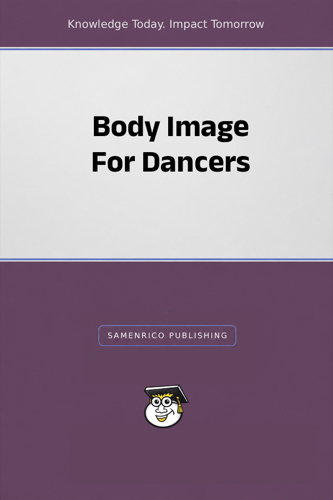
Body Image For Dancers
Protect your mental health in appearance-focused p
Protect your mental health in appearance-focused performance industries.
Formats
About this book
Free sample
Chapter 1: The Status Quo Body...--–- Who gets to be a dancer? Ask this question in any studio, and you will receive a thousand answers wrapped in silence. The youngest students will point to pictures on the wall—a principal in arabesque, a soloist in attitude, a corps de ballet in perfect unison. The older dancers will look at their own feet. The retired dancers will look away.
Beneath all these answers lies a truth that the dance world rarely speaks aloud: there is an invisible blueprint of the "correct" body, and most dancers spend their careers trying to fold themselves into a shape that was never designed to hold them.This chapter is about that blueprint. It is about the historical construction of the ideal dance body, the hidden curriculum that teaches dancers which bodies belong and which bodies must apologize for existing, and the psychological cost of chasing a standard that moves further away the harder you try. If you have ever stood at the barre and wondered why your hips are too wide, your thighs too muscular, your feet too flat, your chest too large, your ribs too visible, or your spine too curved, this chapter is for you. If you have ever been told that you have "the wrong body for dance" despite having the technique, the musicality, and the passion, this chapter is your evidence that the problem was never you.The Status Quo Body is not a neutral description. It is a weapon.The Invention of the Ideal The ideal dance body is not timeless.
It is not universal. It is not even particularly functional. It is a historical artifact, a collection of aesthetic preferences that congealed into orthodoxy at specific moments in time, driven by specific people with specific biases, and then calcified into tradition.Let us begin in 19th-century Paris, where Romantic ballet was inventing itself. The Romantic era gave us La Sylphide, Giselle, and the image of the ballerina as an ethereal, otherworldly creature—weightless, pale, thin, and fragile. These were not neutral artistic choices.
The Romantic ballet emerged alongside industrialization, urbanization, and a cultural panic about women's bodies. The ideal ballerina was everything a…
This is the end of the free sample. Get the eBook to keep going. Buy now
Contents
- Chapter 1
- Chapter 2
- Chapter 3
- Chapter 4
- Chapter 5
- Chapter 6
- Chapter 7
- Chapter 8
- Chapter 9
- Chapter 10
- Chapter 11
- Chapter 12
Details
- Author
- Mcewen Anibal
- Publisher
- SamEnrico
- Language
- English
- Genre
- Non-Fiction, Self-Help, Dance
- Released
- 2026-06-11
- Pages (approx.)
- 118
- Available as
- eBook, Audiobook

Read better in the ZLOADR app
Your eBooks on your phone or tablet. Sign in with your SamEnrico account and start reading.
More by Mcewen Anibal
 Commercial Real Estate Water RightsMcewen Anibal$11.99
 Reign Of Terror History HandbookMcewen Anibal$11.99
 Pattern Recognition for MindfulnessMcewen Anibal$11.99
 Pelvic Floor for MenMcewen Anibal$11.99
 Living Abroad in Spain ArbitrageMcewen Anibal$11.99
 Breaking the Cycle ManualMcewen Anibal$11.99
 Physical Anger Release GuideMcewen Anibal$11.99
 Meth Recovery Social Reconnection CourseMcewen Anibal$11.99
 The Vanishing of Flight 19: Lost in the Bermuda TriangleMcewen Anibal$11.99
 The Tides of Infinity: How Calculus Charted the Atlantic’s UnknownMcewen Anibal$11.99
 The Hollow Echo of the Vanishing IslandMcewen Anibal$11.99
 Understanding AmelogenesisMcewen Anibal$17.99
You may also like
 Hong Kong Handover 1997Dunn Johnnie$11.99
 Zumba For Postnatal Recovery CourseNeal Christian$11.99
 Zumba for BeginnersLadner Nikia$11.99
 YouTube Comment Mining GuideHumes Pandora$12.99
 Worry Box MeditationCarlin Rudy$11.99
 Workplace Stress MeditationNguyen Lynn$11.99
 Workplace Stress and Sleep RepairHawley Ivory$11.99
 Workplace Perfectionism CureDelaney Jeffry$11.99
 Workplace Injustice Anger GuideWallen Isabelle$11.99
 Work Addiction and Burnout LinkGreenwood Ester$11.99
 Women in Yoga and WellnessBeattie Galina$11.99
 Women in Stand Up ComedyChun Evangeline$11.99