
Non-FictionSelf-HelpIntuitive Eating
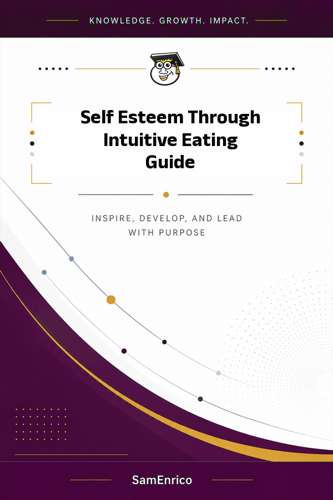
Self Esteem Through Intuitive Eating Guide eBook
Connects food freedom with improved body image and
Connects food freedom with improved body image and self worth.
Formats
Free sample
Chapter 1: The Self-Esteem Trap--–- You have been lied to. Not maliciously, not by any single person you can point to and blame, but systematically, beautifully, and dangerously. The lie sounds like hope. It sounds like empowerment. It sounds like the answer you have been searching for since the first time you looked in a mirror and felt something tighten in your chest.The lie is this: if you can just change your body, you will finally change your life.If you lose those fifteen pounds, you will be confident enough to ask for the promotion.
If you finally stick to the meal plan, you will feel worthy of that vacation, that relationship, that dress hanging in the back of your closet with the tags still on. If you can just look like the after picture, you will become the person you have always wanted to be—calm, magnetic, at peace, enough.This is the most seductive promise diet culture makes. And it is a complete and total fabrication.Here is what actually happens when you chase self-worth through weight loss: you start with hope, you follow the rules, you feel virtuous and in control, and then—inevitably, biologically, predictably—you eat something not on the plan. Or you skip a workout. Or the scale moves in the wrong direction despite your perfect compliance.
And in that moment, the promise collapses. You do not feel empowered. You feel ashamed. You tell yourself you have no willpower. You call yourself lazy, weak, undisciplined.
Your self-esteem, far from rising, plummets below where it started. And then, because the shame is unbearable, you either give up entirely or double down with even stricter rules, setting yourself up for an even harder crash.This is the self-esteem trap. And this book exists to spring it.The Anatomy of a Broken Promise Let us walk through the cycle slowly because it happens so fast in real life that most people never see its structure. Every diet, whether it is called a diet or rebranded as a "wellness reset," a "metabolic detox," or a "thirty-day transformation," follows the same emotional arc.Stage One: The Hope High. You decide to start on Monday.
You clean out your fridge. You buy the special shakes or the approved snacks or the meal prep containers. You feel electric with possibility. This time, you tell yourself, will be different. This time you have the right plan, the right motivation, the right reason.
You can already imagine the future you—thinner, happier, free. This stage feels wonderful. It feels like self-improvement. It feels like love.Stage Two: The Grind. The first few days are hard but satisfying.
You are saying no to things you want, and each no feels like a victory. You weigh yourself. You track your food. You feel disciplined. But slowly, the novelty wears off.
The food becomes boring. The cravings do not disappear the way the plan promised they would. You start to feel deprived, not empowered. You begin to fantasize about the foods you are not "allowed" to eat. This is not a moral failure; it is biology.
Restriction creates obsession. The more you tell yourself you cannot have something, the more your brain fixates on it.Stage Three: The Break. It happens on a Tuesday night, or after a stressful day at work, or at a birthday party where everyone else is eating cake. You eat something not on the plan. It might be one cookie.
It might be an entire pint of ice cream. The specific food does not matter. What matters is what happens next inside your head. The Diet Voice, which has been cheering for you all week, suddenly turns on you. You ruined it.
You have no self-control. Why do you always do this? What is wrong with you?Stage Four: The Shame Spiral. This is where the trap snaps shut. The shame is not just uncomfortable; it is physically and emotionally overwhelming.
To escape it, you do one of two things. Either you give up entirely—"I already messed up, I might as well eat everything and start over on Monday"—which leads to a binge. Or you double down on the rules, eating even less, exercising even more, trying to "earn back" your virtue. Both paths lead to the same destination: lower self-trust, lower self-worth, and a reinforced belief that you cannot be trusted around food.Stage Five: The Reset. Monday comes again.
Or the first of the month. Or your birthday. You find a new plan, a new promise, a new hope. And the entire cycle begins again.This is not a character flaw. This is not a lack of willpower.
This is the predictable, researched, inevitable outcome of a system designed to fail. Diets do not fail because you are weak. Diets fail because they are biologically and psychologically unsustainable for human beings. And the shame you feel when they fail is not a sign that you need more discipline. It is a sign that you have been sold a product that cannot deliver what it promised.Why Willpower Is Not the Answer One of the most damaging myths diet culture perpetuates is that thin people have more willpower than fat people.
This is not true. What thin people often have is a different relationship with food—not a stronger one. They are not fighting against their biology every day. They are not living in a state of chronic deprivation. They eat when they are hungry.
They stop when they are full. They eat cake at parties and salad for lunch and do not spend an hour feeling guilty about either choice. This is not willpower. This is freedom from the diet mentality.Research on willpower is remarkably consistent. Willpower is not a character trait you either have or do not have.
It is a finite resource that depletes with use. When you spend all day saying no to food, making constant decisions about what you can and cannot eat, you exhaust your cognitive reserves. By evening, you have less capacity to resist temptation—not because you are weak but because your brain is tired. This is called ego depletion, and it is one of the most replicated findings in social psychology.The solution is not to build more willpower. The solution is to stop relying on willpower entirely.
You do not need willpower to breathe or to sleep or to blink because those are automatic processes your body handles without conscious effort. The goal of intuitive eating is to make eating similarly automatic—a responsive, trusting relationship with your body rather than a battle between your will and your cravings.Dichotomous Thinking: The Cognitive Trap Diet culture thrives on a mental habit called dichotomous thinking. This is the tendency to split the world into binary opposites: good versus bad, success versus failure, on plan versus off plan. There is no gray area in diet culture. A food is either clean or dirty, permitted or forbidden, virtuous or sinful.
A day is either perfect or ruined. You are either being good or being bad.This kind of thinking is catastrophic for self-esteem because it leaves no room for being…
This is the end of the free sample. Get the eBook to keep going. Buy now
About this book
Details
- Author
- Jeffrey Dennise
- Publisher
- SamEnrico
- Language
- English
- Genre
- Non-Fiction, Self-Help, Intuitive Eating
- Released
- 2026-06-09
- Pages (approx.)
- 119
- Available as
- eBook, Audiobook

Read better in the ZLOADR app
Your eBooks on your phone or tablet. Sign in with your SamEnrico account and start reading.
More by Jeffrey Dennise
 Nobel Laureates In Climate EconomicsJeffrey Dennise$11.99
 Lip Licking as AnticipationJeffrey Dennise$11.99
 Jungle Trek to Lost CityJeffrey Dennise$11.99
 Aging Planning WorkbookJeffrey Dennise$11.99
 Saguaro National Park MysteriesJeffrey Dennise$11.99
 Meditation For Fatigue BeginnersJeffrey Dennise$11.99
 Executive Work Addiction GuideJeffrey Dennise$11.99
 The Secret League: How Women Smuggled Football into the SpotlightJeffrey Dennise$11.99
 Maui the Trickster: How the Sun Was TamedJeffrey Dennise$11.99
 Growing CrassulaJeffrey Dennise$11.99
 Advanced Solidity and Gas OptimizationJeffrey Dennise$11.99
 Magnetism Matter JEE GuideJeffrey Dennise$12.99
You may also like
 Hong Kong Handover 1997Dunn Johnnie$11.99
 Zumba For Postnatal Recovery CourseNeal Christian$11.99
 Zumba for BeginnersLadner Nikia$11.99
 YouTube Comment Mining GuideHumes Pandora$12.99
 Worry Box MeditationCarlin Rudy$11.99
 Workplace Stress MeditationNguyen Lynn$11.99
 Workplace Stress and Sleep RepairHawley Ivory$11.99
 Workplace Perfectionism CureDelaney Jeffry$11.99
 Workplace Injustice Anger GuideWallen Isabelle$11.99
 Work Addiction and Burnout LinkGreenwood Ester$11.99
 Women in Yoga and WellnessBeattie Galina$11.99
 Women in Stand Up ComedyChun Evangeline$11.99