
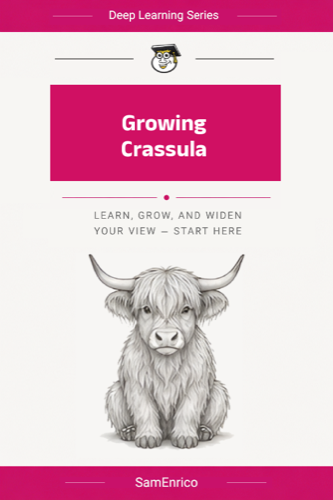
Growing Crassula
This publication, published by SamEnrico, covers G
This publication, published by SamEnrico, covers Growing Crassula
Formats
About this book
Free sample
Chapter 1: More Than Money Trees--When most people hear the word "Crassula," a single image comes to mind: the ubiquitous jade plant, often called the money tree, sitting on a grandmother's windowsill or occupying a forgotten corner of a dentist's waiting room. This is a botanical tragedy of the highest order. The genus Crassula encompasses approximately 150 to 200 recognized species, with additional subspecies and varieties bringing the total number of named taxa to well over three hundred. They range from tiny moss-like ground covers that form dense mats no taller than a finger's width, to shrubby trees that can reach six feet indoors and twice that in their native habitat. They produce leaves shaped like beads, like buttons, like pagodas, like miniature pine needles, like perfectly flat pancakes, like shimmering columns, and like something that might have drifted down from an alien planet.
They bloom in clouds of white, pink, yellow, and red. They thrive on neglect but reward attention. And yet, the average gardener knows only one.This book exists to correct that oversight.Growing Crassula is not merely a care manual, though it certainly provides that. It is an invitation to explore one of the most diverse, forgiving, and rewarding succulent genera on earth. It is a guide written for everyone from the complete novice who has killed every plant they have ever owned, to the advanced collector who can rattle off the differences between Crassula sericea subsp.
sericea and Crassula sericea var. velutina without breaking a sweat. The chapters that follow will take you from foundational botanical science to advanced propagation techniques, from basic watering wisdom to the art of training a fifty-year-old jade plant into a living bonsai masterpiece.But before we can grow Crassula well, we must first understand what Crassula is, where it came from, and why the very things that make it unusual also make it surprisingly easy to keep alive. This chapter lays that groundwork. We will explore the biological magic of CAM photosynthesis, the evolutionary journey that carried Crassula from the rocky slopes of South Africa to windowsills around the world, and the taxonomic…
This is the end of the free sample. Get the eBook to keep going. Buy now
Contents
- Chapter 1
- Chapter 2
- Chapter 3
- Chapter 4
- Chapter 5
- Chapter 6
- Chapter 7
- Chapter 8
- Chapter 9
- Chapter 10
- Chapter 11
- Chapter 12
Details
- Author
- Jeffrey Dennise
- Publisher
- SamEnrico
- Language
- English
- Genre
- Non-Fiction, Informative, Educational
- Released
- 2026-06-02
- Pages (approx.)
- 155
- Available as
- eBook, Audiobook

Read better in the ZLOADR app
Your eBooks on your phone or tablet. Sign in with your SamEnrico account and start reading.
More by Jeffrey Dennise
 Nobel Laureates In Climate EconomicsJeffrey Dennise$11.99
 Lip Licking as AnticipationJeffrey Dennise$11.99
 Self Esteem Through Intuitive Eating GuideJeffrey Dennise$11.99
 Jungle Trek to Lost CityJeffrey Dennise$11.99
 Aging Planning WorkbookJeffrey Dennise$11.99
 Saguaro National Park MysteriesJeffrey Dennise$11.99
 Meditation For Fatigue BeginnersJeffrey Dennise$11.99
 Executive Work Addiction GuideJeffrey Dennise$11.99
 The Secret League: How Women Smuggled Football into the SpotlightJeffrey Dennise$11.99
 Maui the Trickster: How the Sun Was TamedJeffrey Dennise$11.99
 Advanced Solidity and Gas OptimizationJeffrey Dennise$11.99
 Magnetism Matter JEE GuideJeffrey Dennise$12.99