
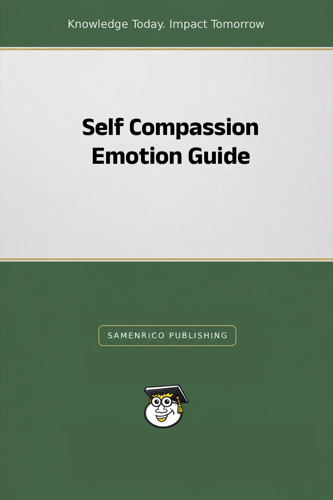
Non-FictionSelf-HelpSelf Compassion
Self Compassion Emotion Guide eBook
Kindness toward self during emotional difficulty.
by Ginn Ursula
Kindness toward self during emotional difficulty.
Formats
Free sample
Chapter 1: The Beast You Befriend--–- You are not broken for having a voice that tells you that you are broken. That voice, the one that whispers or shouts that you are not enough, that you have failed again, that everyone else seems to manage while you are falling apart, is not your enemy. It is, in fact, one of the most misunderstood protectors you will ever meet. This chapter opens with a paradox that will either unsettle you or relieve you deeply: the inner critic that calls you lazy, stupid, unlovable, or weak is actually trying to keep you safe. Evolutionarily, humans survived not by feeling good about themselves, but by scanning relentlessly for threats.
The tribe could not afford a member who was not vigilant about social standing, because social rejection meant expulsion, and expulsion from the tribe meant death. Your inner critic was born from that ancient alarm system. Its job was to anticipate danger, correct mistakes, and ensure you remained inside the circle of acceptance. In the modern world, where predators no longer chase us and ostracism is rarely fatal, this system backfires catastrophically. Instead of keeping you safe, it floods you with cortisol, shame, and paralysis.
But here is the truth that will change everything: you cannot kill the critic, and you should not try. The only way out is through. You must learn to recognize it, map it, and ultimately, befriend it.The Myth of the Enemy Within Most self-help literature treats the inner critic as an enemy to be silenced, destroyed, or overcome. This approach fails because it fights biology with willpower. Your critic is not a philosophical error; it is a neural pathway.
The more you fight it, the more you strengthen it. Think of a tug-of-war with a monster. The harder you pull, the more energy you feed into the struggle. The moment you drop the rope, the monster stumbles. Dropping the rope does not mean agreeing with the critic.
It means ceasing to argue. It means recognizing that the critic’s voice is a set of electrical impulses shaped by evolutionary necessity and personal history. This chapter will teach you to do something radically different from silencing. You will learn to map your critic’s tone, timing, triggers, and texture. You will learn to distinguish between the useful signal inside the noise and the toxic shame that keeps you small.
Most importantly, you will learn the single most important distinction in this entire book: the difference between guilt and shame.Guilt versus Shame: The Fork in the Road Guilt says, “I did a bad thing.” Shame says, “I am bad.” That one word changes everything. Guilt is behavioral. It focuses on a specific action that violated your values. Guilt can be useful because it motivates repair. You feel guilty, you apologize, you make amends, you learn, you move on.
Shame, by contrast, is identity-based. It does not say, “That was a hurtful thing to say.” It says, “I am a hurtful person.” Shame does not motivate repair; it motivates hiding, withdrawal, and self-attack. Shame is the engine of the inner critic’s most destructive cycles. When you fail at something, the critic could say, “That attempt did not work. What could you do differently?” That is guilt’s version.
But the critic rarely speaks that way. Instead, it says, “You always fail. You are a failure. Everyone can see it.” That is shame. And shame is toxic not because it feels bad, but because it shuts down the very neural circuits needed for learning and change.
f MRI studies show that shame activates the threat-defense system and deactivates the prefrontal cortex—the part of your brain required for problem-solving. In other words, shame literally makes you stupider in the moment you most need intelligence.A Unified Model of Shame: Three Components Throughout this book, we will use a single, unified model of shame. Every time you feel shame, you will experience three components, though one may be louder than the others depending on the situation. The first component is negative global self-judgment. This is the core belief that you are fundamentally flawed, defective, or unworthy.
It is not about what you did; it is about who you are. The second component is felt isolation. This is the crushing belief that you are the only one who fails, messes up, or feels this way. Everyone else seems to have it together. You are alone in your brokenness.
The third component is fear of exposure. This is the terror that if others saw the real you—the messy, failing, imperfect you—they would reject you completely. These three components always travel together, but different situations highlight different ones. A public mistake might trigger fear of exposure most strongly. A private failure might trigger negative self-judgment.
A comparison with a seemingly perfect peer might trigger felt isolation. By naming these three components, you gain the ability to dismantle shame piece by piece instead of being flooded by the whole wave. In Chapter 4, we will use this model to cultivate common humanity. In Chapter 10, we will return to it to understand why self-compassion sometimes hurts. For now, simply practice noticing: when you feel shame, which component is loudest?The Evolutionary Logic of Self-Criticism Why would evolution design a system that feels so terrible?
Because feeling terrible motivated our ancestors to change behavior before the tribe expelled them. Imagine an early human who failed to share food or angered a stronger member. The resulting shame spiral—negative self-judgment (“I am bad”), felt isolation (“Everyone hates me”), and fear of exposure (“They will cast me out”)—drove that human to engage in appeasement behaviors: groveling, hiding, hyper-vigilance. Those behaviors sometimes worked. The critic was not trying to make you miserable.
It was trying to keep you alive. The problem is that the system was calibrated for a world of small tribes and immediate physical danger. Today, you might feel the same shame spiral because you sent an email with a typo, or stumbled over words in a meeting, or gained five pounds. The threat is not exile from the tribe; it is a moment of social discomfort. But your nervous system cannot tell the difference.
To your amygdala, a critical comment from a boss is the same as a saber-toothed tiger. This is why the critic overreacts. It is not broken. It is doing exactly what it evolved to do. The problem is not the critic’s existence.
The problem is that we have never learned to update its software. This book is that software update.Mapping Your Critic Without Declaring War Before you can befriend the critic, you must see it clearly. Most people live inside their critic’s voice like a fish lives in water—unaware of the medium because it is everywhere. This chapter introduces a practice called the Critic Map. You will need a notebook or a digital document.
For one week, you will track every instance of self-criticism, but not with the goal of stopping it. With the goal of cataloging it. Each time you notice the critic, write down four things. First, the trigger: what happened right before the critic…
This is the end of the free sample. Get the eBook to keep going. Buy now
About this book
Details
- Author
- Ginn Ursula
- Publisher
- SamEnrico
- Language
- English
- Genre
- Non-Fiction, Self-Help, Self Compassion
- Released
- 2026-06-11
- Pages (approx.)
- 124
- Available as
- eBook, Audiobook

Read better in the ZLOADR app
Your eBooks on your phone or tablet. Sign in with your SamEnrico account and start reading.
More by Ginn Ursula
 Gambling Addiction For DiplomatsGinn Ursula$11.99
 Sober Morning Routine ManualGinn Ursula$11.99
 Myanmar Rohingya FamilyGinn Ursula$11.99
 Outsourcing SOP Creation GuideGinn Ursula$11.99
 Crowdfunding Accounting GuideGinn Ursula$11.99
 Antwerp Heist Inside JobGinn Ursula$11.99
 Deepak Chopra JourneyGinn Ursula$11.99
 The Silk Road Kingpin: How a Quiet Chemist Built a Global EmpireGinn Ursula$11.99
 The Poisoned Chalice: Lebanon's Deadly Political Assassinations (1970s-1980s)Ginn Ursula$11.99
 How to Produce StickersGinn Ursula$11.99
 How to Become a Roll ExaminerGinn Ursula$11.99
 A Collector's Handbook to the Dodge D11Ginn Ursula$11.99
You may also like
 Hong Kong Handover 1997Dunn Johnnie$11.99
 Zumba For Postnatal Recovery CourseNeal Christian$11.99
 Zumba for BeginnersLadner Nikia$11.99
 YouTube Comment Mining GuideHumes Pandora$12.99
 Worry Box MeditationCarlin Rudy$11.99
 Workplace Stress MeditationNguyen Lynn$11.99
 Workplace Stress and Sleep RepairHawley Ivory$11.99
 Workplace Perfectionism CureDelaney Jeffry$11.99
 Workplace Injustice Anger GuideWallen Isabelle$11.99
 Work Addiction and Burnout LinkGreenwood Ester$11.99
 Women in Yoga and WellnessBeattie Galina$11.99
 Women in Stand Up ComedyChun Evangeline$11.99