
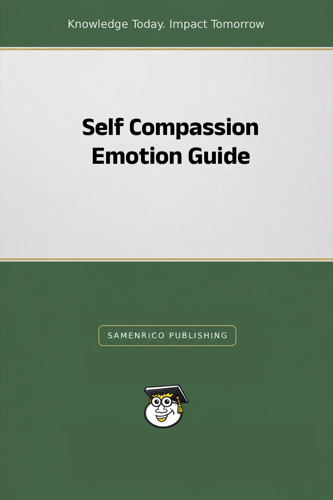
Non-FictionSelf-HelpSelf Compassion
Self Compassion Emotion Guide Audiobook
Kindness toward self during emotional difficulty.
by Ginn Ursula
Kindness toward self during emotional difficulty.
Formats
Free sample
Chapter 1: The Beast You Befriend--–- You are not broken for having a voice that tells you that you are broken. That voice, the one that whispers or shouts that you are not enough, that you have failed again, that everyone else seems to manage while you are falling apart, is not your enemy. It is, in fact, one of the most misunderstood protectors you will ever meet. This chapter opens with a paradox that will either unsettle you or relieve you deeply: the inner critic that calls you lazy, stupid, unlovable, or weak is actually trying to keep you safe. Evolutionarily, humans survived not by feeling good about themselves, but by scanning relentlessly for threats.
The tribe could not afford a member who was not vigilant about social standing, because social rejection meant expulsion, and expulsion from the tribe meant death. Your inner critic was born from that ancient alarm system. Its job was to anticipate danger, correct mistakes, and ensure you remained inside the circle of acceptance. In the modern world, where predators no longer chase us and ostracism is rarely fatal, this system backfires catastrophically. Instead of keeping you safe, it floods you with cortisol, shame, and paralysis.
But here is the truth that will change everything: you cannot kill the critic, and you should not try. The only way out is through. You must learn to recognize it, map it, and ultimately, befriend it.The Myth of the Enemy Within Most self-help literature treats the inner critic as an enemy to be silenced, destroyed, or overcome. This approach fails because it fights biology with willpower. Your critic is not a philosophical error; it is a neural pathway.
The more you fight it, the more you strengthen it. Think of a tug-of-war with a monster. The harder you pull, the more energy you feed into the struggle. The moment you drop the rope, the monster stumbles. Dropping the rope does not mean agreeing with the critic.
It means ceasing to argue. It means recognizing that the critic’s voice is a set of electrical impulses shaped by evolutionary necessity and personal history. This chapter will teach you to do something radically different from silencing. You will learn to map your critic’s tone, timing, triggers, and texture. You will learn to distinguish between the useful signal inside the noise and the toxic shame that keeps you small.
Most importantly, you will learn the single most important distinction in this entire book: the difference between guilt and shame.Guilt…
This is the end of the free sample. Get the Audiobook to keep going. Buy now
About this book
Details
- Author
- Ginn Ursula
- Publisher
- SamEnrico
- Language
- English
- Genre
- Non-Fiction, Self-Help, Self Compassion
- Released
- 2026-06-11
- Pages (approx.)
- 124
- Available as
- eBook, Audiobook

Listen in the VoxFlicks app
Audiobooks and audio dramas wherever you go. Sign in with your SamEnrico account and press play.
More by Ginn Ursula
 Gambling Addiction For DiplomatsGinn Ursula$11.99
 Sober Morning Routine ManualGinn Ursula$11.99
 Myanmar Rohingya FamilyGinn Ursula$11.99
 Outsourcing SOP Creation GuideGinn Ursula$11.99
 Crowdfunding Accounting GuideGinn Ursula$11.99
 Antwerp Heist Inside JobGinn Ursula$11.99
 Deepak Chopra JourneyGinn Ursula$11.99
 The Silk Road Kingpin: How a Quiet Chemist Built a Global EmpireGinn Ursula$11.99
 The Poisoned Chalice: Lebanon's Deadly Political Assassinations (1970s-1980s)Ginn Ursula$11.99
 How to Produce StickersGinn Ursula$11.99
 How to Become a Roll ExaminerGinn Ursula$11.99
 A Collector's Handbook to the Dodge D11Ginn Ursula$11.99
You may also like
 Hong Kong Handover 1997Dunn Johnnie$11.99
 Zumba For Postnatal Recovery CourseNeal Christian$11.99
 Zumba for BeginnersLadner Nikia$11.99
 YouTube Comment Mining GuideHumes Pandora$12.99
 Worry Box MeditationCarlin Rudy$11.99
 Workplace Stress MeditationNguyen Lynn$11.99
 Workplace Stress and Sleep RepairHawley Ivory$11.99
 Workplace Perfectionism CureDelaney Jeffry$11.99
 Workplace Injustice Anger GuideWallen Isabelle$11.99
 Work Addiction and Burnout LinkGreenwood Ester$11.99
 Women in Yoga and WellnessBeattie Galina$11.99
 Women in Stand Up ComedyChun Evangeline$11.99