
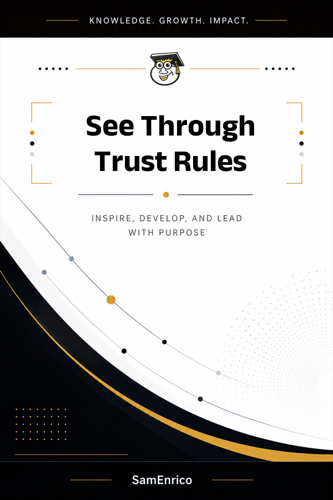
Non-FictionBusiness Brief / Trust Law
See Through Trust Rules eBook
undefined
by Beal Carmen
undefined
Formats
Free sample
Chapter 1: The Gut Lie--–- It was 3:47 on a Tuesday afternoon when Mark signed the contract that would cost his company $2.4 million.He remembered the moment vividly, not because of the signing itself, but because of the feeling that preceded it. For three weeks, something had nagged at him. A whisper in the back of his mind. A faint, wordless unease every time he sat across from the charming, confident entrepreneur who promised revolutionary software and a partnership that would transform their business.Mark liked the guy. Everyone liked the guy.
He had a firm handshake, made eye contact, laughed at Mark’s jokes, and remembered the names of Mark’s children. In every meeting, he projected certainty and warmth. Mark’s gut said: This is a good person. You can trust him.But another part of Mark—a quieter, less articulate part—felt the unease. He couldn’t name it.
There was no evidence, no red flag he could point to. Just a sensation. A slight tension in his chest when the entrepreneur talked about their “shared vision.” A flicker of doubt when the financial projections seemed just a little too perfect.Mark did what most people do when their gut sends mixed signals. He ignored the quiet unease and listened to the loud, positive feeling. He trusted his instinct.
He liked the guy, so he signed.Six months later, the software didn’t exist. The entrepreneur had fabricated client testimonials, inflated user numbers, and diverted the upfront payment to a shell company. Mark’s company lost $2.4 million. He lost his bonus, his team lost their morale, and Mark lost something even harder to quantify: his confidence in his own judgment.“I knew something was wrong,” he told the author in an interview for this book. “I felt it.
But I told myself I was being paranoid. I trusted my gut, and my gut was wrong.”This is the central tragedy of trust. Not that we are bad at reading people—though we often are. But that we have been taught to rely on a compass that points in the wrong direction half the time and calls itself intuition.The Intuition Trap Mark’s story is not unusual. In fact, it is so common that psychologists have a name for the phenomenon: affective trust bias—the tendency to trust people based on how they make us feel rather than on evidence of their behavior.The word “intuition” sounds almost mystical.
It carries the weight of ancient wisdom, gut-level knowing, and the romantic idea that our bodies perceive truth before our minds catch up. But here is the uncomfortable reality that most self-help books will not tell you: Raw, unexamined intuition is not a reliable lie detector. It is often a liability.Let us be precise about what we mean, because this distinction will shape the entire book.There are two kinds of intuition.The first is raw intuition—the automatic, unexamined feeling that arises from your brain’s fastest, most primitive processing systems. This is the “gut feeling” that tells you someone is trustworthy because they smile warmly, speak confidently, or remind you of your favorite uncle. Raw intuition is fast, effortless, and frequently wrong.
It is shaped by your childhood attachments, your cultural conditioning, your recent mood, and a hundred other variables that have nothing to do with the actual trustworthiness of the person in front of you.The second is trained intuition—the rapid pattern recognition that emerges after you have systematically studied a subject. A firefighter who can sense that a burning building is about to collapse is not relying on raw intuition. He is relying on decades of experience, thousands of prior observations, and a mental database of subtle cues that he has learned to recognize through deliberate practice. His intuition is earned.Here is the central argument of this chapter—and of this book: Raw intuition is a dangerous myth. Trained intuition is a valuable skill.
And the only path from the former to the latter is systematic, deliberate practice.Most people never make the journey. They wander through life trusting their raw gut feelings, getting burned by betrayals, and then swinging to the opposite extreme—“I’ll never trust anyone again”—only to repeat the cycle with the next charming person who comes along.This book exists to break that cycle.What the Research Actually Says Linda K. Stroh, whose research anchors much of this book, spent years studying how people make trust decisions in high-stakes environments. Her findings are sobering.In controlled studies, people performed no better than chance at detecting whether a stranger was lying or telling the truth. Not slightly better.
Not a little above average. Exactly at chance—fifty percent. A coin flip would have served them as well as their “gut.”Even more disturbing: people were most confident in their judgments when they were most wrong. The ones who said “I can always tell when someone is lying” were the worst detectors. Their confidence was not a sign of skill.
It was a symptom of self-deception.Why are we so bad at this? Evolution offers a compelling explanation.For most of human history, social harmony was more valuable than accuracy. Our ancestors lived in small tribes where survival depended on cooperation. Being able to detect every single lie was less important than maintaining enough trust to hunt together, share food, and defend against predators. The human brain evolved to prioritize connection over correction.This means you are neurologically predisposed to believe people.
Your brain defaults to trust because, for 99 percent of human history, that was the safer bet. The person standing in front of you was probably a member of your tribe, not a stranger trying to deceive you.But you do not live in a tribe anymore. You live in a world of anonymous transactions, professional negotiations, and relationships that cross social boundaries your ancestors never encountered. Your ancient brain is trying to navigate a modern world with tools designed for a very different environment.This is not a moral failing. It is a design feature.
But it is a feature that requires a workaround.The High Cost of Betrayal Before we go further, let us pause and acknowledge why this matters. Betrayal is not a minor inconvenience. It is not something you “get over” if you are strong enough. The cost of misplaced trust is measurable, pervasive, and often devastating.Financial costs. Corporate fraud costs organizations an estimated 5 percent of annual revenues—over $4.5 trillion globally each year.
But the financial toll is not limited to Enron-level scandals. Every day, people make bad hires, sign bad contracts, partner with unreliable vendors, and invest in ventures led by untrustworthy people. Each of these decisions traces back to a failure of trust assessment.Career costs. The wrong mentor can derail your trajectory. The wrong boss can take credit for your work and blame you for their failures.
The wrong colleague can sabotage your projects while smiling to your face. These are not abstract risks. They are daily realities in every organization.Health costs. The stress of betrayal triggers measurable physiological responses: elevated cortisol, disrupted sleep, impaired immune function. People who…
This is the end of the free sample. Get the eBook to keep going. Buy now
About this book
Details
- Author
- Beal Carmen
- Publisher
- SamEnrico
- Language
- English
- Genre
- Non-Fiction, Business Brief / Trust Law
- Released
- 2026-06-07
- Pages (approx.)
- 139
- Available as
- eBook, Audiobook

Read better in the ZLOADR app
Your eBooks on your phone or tablet. Sign in with your SamEnrico account and start reading.
More by Beal Carmen
 FCPA Declination DecisionsBeal Carmen$11.99
 Tourist Driving Patience GuideBeal Carmen$11.99
 Stolen Diamond Smuggling NetworkBeal Carmen$11.99
 Opioid Recovery and LonelinessBeal Carmen$11.99
 Bipolar Crisis Response HandbookBeal Carmen$11.99
 Imposter Syndrome for ConsultantsBeal Carmen$11.99
 Walking Before Bed ProtocolBeal Carmen$11.99
 PMS Relief Nutrition GuideBeal Carmen$11.99
 Whispers in the Pines: The Vanishing of the Boy ScoutsBeal Carmen$11.99
 The Burning of Washington: America's Capital in FlamesBeal Carmen$11.99
 The Last Oracle of Delphi: When the Gods Stopped SpeakingBeal Carmen$11.99
 Growing Raphia (Raffia)Beal Carmen$11.99
You may also like
 Hong Kong Handover 1997Dunn Johnnie$11.99
 Zumba For Postnatal Recovery CourseNeal Christian$11.99
 Zumba for BeginnersLadner Nikia$11.99
 YouTube Comment Mining GuideHumes Pandora$12.99
 Worry Box MeditationCarlin Rudy$11.99
 Workplace Stress MeditationNguyen Lynn$11.99
 Workplace Stress and Sleep RepairHawley Ivory$11.99
 Workplace Perfectionism CureDelaney Jeffry$11.99
 Workplace Injustice Anger GuideWallen Isabelle$11.99
 Work Addiction and Burnout LinkGreenwood Ester$11.99
 Women in Yoga and WellnessBeattie Galina$11.99
 Women in Stand Up ComedyChun Evangeline$11.99