
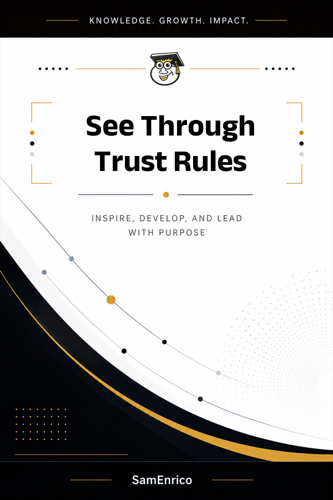
Non-FictionBusiness Brief / Trust Law
See Through Trust Rules Audiobook
undefined
by Beal Carmen
undefined
Formats
Free sample
Chapter 1: The Gut Lie--–- It was 3:47 on a Tuesday afternoon when Mark signed the contract that would cost his company $2.4 million.He remembered the moment vividly, not because of the signing itself, but because of the feeling that preceded it. For three weeks, something had nagged at him. A whisper in the back of his mind. A faint, wordless unease every time he sat across from the charming, confident entrepreneur who promised revolutionary software and a partnership that would transform their business.Mark liked the guy. Everyone liked the guy.
He had a firm handshake, made eye contact, laughed at Mark’s jokes, and remembered the names of Mark’s children. In every meeting, he projected certainty and warmth. Mark’s gut said: This is a good person. You can trust him.But another part of Mark—a quieter, less articulate part—felt the unease. He couldn’t name it.
There was no evidence, no red flag he could point to. Just a sensation. A slight tension in his chest when the entrepreneur talked about their “shared vision.” A flicker of doubt when the financial projections seemed just a little too perfect.Mark did what most people do when their gut sends mixed signals. He ignored the quiet unease and listened to the loud, positive feeling. He trusted his instinct.
He liked the guy, so he signed.Six months later, the software didn’t exist. The entrepreneur had fabricated client testimonials, inflated user numbers, and diverted the upfront payment to a shell company. Mark’s company lost $2.4 million. He lost his bonus, his team lost their morale, and Mark lost something even harder to quantify: his confidence in his own judgment.“I knew something was wrong,” he told the author in an interview for this book. “I felt it.
But I told myself I was being paranoid. I trusted my gut, and my gut was wrong.”This is the central tragedy of trust. Not that we are bad at reading people—though we often are. But that we have been taught to rely on a compass that points in the wrong direction half the time and calls itself intuition.The Intuition Trap Mark’s story is not unusual. In fact, it is so common that psychologists have a name for the phenomenon: affective trust bias—the tendency to trust people based on how they make us feel rather than on evidence of their behavior.The…
This is the end of the free sample. Get the Audiobook to keep going. Buy now
About this book
Details
- Author
- Beal Carmen
- Publisher
- SamEnrico
- Language
- English
- Genre
- Non-Fiction, Business Brief / Trust Law
- Released
- 2026-06-07
- Pages (approx.)
- 139
- Available as
- eBook, Audiobook

Listen in the VoxFlicks app
Audiobooks and audio dramas wherever you go. Sign in with your SamEnrico account and press play.
More by Beal Carmen
 FCPA Declination DecisionsBeal Carmen$11.99
 Tourist Driving Patience GuideBeal Carmen$11.99
 Stolen Diamond Smuggling NetworkBeal Carmen$11.99
 Opioid Recovery and LonelinessBeal Carmen$11.99
 Bipolar Crisis Response HandbookBeal Carmen$11.99
 Imposter Syndrome for ConsultantsBeal Carmen$11.99
 Walking Before Bed ProtocolBeal Carmen$11.99
 PMS Relief Nutrition GuideBeal Carmen$11.99
 Whispers in the Pines: The Vanishing of the Boy ScoutsBeal Carmen$11.99
 The Burning of Washington: America's Capital in FlamesBeal Carmen$11.99
 The Last Oracle of Delphi: When the Gods Stopped SpeakingBeal Carmen$11.99
 Growing Raphia (Raffia)Beal Carmen$11.99
You may also like
 Hong Kong Handover 1997Dunn Johnnie$11.99
 Zumba For Postnatal Recovery CourseNeal Christian$11.99
 Zumba for BeginnersLadner Nikia$11.99
 YouTube Comment Mining GuideHumes Pandora$12.99
 Worry Box MeditationCarlin Rudy$11.99
 Workplace Stress MeditationNguyen Lynn$11.99
 Workplace Stress and Sleep RepairHawley Ivory$11.99
 Workplace Perfectionism CureDelaney Jeffry$11.99
 Workplace Injustice Anger GuideWallen Isabelle$11.99
 Work Addiction and Burnout LinkGreenwood Ester$11.99
 Women in Yoga and WellnessBeattie Galina$11.99
 Women in Stand Up ComedyChun Evangeline$11.99