
Non-FictionInformativeEducational
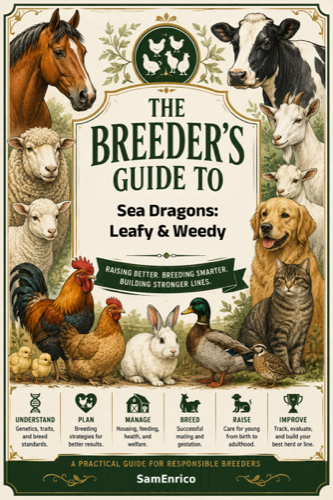
Sea Dragons: Leafy & Weedy eBook
This wildlife publication, published by SamEnrico,
by Wyman Yang
This wildlife publication, published by SamEnrico, covers Sea Dragons: Leafy & Weedy
Formats
Free sample
Chapter 1: The Ghost in the Kelp--The first time Dr. Emma Witney saw a leafy sea dragon, she almost swam right past it. That was the point, of course. The creature had spent fifty million years perfecting the art of not being seen. But on that February morning in 2011, as a twenty-four-year-old graduate student descending through the cold green waters of South Australia’s Rapid Bay, she wasn’t looking for perfection.
She was looking for kelp. The transect was supposed to be a simple one: document the density of the giant kelp forest, measure water temperature, collect sediment samples. The sea dragon was an accident. It drifted into her peripheral vision like a piece of torn seaweed, its leaf-like appendages swaying in the surge. She turned her head.
The seaweed had eyes. Two small, dark, perfectly aware eyes watched her from inside a tangle of what looked like living lace. She stopped kicking. For ten seconds, neither of them moved. Then the dragon gave a gentle flick of its translucent fins and disappeared back into the forest, becoming, once again, a piece of the scenery.
Emma surfaced with her heart pounding. She called her advisor from the dock. “I found one,” she said. “A leafy. A big one.” Her advisor paused.
“Don’t get attached,” he said. “They don’t last.”Twelve years later, Emma Witney stood on the same dock, staring at the same water, and wondered if he had been right all along.The Disappearance It was February 2023, the height of the Australian summer, and Emma had just completed her tenth dive of the season. The data sheet in her waterproof notebook told a story she did not want to believe. Transect one: zero dragons. Transect two: zero.
Transect three through twelve: zero. She had surveyed the same fifty-meter line she had first laid down as a graduate student, the line that had once held one of the densest populations of leafy sea dragons ever recorded. In 2011, she had counted twenty-three individuals in a single dive. In 2015, eighteen. In 2019, eleven.
Now, in 2023, she had completed her tenth dive without seeing a single one.The kelp forest itself was dying. What had once been a cathedral of golden-brown fronds reaching toward the surface had become a graveyard of stumps. The water was too warm. A marine heatwave had parked itself off the coast of South Australia in December, pushing water temperatures five degrees Celsius above the summer average. Giant kelp, Macrocystis pyrifera, cannot tolerate prolonged heat.
It begins to bleach at twenty-two degrees Celsius. By twenty-four, it dies. Rapid Bay had hit twenty-five in January.Emma sat on the dock, her dive gear spread around her like the shed skin of some mechanical reptile, and tried to remember the last time she had seen a leafy dragon here. It had been October. A small male, maybe two years old, carrying a brood of eggs on his tail.
She had photographed him, noted his location, given him a code in her database: RB-204. She had assumed she would see him again. She had been wrong.The Question That Drove Her Emma had not set out to study sea dragons. She had set out to study kelp. But the dragons had found her, as they find everyone who spends enough time in the Great Southern Reef, and they had refused to let go.
The question that consumed her was deceptively simple: how does an animal that looks like a piece of ornamental foliage survive in a world full of hungry mouths, shifting currents, and now, a rapidly warming ocean?The answer, she had learned over twelve years of diving, was that sea dragons survive by being almost impossibly good at three things. First, camouflage so perfect that it borders on the supernatural. Second, reproduction so strange that it rewires the very definition of fatherhood. And third, patience so extreme that a single dragon might spend its entire five-to-ten-year lifespan within a hundred-meter stretch of kelp forest.But patience, Emma had come to understand, is not the same thing as resilience. A creature that never leaves home is a creature with nowhere to go when home becomes uninhabitable.The Book You Are About to Read This book is the story of that creature.
It is the story of the leafy sea dragon, Phycodurus eques, and its hardier cousin, the weedy sea dragon, Phyllopteryx taeniolatus. It is a story about evolution’s wildest experiments, about male pregnancy and living camouflage, about a hidden reef off the coast of Australia that most people have never heard of, and about the scientists, divers, and citizen activists who are racing to understand these animals before they vanish.But it is also a story about loss. Because when Emma Witney surfaced from her final dive in February 2023 and recorded her data, she knew what the numbers meant. The Rapid Bay population of leafy sea dragons—one of the most studied and photographed in the world—had collapsed.The question was no longer whether they would survive. The question was whether anyone would notice.What Are Sea Dragons, Exactly?Before we go any further, let us be clear about what sea dragons are not.
They are not seahorses, though they are cousins. They are not plants, though they look like them. They are not mythical creatures, though their name suggests otherwise. Sea dragons are fish. Bony fish, to be precise, belonging to the family Syngnathidae, which also includes seahorses and pipefish.
The name Syngnathidae comes from the Greek words syn (together) and gnathos (jaw), a reference to their fused, tube-like snouts.There are three known species of sea dragon in the world. The leafy sea dragon, Phycodurus eques, is the showstopper. Its body is covered in elaborate, leaf-like appendages that provide near-perfect camouflage in kelp forests. The weedy, or common, sea dragon, Phyllopteryx taeniolatus, is more understated, with simpler appendages and a reddish coloring accented by yellow spots and purple stripes. The third species, the ruby sea dragon, Phyllopteryx dewysea, was discovered only in 2015 and is so rarely seen that scientists have never photographed a living adult in the wild.All three species are found exclusively in the temperate waters of southern Australia.
None of them exist anywhere else on Earth.The Family They Left Behind To understand sea dragons, you have to understand the family they left behind. Seahorses, the most famous members of the Syngnathidae, evolved a suite of adaptations that made them successful in tropical and temperate waters worldwide: a prehensile tail for grasping seagrass, an upright swimming posture, and a brood pouch in which males carry fertilized eggs.Sea dragons abandoned all of that.Why? The leading hypothesis is that sea dragons evolved to exploit a very specific ecological niche: the dense, cold-water kelp forests of the Great Southern Reef. In these forests, hanging onto vegetation is less important than blending into it. A prehensile tail, useful for anchoring in seagrass, becomes a liability when you need to sway like a piece of drifting kelp.
So sea dragons lost it. Their tails are straight and rigid, fused like a pipefish’s.They also lost the ability to curl into the classic seahorse S-shape. Instead, they swim…
This is the end of the free sample. Get the eBook to keep going. Buy now
About this book
Details
- Author
- Wyman Yang
- Publisher
- SamEnrico
- Language
- English
- Genre
- Non-Fiction, Informative, Educational
- Released
- 2026-05-25
- Pages (approx.)
- 107
- Available as
- eBook, Audiobook

Read better in the ZLOADR app
Your eBooks on your phone or tablet. Sign in with your SamEnrico account and start reading.
More by Wyman Yang
 Retirement EQ GuideWyman Yang$11.99
 Group Creative Leadership CourseWyman Yang$11.99
 Melatonin and Jet Lag RecoveryWyman Yang$11.99
 Senior Financial ConfidenceWyman Yang$11.99
 Child Bite Mark CasesWyman Yang$11.99
 Self Hypnosis for EmetophobiaWyman Yang$11.99
 Massage For AnxietyWyman Yang$11.99
 Acupuncture for AnxietyWyman Yang$11.99
 The Olympic Riots of 508 BC: When Athens and Sparta Turned the Games into WarWyman Yang$11.99
 The Unseen Crown: How Lady Bird Johnson Shaped America's LandscapeWyman Yang$11.99
 How to Produce Photo StorageWyman Yang$11.99
 How to Produce Decorative TraysWyman Yang$11.99
You may also like
 Hong Kong Handover 1997Dunn Johnnie$11.99
 Zumba For Postnatal Recovery CourseNeal Christian$11.99
 Zumba for BeginnersLadner Nikia$11.99
 YouTube Comment Mining GuideHumes Pandora$12.99
 Worry Box MeditationCarlin Rudy$11.99
 Workplace Stress MeditationNguyen Lynn$11.99
 Workplace Stress and Sleep RepairHawley Ivory$11.99
 Workplace Perfectionism CureDelaney Jeffry$11.99
 Workplace Injustice Anger GuideWallen Isabelle$11.99
 Work Addiction and Burnout LinkGreenwood Ester$11.99
 Women in Yoga and WellnessBeattie Galina$11.99
 Women in Stand Up ComedyChun Evangeline$11.99