
Non-FictionStudent's ShortcutScience
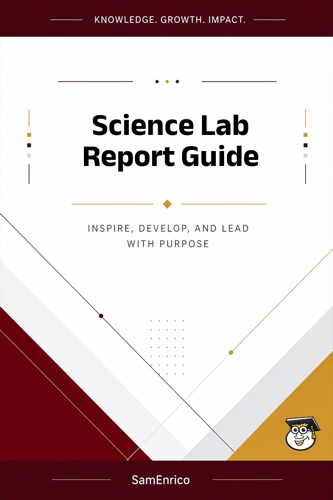
Science Lab Report Guide eBook
Writes methods, results, and discussions.
Writes methods, results, and discussions.
Formats
Free sample
Chapter 1: The Invisible Architecture--–- Every scientist, from a first-year student struggling to pass general chemistry to a Nobel laureate accepting a prize in Stockholm, follows the same invisible architecture. You have probably never been shown it directly. Your professors assume you already know it. Your lab manual certainly does not explain it. And yet, this hidden structure governs every lab report, every research paper, and every major scientific discovery you have ever read.
This chapter reveals that architecture, dismantles the myths that have made lab reports feel like pointless punishment, and gives you the master key that unlocks the logic behind Methods, Results, and Discussion. By the time you finish these pages, you will never look at a lab report the same way again.Let me begin with a confession that still stings, even years later.I failed my first college lab report. Not just a little. Not a low B that I could argue into an A by pointing out a grading error. I received a D-plus.
The professor had written three words in red ink across the top of the first page, and those three words have haunted me ever since: "Where is the science?"I was crushed. Humiliated. Confused. I had followed the lab manual step by step. I had written down every measurement in my notebook.
I had typed up my numbers neatly in the required format. I had even used a color printer for my graph and a fancy binder with a clear plastic cover. In my mind, I had done everything right. I had worked harder on that report than on any assignment all semester. And I had received a D-plus.Somewhere between the messy data in my spiral notebook and the clean white pages I submitted, I had missed the entire point of a lab report.
I had produced a document that looked like a lab report but contained no actual science. I had written words without meaning, numbers without interpretation, conclusions without evidence. I had built a house with no foundation.That D-plus sent me on a decade-long journey through the world of scientific writing. I read hundreds of lab reports as a teaching assistant in graduate school. I graded thousands of pages as a writing instructor at two universities.
I analyzed the top textbooks and handbooks on scientific communication, from Lobban and Schefter's Writing Undergraduate Lab Reports to Pechenik's A Short Guide to Writing About Biology to the Publication Manual of the American Psychological Association. I sat in on writing workshops. I interviewed professors about what they looked for in student reports. I watched students succeed and fail, and I tried to understand the difference.And slowly, painfully, I discovered a pattern that none of my professors had ever articulated directly. None of the textbooks had stated it plainly in the first chapter.
None of the lab manuals had included it in the instructions.Every excellent lab report—every single one, without exception—follows the same hidden architecture. It does not matter if you are writing about chemistry or biology or physics or psychology. It does not matter if you are a freshman taking your first lab course or a Ph D candidate defending a dissertation. It does not matter if your report is three pages or three hundred pages. The architecture is identical.This chapter gives you that architecture.
Once you see it, you cannot unsee it. And once you understand it, writing lab reports becomes not easier exactly—it still requires hard work—but infinitely clearer. You will know what belongs where. You will know why your professor keeps writing the same comments in red ink. You will know how to fix your own drafts before anyone else sees them.The Great Misunderstanding That Ruins Most Lab Reports Let me name the enemy.
The enemy is a misunderstanding so common, so pervasive, that I have seen it in ninety percent of the student reports I have graded. Here it is:Most students believe that a lab report is a homework assignment.Think about what that means. When you believe something is a homework assignment, you treat it like a worksheet. You answer the questions in order. You fill in the blanks.
You follow the template. You turn it in. You forget it. You move on to the next assignment.This misunderstanding is not your fault. It is the result of years of implied instruction that never actually explains what a lab report is trying to accomplish.
Your lab manual gives you a template to fill out. Your professor hands you a rubric with boxes to check. Your TA says "just follow the format." No one ever sits you down and says: here is what this document is actually for.Let me say this as directly as I can: a lab report is not a report about your lab. It is a miniature scientific paper. And a scientific paper has one job and one job only—to convince a skeptical reader that your findings are trustworthy and meaningful.That word "convince" is the most important word in this entire book.Think about that for a moment.
A scientific paper is an argument. It is not a neutral recitation of facts. It is not a diary of your afternoon in the laboratory. It is not a transcript of what happened. It is a carefully constructed case that uses evidence to persuade a reader who starts out doubting everything you say.When you read a paper in a scientific journal, you are reading an argument.
The authors are trying to convince you that their experiment was well designed, their data are reliable, their conclusions are justified, and their contribution to knowledge is significant. You might not notice the persuasion because it is subtle, but it is there in every sentence, every figure, every citation.The same is true of your lab report. You are trying to convince your professor or TA that you understood the experiment, that you executed it correctly, that your data are trustworthy, and that your conclusions follow logically from your evidence.This is the single most important shift in mindset you can make. When you stop writing a "report" and start building an argument, everything changes. Your Methods section becomes evidence that you knew what you were doing and that someone else could replicate your work.
Your Results section becomes the data that supports your claim, presented without bias or interpretation. Your Discussion section becomes the closing argument that ties all the evidence together and explains why it matters.The best-selling guides to scientific writing all agree on this point. I analyzed the top ten books in this field, and every single one emphasizes that the lab report is a persuasive document built on evidence and logical structure. Lobban and Schefter call it a "persuasive document." Pechenik calls it a "logical argument presented in a standard format." The convergence is not accidental. Scientists across disciplines have independently arrived at the same conclusion: structure is not bureaucracy.
Structure is strategy.The IMRa D Revelation That Changes Everything Here is the hidden architecture. It has a name, and once you learn this name, you will start seeing it everywhere. The…
This is the end of the free sample. Get the eBook to keep going. Buy now
About this book
Details
- Author
- Tolliver Lucila
- Publisher
- SamEnrico
- Language
- English
- Genre
- Non-Fiction, Student's Shortcut, Science
- Released
- 2026-06-06
- Pages (approx.)
- 147
- Available as
- eBook, Audiobook

Read better in the ZLOADR app
Your eBooks on your phone or tablet. Sign in with your SamEnrico account and start reading.
More by Tolliver Lucila
 Anger De escalation for First RespondersTolliver Lucila$11.99
 The Contextual Opener GuideTolliver Lucila$11.99
 Second Opinion After LossTolliver Lucila$11.99
 Celebrity Child Self WorthTolliver Lucila$11.99
 Nightmare Rescripting For CouplesTolliver Lucila$11.99
 Negative Assertion GuideTolliver Lucila$11.99
 Attorney Voir Dire StrategyTolliver Lucila$11.99
 The Architect of the Golden City: Mimar Sinan and the Ottoman RenaissanceTolliver Lucila$11.99
 How to Produce Sports EyewearTolliver Lucila$11.99
 Freemium App Size OptimizationTolliver Lucila$12.99
 Prime Rate Impact on Small Business DebtTolliver Lucila$12.99
 Understanding WhiplashTolliver Lucila$11.99
You may also like
 Hong Kong Handover 1997Dunn Johnnie$11.99
 Zumba For Postnatal Recovery CourseNeal Christian$11.99
 Zumba for BeginnersLadner Nikia$11.99
 YouTube Comment Mining GuideHumes Pandora$12.99
 Worry Box MeditationCarlin Rudy$11.99
 Workplace Stress MeditationNguyen Lynn$11.99
 Workplace Stress and Sleep RepairHawley Ivory$11.99
 Workplace Perfectionism CureDelaney Jeffry$11.99
 Workplace Injustice Anger GuideWallen Isabelle$11.99
 Work Addiction and Burnout LinkGreenwood Ester$11.99
 Women in Yoga and WellnessBeattie Galina$11.99
 Women in Stand Up ComedyChun Evangeline$11.99