
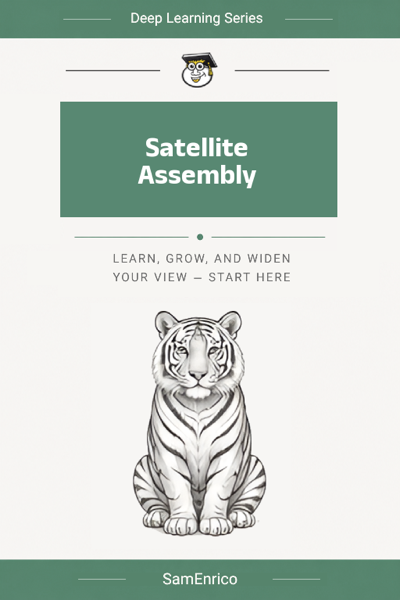
Non-FictionInformativeEducational
Satellite Assembly eBook
A Coursebook on Satellite Assembly
A Coursebook on Satellite Assembly
Formats
Free sample
Chapter 1: The Fragile Constellation...–- On a Tuesday morning in March 2014, a 260millionsatellitenamed AMC−5H—fullyassembled,tested,anddeclaredflight−ready—satinacleanroomat Cape Canaveral,waitingforitsfinalpre−launchinspection.Atechnicianleanedoveritsavionicsbaytoperformaroutinetorquecheckonasingle M4screw.Thescrewturned.Notbecauseitwasloose,butbecausethetechnicianhadmisreadthetorquespecificationby0.3Newton−meters.Theresultingmicro−crackintheprintedcircuitboardbeneathwasinvisibletothenakedeye.Twenty−threedayslater,at T+47secondsafterlaunch,thatcrackpropagatedundervibration.Thesatellite′smaincomputerreset.Thebackupcomputer,sharingthesamecrackedmountingstructure,resetthreesecondslater.The260 million satellite named AMC-5H—fully assembled, tested, and declared flight-ready—sat in a cleanroom at Cape Canaveral, waiting for its final pre-launch inspection. A technician leaned over its avionics bay to perform a routine torque check on a single M4 screw. The screw turned. Not because it was loose, but because the technician had misread the torque specification by 0.3 Newton-meters. The resulting micro-crack in the printed circuit board beneath was invisible to the naked eye.
Twenty-three days later, at T+47 seconds after launch, that crack propagated under vibration. The satellite's main computer reset. The backup computer, sharing the same cracked mounting structure, reset three seconds later. The 260millionsatellitenamed AMC−5H—fullyassembled,tested,anddeclaredflight−ready—satinacleanroomat Cape Canaveral,waitingforitsfinalpre−launchinspection.Atechnicianleanedoveritsavionicsbaytoperformaroutinetorquecheckonasingle M4screw.Thescrewturned.Notbecauseitwasloose,butbecausethetechnicianhadmisreadthetorquespecificationby0.3Newton−meters.Theresultingmicro−crackintheprintedcircuitboardbeneathwasinvisibletothenakedeye.Twenty−threedayslater,at T+47secondsafterlaunch,thatcrackpropagatedundervibration.Thesatellite′smaincomputerreset.Thebackupcomputer,sharingthesamecrackedmountingstructure,resetthreesecondslater.The260 million constellation node tumbled into the Atlantic Ocean. The screw cost $0.08.
The technician had seventeen years of experience.This is not a story about incompetence. It is a story about the terrifying fragility of things that work perfectly until they don't. And it is the reason this book exists.Satellite assembly is not manufacturing. Manufacturing takes raw materials and turns them into identical products—thousands of smartphones, millions of screws, endless identical widgets. Satellite assembly is something else entirely.
It is the deliberate, obsessive, almost paranoid process of taking components that were never designed to work together and forcing them into a symbiotic relationship that must survive the single most violent event known to human engineering: a rocket launch, followed by the single most hostile environment known to physics: the vacuum, radiation, and temperature extremes of space.There is no warranty. There is no recall. There is no mechanic in orbit.What you are about to learn in this book is not theory. It is the distilled experience of thousands of engineers who have watched satellites fail—on the bench, on the shaker table, in the thermal vacuum chamber, and occasionally, catastrophically, in flight. Every procedure, every torque value, every cleanroom protocol in these pages exists because someone, somewhere, learned the hard way what happens when you skip it.This chapter will give you the mental framework you need before you touch a single screw.
You will learn what a satellite actually is (and why that definition matters more than you think), the brutal logic of Assembly, Integration, and Testing (AIT), the single most important rule of space hardware (it will surprise you), and why this book focuses on small-to-medium satellites—the 1U Cube Sat to 500 kg class—while still respecting the giants of geostationary orbit. By the end of this chapter, you will understand why cleanrooms exist, why testing is not optional, and why the most dangerous word in satellite assembly is "probably."What a Satellite Actually Is: The Bus and the Payload If you ask a child to draw a satellite, they will draw a box with two rectangular wings (solar arrays) and a circle on top (an antenna). That child is not wrong, but they are missing the essential truth: a satellite is two completely different machines bolted together, each with its own personality, its own demands, and its own failure modes.The first machine is the bus (sometimes called the service module). The bus is the workhorse. It contains everything the satellite needs to stay alive: structure (the skeleton), propulsion (the legs, if legs could push you through vacuum), power generation and storage (solar arrays and batteries), thermal control (heaters and radiators), command and data handling (the brain), and communications (the voice).
The bus is pragmatic, robust, and slightly boring—like a diesel engine. It does not care what mission it serves. A bus designed for Earth observation is ninety percent identical to a bus designed for telecommunications. This is intentional. Reusing bus designs is how the space industry keeps costs from becoming astronomical.The second machine is the payload.
The payload is the reason the satellite exists. It is the telescope, the camera, the communications transponder, the science experiment, the quantum entanglement demonstrator, or the classified government instrument that no one will describe to you. The payload is delicate, demanding, and often temperamental—like a thoroughbred racehorse. It requires specific vibration isolation, precise thermal control, and absolute electromagnetic silence. It will refuse to work if the bus's power converters are too close.
It will develop condensation if the bus's radiators are pointed the wrong way. And it will cost anywhere from ten percent to ninety percent of the satellite's total budget, depending on how exotic the mission.Why does this distinction matter for assembly? Because the bus and the payload are assembled separately, tested separately, and only brought together in the final stages of integration. This separation is not logistical convenience; it is survival. A single dropped screw during payload integration can ruin an optical lens worth more than a house.
A single electrostatic discharge during bus assembly can fry a computer that took eighteen months to qualify. You will learn to treat these two halves of the satellite with different kinds of respect—the bus for its complexity, the payload for its fragility.The Seven Subsystems (And Why You Cannot Ignore Any of Them)Every satellite, regardless of size or mission, contains seven critical subsystems. You will encounter each one repeatedly throughout this book. Memorize them now.1. Structure: The skeleton.
It holds everything together, transfers launch loads to the rocket adapter, and provides mounting surfaces for every other subsystem. Materials range from aluminum (6061-T6 or 7075-T6 for most applications) to CFRP (carbon-fiber reinforced polymer for high-stiffness, low-mass needs) to titanium for fasteners and high-stress points. Structural assembly is the first thing you will do (Chapter 3) and the last thing you will check (Chapter 11).2. Thermal: The climate control system. Space is not uniformly cold—it is a patchwork of extreme heat (direct sunlight, up to +120°C) and extreme cold (shadow, down to -180°C).
The thermal subsystem uses radiators to dump heat, heaters to add heat, and Multi-Layer Insulation (MLI) to slow heat transfer. You will learn to install thermocouples and heaters in Chapter 9.3. Power: The heart. Solar arrays (Chapter 6) convert sunlight to electricity. Batteries store that electricity for when the satellite is in Earth's shadow.
Power distribution units regulate voltage and current to every other subsystem. A single short circuit can kill an entire satellite.4. Command and Data Handling (C&DH): The brain (Chapter 8). A radiation-hardened computer (or several, in redundant pairs) runs all onboard software, collects data from the payload, formats it for transmission, and executes commands from the ground. The C&DH is the only subsystem that talks to every other subsystem—which means its assembly requires extreme care with grounding, shielding, and thermal management.5.
Communications (Comms): The voice. Transmitters, receivers, and antennas (Chapter 5 covers the harnessing, but antenna integration appears throughout). The comms subsystem sends data to ground stations and receives commands.…
This is the end of the free sample. Get the eBook to keep going. Buy now
About this book
Details
- Author
- Hancock Pearle
- Publisher
- SamEnrico
- Language
- English
- Genre
- Non-Fiction, Informative, Educational
- Released
- 2026-05-09
- Pages (approx.)
- 148
- Available as
- eBook, Audiobook

Read better in the ZLOADR app
Your eBooks on your phone or tablet. Sign in with your SamEnrico account and start reading.
More by Hancock Pearle
 LSE Online Faculty ProfilesHancock Pearle$11.99
 Effortless Meditation Technique GuideHancock Pearle$11.99
 Band of Brothers VeteransHancock Pearle$11.99
 The Rogue AmbassadorHancock Pearle$11.99
 Guido d'Arezzo: The Monk Who Unlocked the HeavensHancock Pearle$11.99
 How to Produce Bicycle LocksHancock Pearle$11.99
 Narrative Inquiry Proposal GuideHancock Pearle$12.99
You may also like
 Hong Kong Handover 1997Dunn Johnnie$11.99
 Zumba For Postnatal Recovery CourseNeal Christian$11.99
 Zumba for BeginnersLadner Nikia$11.99
 YouTube Comment Mining GuideHumes Pandora$12.99
 Worry Box MeditationCarlin Rudy$11.99
 Workplace Stress MeditationNguyen Lynn$11.99
 Workplace Stress and Sleep RepairHawley Ivory$11.99
 Workplace Perfectionism CureDelaney Jeffry$11.99
 Workplace Injustice Anger GuideWallen Isabelle$11.99
 Work Addiction and Burnout LinkGreenwood Ester$11.99
 Women in Yoga and WellnessBeattie Galina$11.99
 Women in Stand Up ComedyChun Evangeline$11.99