
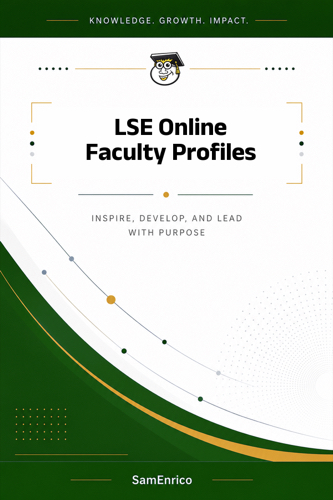
LSE Online Faculty Profiles
Meet leading economists and social scientists teac
Meet leading economists and social scientists teaching in LSE's virtual classrooms.
Formats
About this book
Free sample
Chapter 1: The Algorithmic Professor--The year is 2010. The place: a cramped committee room on the fourth floor of the Old Building, London School of Economics. Outside, Houghton Street hums with the usual chaos—students rushing between lectures, the clatter of the George IV pub spilling onto the pavement, the brutalist concrete tower of the Saw Swee Hock Student Centre still years away from breaking ground. Inside, a mathematician sits alone at a long wooden table, a whiteboard behind him covered not in equations but in something that looks like a circuit diagram crossed with a bus timetable.Professor Martin Anthony is sketching a flowchart for a lecture that does not yet exist—a lecture that will be watched not by seventy students in a tiered auditorium but by seven hundred students scattered across six continents, each watching on a laptop in a time zone where the sun sits at a different angle. He is not designing slides or writing exam questions.
He is decomposing the act of teaching into discrete, optimizable units. How long before attention decays? Seven minutes? Twelve? Where do you insert a checkpoint question without breaking the flow of a proof?
How do you build a feedback loop when there are no nodding heads to read?These are mathematical problems, and Anthony approaches them as such. His Ph D is in pure mathematics. His specialisation is discrete mathematics and computational learning theory—the study of how systems learn from data, how algorithms improve with feedback. He has spent years asking: given a set of training examples, how does a machine generalise to new inputs? Now he is asking: given a distributed population of students with different backgrounds, different schedules, different cognitive rhythms, how does a teaching system adapt to maximise learning for all of them?The answer he will spend the next decade building is not a piece of software.
It is a philosophy. It is a framework that treats online education not as a degraded version of the classroom but as a distinct medium with its own mathematics, its own optimisations, its own rigorous standards. By the…
This is the end of the free sample. Get the eBook to keep going. Buy now
Contents
- Chapter 1
- Chapter 2
- Chapter 3
- Chapter 4
- Chapter 5
- Chapter 6
- Chapter 7
- Chapter 8
- Chapter 9
- Chapter 10
- Chapter 11
- Chapter 12
Details
- Author
- Hancock Pearle
- Publisher
- SamEnrico
- Language
- English
- Genre
- Non-Fiction, Student's Shortcut
- Released
- 2026-06-09
- Pages (approx.)
- 139
- Available as
- eBook, Audiobook

Read better in the ZLOADR app
Your eBooks on your phone or tablet. Sign in with your SamEnrico account and start reading.
More by Hancock Pearle
 Effortless Meditation Technique GuideHancock Pearle$11.99
 Band of Brothers VeteransHancock Pearle$11.99
 The Rogue AmbassadorHancock Pearle$11.99
 Guido d'Arezzo: The Monk Who Unlocked the HeavensHancock Pearle$11.99
 How to Produce Bicycle LocksHancock Pearle$11.99
 Narrative Inquiry Proposal GuideHancock Pearle$12.99
 Satellite AssemblyHancock Pearle$11.99
You may also like
 Hong Kong Handover 1997Dunn Johnnie$11.99
 Zumba For Postnatal Recovery CourseNeal Christian$11.99
 Zumba for BeginnersLadner Nikia$11.99
 YouTube Comment Mining GuideHumes Pandora$12.99
 Worry Box MeditationCarlin Rudy$11.99
 Workplace Stress MeditationNguyen Lynn$11.99
 Workplace Stress and Sleep RepairHawley Ivory$11.99
 Workplace Perfectionism CureDelaney Jeffry$11.99
 Workplace Injustice Anger GuideWallen Isabelle$11.99
 Work Addiction and Burnout LinkGreenwood Ester$11.99
 Women in Yoga and WellnessBeattie Galina$11.99
 Women in Stand Up ComedyChun Evangeline$11.99