
Non-FictionStartup GuideVenture FundingStartup Guide / Legal
SAFE Agreement Guide eBook
undefined
by Wendt Wes
undefined
Formats
Free sample
Chapter 1: The $10 Million Typo--The email arrived at 11:47 PM on a Tuesday. Sarah, the founder of a promising fintech startup, had just closed a $500,000 SAFE investment from a prominent angel syndicate. The deal was done. The documents were signed. She poured herself a glass of wine and celebrated what she thought was a fair valuation: a $5 million cap on a post-money SAFE.Eighteen months later, during her Series A due diligence, her lawyer delivered the news.
That single number—$5 million—wasn't just a cap. It was the key variable in a formula that would determine how much of her company she kept. Because she had issued three separate SAFEs to different investors at different times, with different caps, the conversion math produced a result no one had modeled. When the dust settled, Sarah had accidentally given away 38% of her company to SAFE holders who had invested only $1.2 million combined. Her co-founders were diluted to near-irrelevance.
The lead VC walked away.Sarah now drives for Uber in San Francisco. The term sheet was fine. The product was fine. The mistake was a failure to understand one thing: how a SAFE actually works when the pen hits the paper.This book exists to ensure you never become Sarah.The Problem That Needed Solving Before we can understand what a SAFE is, we must understand what it replaced—and why that replacement was necessary. The year is 2012.
You are a founder with a working prototype, a small team, and a desperate need for $500,000 to reach your next milestone. Your only practical option is a convertible note.A convertible note is debt. It accrues interest. It has a maturity date, typically 18 to 24 months. And if you cannot raise a priced equity round before that maturity date, the investor can demand repayment—plus interest—or force you into bankruptcy.
This is not a theoretical risk. In 2011 alone, over 200 early-stage startups collapsed under the weight of convertible notes they could not refinance or convert.The convertible note creates a perverse incentive structure. The investor wants you to succeed enough to convert their debt into equity at a discount, but not so slowly that the note matures while you are still unprofitable. The founder, meanwhile, is building a company while a ticking clock counts down to potential insolvency. Every month of progress is also a month closer to a debt trap.Enter Y Combinator.
In late 2013, the legendary accelerator introduced a radical alternative: the Simple Agreement for Future Equity. No interest. No maturity date. No debt. Just a one-way promise: you give us money now, and when you eventually raise a priced equity round, we get shares at a discount or a capped valuation—whichever benefits us more.The SAFE was not a loan.
It was not equity. It was something entirely new: a contractual placeholder that deferred the hard question of valuation until a future investor (typically a venture capital firm) did the work of pricing the company.In its first two years, the SAFE was adopted by over 3,000 startups. By 2018, it had become the default seed-stage instrument in Silicon Valley, used in an estimated 70% of all pre-Series A financings. The reason was simple: SAFEs closed faster, cost less in legal fees, and removed the existential threat of a maturity date.But here is the truth that Sarah learned too late: simpler does not mean simple.What This Book Is (And Is Not)Let me be direct with you. This book will not teach you how to draft a SAFE from scratch.
You should not draft a SAFE from scratch. You should use the Y Combinator form, which is freely available, battle-tested, and regularly updated. This book will teach you how to read, negotiate, model, and manage that form so you never accidentally give away your company.This book is written for three audiences, and I will signal clearly when a section is not for you:Founders – You are the primary audience. You need to understand what you are signing, how it affects your cap table, and what levers you can pull in negotiation. Most of this book is for you.Angel Investors – You need to understand what protections you do not have (most of them), what rights you can negotiate (pro-rata, MFN, information rights), and how to model your potential ownership.
Chapters 4, 8, and 9 are especially relevant to you.Lawyers and Accountants – You need a reference that your clients can read before they come to you. Use this book to reduce your educational burden so you can focus on actual legal work. Chapters 2, 10, and the Appendix are your anchors.One more clarification before we proceed. When I say a SAFE is "simpler than a convertible note," I mean it has fewer moving parts. It does not mean you can sign it without understanding the implications.
As you will see in Chapter 9, almost every term in a SAFE is negotiable. As you will see in Chapter 7, the cap table math can become extraordinarily complex. And as you will see in Chapter 8, SAFE holders have nearly no protections during the gap period between investment and conversion.If you came here looking for a one-page explanation and a signature line, put this book down. If you came here to truly understand the instrument that will shape the first years of your company's financial life, turn the page.The Historical Context: Why 2013 Mattered To understand the SAFE, you must understand the venture capital ecosystem of the early 2010s. The great recession had ended, but its scars remained.
Banks were not lending to startups. Traditional debt was unavailable. And the priced equity round—the gold standard of venture financing—required months of due diligence, tens of thousands of dollars in legal fees, and a lead investor willing to set a valuation.For a company that needed $500,000 to hire three engineers and launch a product, a priced round was overkill. The legal costs alone could consume 10% of the raise. The time spent negotiating could kill the opportunity.
Enter the convertible note as the only game in town.But convertible notes had a dark secret. In 2012, a study of 500 seed-stage startups found that nearly 40% of those using convertible notes either (a) converted at a valuation that was substantially lower than expected due to a down round, or (b) faced a maturity event that forced a "cram down" conversion on unfavorable terms. The problem was structural: the note holder had the right to demand repayment, but the company had no money. The only exit was a fire sale of equity at the worst possible moment.Y Combinator's insight was brilliant in its simplicity. Remove the debt.
Remove the interest. Remove the maturity date. What remains is a pure instrument of optionality: the investor bets on future success, the founder retains control during the critical development phase, and the valuation question is deferred until a sophisticated third party (the Series A investor) provides a market price.The first SAFEs were pre-money instruments. That meant the valuation cap applied before the conversion of any other SAFEs or the option pool. The math was opaque, and founders often had no idea what percentage of their company they had sold until years later.
In 2018, Y Combinator released the post-money SAFE, which solved the clarity problem by expressing the cap as a percentage…
This is the end of the free sample. Get the eBook to keep going. Buy now
About this book
Details
- Author
- Wendt Wes
- Publisher
- SamEnrico
- Language
- English
- Genre
- Non-Fiction, Startup Guide, Venture Funding, Startup Guide / Legal
- Released
- 2026-06-07
- Pages (approx.)
- 140
- Available as
- eBook, Audiobook

Read better in the ZLOADR app
Your eBooks on your phone or tablet. Sign in with your SamEnrico account and start reading.
More by Wendt Wes
 Vocational Rehab for AddictsWendt Wes$11.99
 Thermostat Wars Anger GuideWendt Wes$11.99
 Affirmation Visualization Practice CourseWendt Wes$11.99
 CrossFit Beginner's Journey ManualWendt Wes$11.99
 The Fear of Puppets GuideWendt Wes$11.99
 The Pooka’s Deception: Shapeshifting Trickster of the Celtic WildsWendt Wes$11.99
 Event Planning Services BusinessWendt Wes$11.99
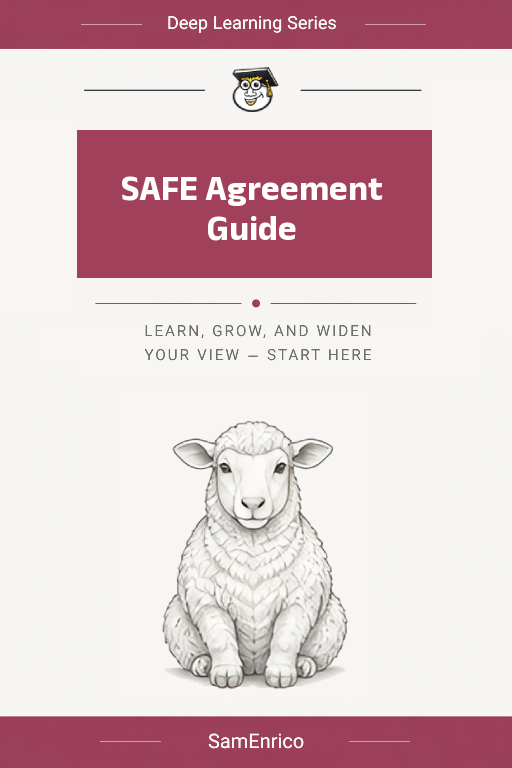 SAFE Agreement GuideWendt Wes$12.99
 Australian Export Green MarksWendt Wes$12.99
 Understanding Uniparental Disomy of 11Wendt Wes$17.99
 How to Start a Academic Outreach Business (Beginners Guide)Wendt Wes$11.99
You may also like
 Hong Kong Handover 1997Dunn Johnnie$11.99
 Zumba For Postnatal Recovery CourseNeal Christian$11.99
 Zumba for BeginnersLadner Nikia$11.99
 YouTube Comment Mining GuideHumes Pandora$12.99
 Worry Box MeditationCarlin Rudy$11.99
 Workplace Stress MeditationNguyen Lynn$11.99
 Workplace Stress and Sleep RepairHawley Ivory$11.99
 Workplace Perfectionism CureDelaney Jeffry$11.99
 Workplace Injustice Anger GuideWallen Isabelle$11.99
 Work Addiction and Burnout LinkGreenwood Ester$11.99
 Women in Yoga and WellnessBeattie Galina$11.99
 Women in Stand Up ComedyChun Evangeline$11.99