
Non-FictionStartup GuideVenture FundingStartup Guide / Legal
SAFE Agreement Guide Audiobook
undefined
by Wendt Wes
undefined
Formats
Free sample
Chapter 1: The $10 Million Typo--The email arrived at 11:47 PM on a Tuesday. Sarah, the founder of a promising fintech startup, had just closed a $500,000 SAFE investment from a prominent angel syndicate. The deal was done. The documents were signed. She poured herself a glass of wine and celebrated what she thought was a fair valuation: a $5 million cap on a post-money SAFE.Eighteen months later, during her Series A due diligence, her lawyer delivered the news.
That single number—$5 million—wasn't just a cap. It was the key variable in a formula that would determine how much of her company she kept. Because she had issued three separate SAFEs to different investors at different times, with different caps, the conversion math produced a result no one had modeled. When the dust settled, Sarah had accidentally given away 38% of her company to SAFE holders who had invested only $1.2 million combined. Her co-founders were diluted to near-irrelevance.
The lead VC walked away.Sarah now drives for Uber in San Francisco. The term sheet was fine. The product was fine. The mistake was a failure to understand one thing: how a SAFE actually works when the pen hits the paper.This book exists to ensure you never become Sarah.The Problem That Needed Solving Before we can understand what a SAFE is, we must understand what it replaced—and why that replacement was necessary. The year is 2012.
You are a founder with a working prototype, a small team, and a desperate need for $500,000 to reach your next milestone. Your only practical option is a convertible note.A convertible note is debt. It accrues interest. It has a maturity date, typically 18 to 24 months. And if you cannot raise a priced equity round before that maturity date, the investor can demand repayment—plus interest—or force you into bankruptcy.
This is not a theoretical risk. In 2011 alone, over 200 early-stage startups collapsed under the weight of convertible notes they could not refinance or convert.The convertible note creates a perverse incentive structure. The investor wants you to succeed enough to convert their debt into equity at a discount, but not so slowly that the note matures while you are still unprofitable. The founder, meanwhile, is building a company while a ticking clock counts down to potential insolvency. Every month of progress is also a month closer to a debt trap.Enter Y Combinator.
In late 2013, the legendary accelerator introduced a radical alternative: the Simple Agreement for Future Equity. No interest. No maturity…
This is the end of the free sample. Get the Audiobook to keep going. Buy now
About this book
Details
- Author
- Wendt Wes
- Publisher
- SamEnrico
- Language
- English
- Genre
- Non-Fiction, Startup Guide, Venture Funding, Startup Guide / Legal
- Released
- 2026-06-07
- Pages (approx.)
- 140
- Available as
- eBook, Audiobook

Listen in the VoxFlicks app
Audiobooks and audio dramas wherever you go. Sign in with your SamEnrico account and press play.
More by Wendt Wes
 Vocational Rehab for AddictsWendt Wes$11.99
 Thermostat Wars Anger GuideWendt Wes$11.99
 Affirmation Visualization Practice CourseWendt Wes$11.99
 CrossFit Beginner's Journey ManualWendt Wes$11.99
 The Fear of Puppets GuideWendt Wes$11.99
 The Pooka’s Deception: Shapeshifting Trickster of the Celtic WildsWendt Wes$11.99
 Event Planning Services BusinessWendt Wes$11.99
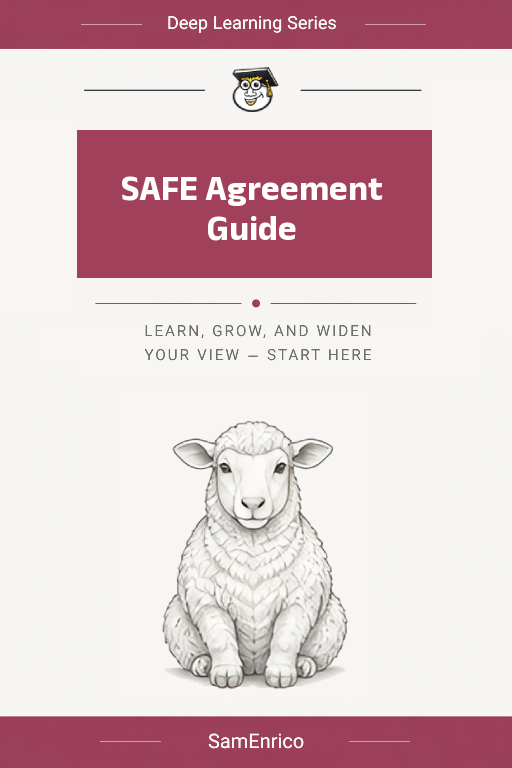 SAFE Agreement GuideWendt Wes$12.99
 Australian Export Green MarksWendt Wes$12.99
 Understanding Uniparental Disomy of 11Wendt Wes$17.99
 How to Start a Academic Outreach Business (Beginners Guide)Wendt Wes$11.99
You may also like
 Hong Kong Handover 1997Dunn Johnnie$11.99
 Zumba For Postnatal Recovery CourseNeal Christian$11.99
 Zumba for BeginnersLadner Nikia$11.99
 YouTube Comment Mining GuideHumes Pandora$12.99
 Worry Box MeditationCarlin Rudy$11.99
 Workplace Stress MeditationNguyen Lynn$11.99
 Workplace Stress and Sleep RepairHawley Ivory$11.99
 Workplace Perfectionism CureDelaney Jeffry$11.99
 Workplace Injustice Anger GuideWallen Isabelle$11.99
 Work Addiction and Burnout LinkGreenwood Ester$11.99
 Women in Yoga and WellnessBeattie Galina$11.99
 Women in Stand Up ComedyChun Evangeline$11.99