
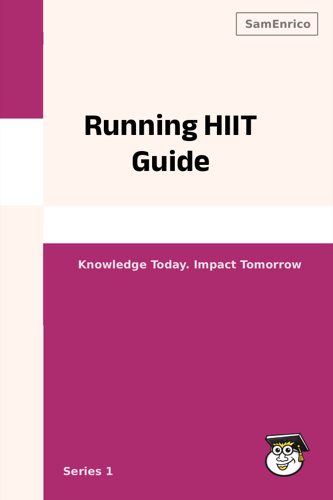
Non-FictionHealth & Wellness / Running
Running HIIT Guide eBook
Applies interval principles to running with track
by Acosta Yetta
Applies interval principles to running with track and treadmill workouts.
Formats
Free sample
Chapter 1: The Mileage Lie--–- The first time my knee gave out, I was exactly 3.2 miles from home, it was raining, and my watch said I had burned 487 calories—none of which mattered because I couldn’t walk. I was forty-three years old, reasonably fit by any external measure, and I had just completed what every running expert told me to do: more miles. More steady, consistent, moderate-paced miles. The kind of miles that build character, they said. The kind of miles that separate real runners from hobby joggers.
I had logged forty to fifty miles per week for eighteen months. My marathon time had dropped from 4:12 to 3:58—a respectable improvement, but nothing close to what the mileage charts promised. And now, kneeling on a wet sidewalk with my right knee throbbing, I realized something that would take me another three years and thousands of dollars in physiotherapy to fully understand: I had been running wrong. Not a little wrong. Fundamentally, structurally, mathematically wrong.This chapter dismantles the single most destructive belief in running culture: the assumption that more steady-state mileage equals better fitness, faster times, and improved health.
It does not. For a significant portion of runners—perhaps the majority—excessive steady-state running produces diminishing returns, injury, and boredom long before it produces peak performance. But the solution is not to abandon running entirely, nor is it to jump blindly into the world of high-intensity interval training (HIIT) without understanding its own pitfalls. The solution is something else entirely: a structured, oscillating system called The Pendulum Effect, which this book will teach you to master across treadmills, tracks, and real-world conditions.The Invention of "Junk Miles" and Why It Hurts to Say The term "junk miles" first appeared in competitive running circles in the late 1970s, coined by coaches who noticed that elite runners often ran their slow miles too slowly and their fast miles too fast, with nothing in between that produced meaningful adaptation. But over the past four decades, the concept has been distorted beyond recognition.
Today, "junk miles" is often used to dismiss any running that isn't race-pace or faster—a definition that throws the baby out with the bathwater.Let me be precise about what I mean by excessive steady-state running. Steady-state running is any continuous running at a moderate intensity—typically 60-75% of maximum heart rate, or what feels like a 4-6 on the 1-10 Rate of Perceived Exertion (RPE) scale we will fully define in Chapter 3. This is the pace where you can speak in short sentences but not sing. It is the default pace for most recreational runners, the pace that fitness trackers call "fat burning zone," and the pace that feels sustainable for thirty to ninety minutes.The problem is not that this pace has no value. It absolutely does, as we will explore in Chapter 12 when we discuss strategic low-intensity recovery runs.
The problem is that many runners—especially those with jobs, families, and limited training time—do 80 to 100 percent of their running at this single pace. They have one gear. And a single-gear runner is like a car stuck in third gear: functional on flat roads, but useless on hills, helpless in sprints, and destined for mechanical failure.What Excessive Steady-State Running Actually Does to Your Body To understand why too much moderate running backfires, you need to understand something about your muscle fibers. Human skeletal muscle contains two broad categories of fibers: slow-twitch (Type I) and fast-twitch (Type II). Slow-twitch fibers are oxygen-efficient, fatigue-resistant, and built for endurance.
Fast-twitch fibers are powerful, explosive, and built for speed—but they fatigue quickly.Here is what most runners do not know: when you run exclusively at moderate, steady-state paces, you selectively train your slow-twitch fibers while your fast-twitch fibers gradually atrophy. This is called the "specificity principle" in exercise physiology, and it is relentless. Your body is an efficiency machine. If you never ask your fast-twitch fibers to work—never sprint, never surge, never climb steep hills at max effort—your body will reassign their energy resources elsewhere. Over months and years, your proportion of fast-twitch fibers effectively decreases.
You become metabolically locked into slow running.The research on this is unequivocal. A 2014 study in the Journal of Applied Physiology compared runners who did 80% of their training at low intensity with runners who did 50% low intensity and 30% high intensity (the remaining 20% being moderate). After twelve weeks, the group doing less steady-state running improved their 5K times by an average of 5.8%, while the high-steady-state group improved by only 1.2%. The kicker? The high-steady-state group also reported higher rates of knee pain, plantar fasciitis, and general fatigue.
More miles produced worse results and more injuries.This is not an indictment of all steady-state running. It is an indictment of excessive, exclusive, unvarying steady-state running—what I will call excessive steady-state running throughout this book to distinguish it from the strategic low-intensity runs we will prescribe in Chapter 12. The distinction matters because many runners swing too far in the opposite direction, abandoning all moderate running in favor of chaos. That leads us to the other side of the problem.The HIIT Trap: When Intensity Becomes Injury High-intensity interval training—short bursts of maximum effort followed by rest periods—exploded into mainstream fitness around 2012, propelled by studies showing that four minutes of intense exercise could produce similar cardiovascular benefits to forty minutes of moderate exercise. The promise was intoxicating: less time, more results, and the death of boring cardio.
Running HIIT seemed like the perfect solution for anyone who found steady-state running tedious.But the fitness industry, as it often does, took a promising concept and commercialized it into something dangerous. Walk into any boutique HIIT studio and you will see the same pattern: a well-intentioned coach leading a room of under-slept, under-hydrated, under-warmed-up clients through burpee-sprint-burpee-box jump circuits with minimal rest and maximal yelling. The injury rates, as documented by running researcher David Siik and others, are staggering. One study of over 1,200 HIIT participants found that 32% reported an injury requiring medical attention within six months of starting—compared to 15% for traditional steady-state runners. The most common injuries?
Hamstring strains, Achilles tendinopathy, and lower back pain, all directly traceable to poor form under fatigue.Here is the crucial point that most discussions miss: HIIT itself is not the problem. The problem is how HIIT is typically implemented—without proper warm-up, without adequate recovery between sessions, and without attention to running mechanics at high speeds. When you ask a tired, cold, poorly conditioned runner to sprint at 90% of maximum speed, something will break. Usually the hamstring. Sometimes the spirit.This book is not anti-HIIT.
This book is anti-bad-HIIT. The BITE Method we will introduce in Chapter 5, the Galloway intervals in Chapter 6, and the Pendulum Protocols in Chapter 7 all fall under the HIIT umbrella, but they are HIIT with guardrails. They include mandatory warm-ups (Chapter 4), explicit recovery prescriptions (this chapter and Chapter 12), and a progressive structure that respects your body's need for adaptation. The Pendulum Effect is not a rejection of HIIT—it is the refinement HIIT always needed.Introducing The Pendulum Effect: The Core Innovation The Pendulum Effect is named for its most…
This is the end of the free sample. Get the eBook to keep going. Buy now
About this book
Details
- Author
- Acosta Yetta
- Publisher
- SamEnrico
- Language
- English
- Genre
- Non-Fiction, Health & Wellness / Running
- Released
- 2026-06-06
- Pages (approx.)
- 152
- Available as
- eBook, Audiobook

Read better in the ZLOADR app
Your eBooks on your phone or tablet. Sign in with your SamEnrico account and start reading.
More by Acosta Yetta
 Presentation Contingency PlanningAcosta Yetta$11.99
 Competition Comparison HealingAcosta Yetta$11.99
 Warrant Cashless ExerciseAcosta Yetta$11.99
 The Green Conquest: Cyrus the Great and the Achaemenid Empire's RiseAcosta Yetta$11.99
 Personnel Security SpecialistAcosta Yetta$11.99
 How to Produce Ceramic ValvesAcosta Yetta$11.99
 Factoring in Nigeria HandbookAcosta Yetta$12.99
 How to Start a Lock for Motor Vehicle Business (Beginners Guide)Acosta Yetta$11.99
You may also like
 Hong Kong Handover 1997Dunn Johnnie$11.99
 Zumba For Postnatal Recovery CourseNeal Christian$11.99
 Zumba for BeginnersLadner Nikia$11.99
 YouTube Comment Mining GuideHumes Pandora$12.99
 Worry Box MeditationCarlin Rudy$11.99
 Workplace Stress MeditationNguyen Lynn$11.99
 Workplace Stress and Sleep RepairHawley Ivory$11.99
 Workplace Perfectionism CureDelaney Jeffry$11.99
 Workplace Injustice Anger GuideWallen Isabelle$11.99
 Work Addiction and Burnout LinkGreenwood Ester$11.99
 Women in Yoga and WellnessBeattie Galina$11.99
 Women in Stand Up ComedyChun Evangeline$11.99