
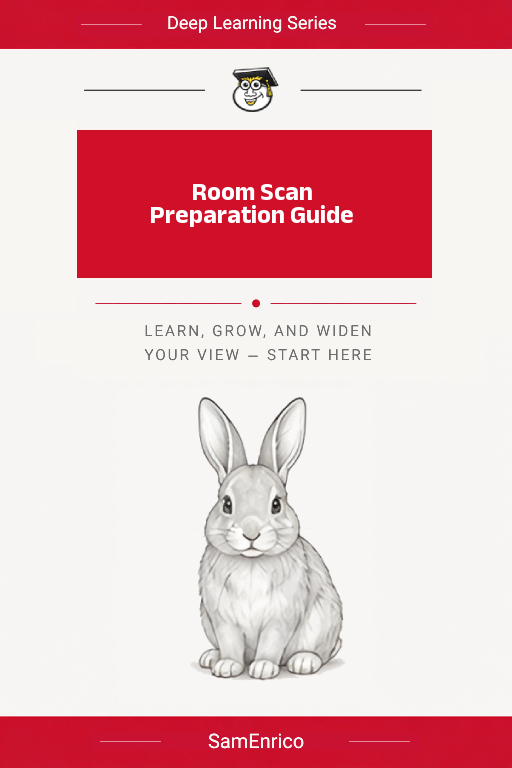
Room Scan Preparation Guide
Clear your desk, hide monitors, and remove prohibi
Clear your desk, hide monitors, and remove prohibited items before the automated 360-degree room scan flags violations.
Formats
About this book
Free sample
Chapter 1: The Algorithmic Witness...--–- The first thing you need to understand about an automated room scan is that it is not a proctor. It is not a security guard, not a supervisor, not even a particularly intelligent piece of software. It is, at its core, a pattern-matching engine—a digital witness that never blinks, never gets distracted, and never forgives. Unlike a human being, who might glance at a cluttered desk and assume innocence, the algorithmic eye sees only geometry, reflectivity, and contrast. A sticky note on your monitor is not a reminder to buy milk; it is a rectangle containing high-contrast glyphs that match the optical character recognition (OCR) library for “unauthorized written materials.” A phone face-down on a chair is not an oversight; it is a rectangular prism with a known reflective signature matching the device database.
This chapter dismantles the myth that automated scans “understand” your environment. They do not. They classify, compare, and convict based on probabilities trained on millions of previous scans. Your job is not to convince a human of your honesty. Your job is to disappear—to present a room so geometrically boring, so optically inert, that the algorithm scrolls past you in 0.3 seconds and stamps “PASS” without a second thought.To achieve this, you must first understand how the algorithmic witness perceives the world.
Human vision is contextual. When you look at a cluttered desk, you see a coffee mug (safe), a stack of sticky notes (probably harmless), and a smartwatch (maybe forgotten). You apply intent, habit, and social norms. The algorithm applies none of these. It receives a 360-degree panoramic image, often captured via structured light or infrared depth sensors, and then processes that image through several layers of computer vision.
The first layer is edge detection: the system identifies every sharp boundary between light and dark, every corner, every straight line. To the algorithm, a monitor bezel and a picture frame are initially indistinguishable—both are rectangles with four right angles. The second layer is classification: the system compares each detected shape against a library of prohibited object profiles.…
This is the end of the free sample. Get the eBook to keep going. Buy now
Contents
- Chapter 1
- Chapter 2
- Chapter 3
- Chapter 4
- Chapter 5
- Chapter 6
- Chapter 7
- Chapter 8
- Chapter 9
- Chapter 10
- Chapter 11
- Chapter 12
Details
- Author
- Cummings Heather
- Publisher
- SamEnrico
- Language
- English
- Genre
- Non-Fiction, Student's Shortcut, Test Environment, Compliance Prep
- Released
- 2026-06-01
- Pages (approx.)
- 152
- Available as
- eBook, Audiobook

Read better in the ZLOADR app
Your eBooks on your phone or tablet. Sign in with your SamEnrico account and start reading.
More by Cummings Heather
 Listening In Coaching GuideCummings Heather$11.99
 The Quiet Stress HandbookCummings Heather$11.99
 The Farmer's DaughterCummings Heather$11.99
 Gamer Distraction Management GuideCummings Heather$11.99
 The Quit Smoking Life InsuranceCummings Heather$11.99
 Bipolar Advance DirectiveCummings Heather$11.99
 Metacognition GuideCummings Heather$11.99
 Mental Health in Refugee CampsCummings Heather$11.99
 EQ for Retirement AdjustmentCummings Heather$11.99
 Caesar vs. Pompey: The Clash of Titans That Shattered RomeCummings Heather$11.99
 Silk and Splendor: The Byzantine Fashion RevolutionCummings Heather$11.99
 The Ghost of Flight 447: The Black Box ConspiracyCummings Heather$11.99