
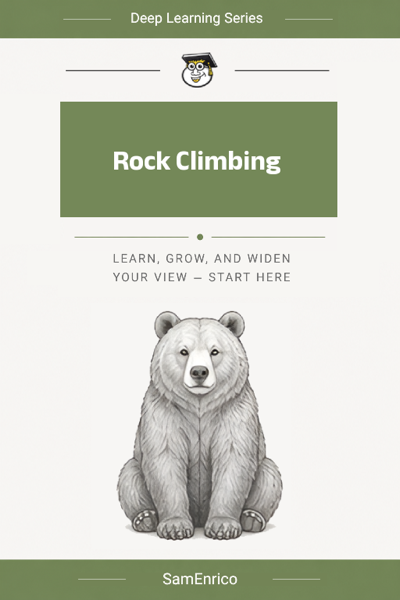
Non-FictionInformativeEducational
Rock Climbing eBook
A Coursebook on Rock Climbing
by Conrad Tien
A Coursebook on Rock Climbing
Formats
Free sample
Chapter 1: The Vertical Conversation...--What if everything you thought you knew about climbing strength was backwards? The climber who spends hours in the gym doing pull-ups and finger rolls is often the same climber who freezes ten feet off the deck, forearms welded into stone, unable to move. Meanwhile, the climber who looks unremarkable—no bulging biceps, no campus-board bravado—floats past them, breathing calmly, placing feet precisely, and resting on holds that seem impossibly small. The difference is not strength. The difference is a conversation.Climbing is a conversation between your body and the rock.
Every move is a sentence. Every rest is a comma. Every fall is a question. And like any language, you cannot learn it by memorizing vocabulary lists (pull harder, lock off, campus). You must learn the grammar—the underlying rules that turn random movements into fluid, efficient, safe ascents.This chapter is not about how to climb.
It is about how to think about climbing. Before you tie into a rope, before you buy a single carabiner, before you step onto the wall, you must understand three things: first, the language of difficulty (grades and what they actually mean); second, the ethics of the vertical world (because the rock does not belong to you); and third, the anatomy of efficiency (how to use your skeleton so your muscles don't have to). Master these three foundations, and everything that follows—face climbing, crack technique, lead head games, multipitch logistics—will be an extension of a single principle: talk to the rock, do not fight it.Grades Are Poetry, Not Physics The first question every new climber asks is, "What grade is that?" It is the wrong question. The right question is, "What does that grade feel like, and why?"Climbing grades are consensus opinions, not physical measurements. The Yosemite Decimal System (YDS), which dominates North America, rates climbs on a scale from 5.0 to 5.15.
A 5.4 is a steep ladder. A 5.7 requires genuine technique. A 5.9 was once considered the absolute limit of human possibility; today, it is a warm-up for intermediate climbers. From 5.10 upward, the system adds letters (a, b, c, d) to indicate increasing difficulty within the number grade. A 5.10a is significantly easier than a 5.10d, and a 5.11a is a full leap beyond that.But here is the secret that no grade conversion chart will tell you: grades are emotional.
A 5.9 at the Gunks in New York, where the rock is horizontal and the gear is terrifying, can feel harder than a 5.11b at a modern sport crag with bolts every six feet. A 5.8 in the Shawangunks might have a move that requires a full split between two horizontals, while a 5.10 in your local gym is a series of jugs on a gentle overhang. Grades shift with geography, generation, and even the mood of the first ascentionist who proposed the grade in the first place.European climbers use the French scale (1 to 9, with letters for sub-grades) or the British system (which separates technical difficulty from how scary the climb is). Boulders use the Hueco scale (V0 to V17) or the Fontainebleau scale. None of these maps correspond perfectly to the territory.
A V4 boulder problem might feel like a 5.11c route, or it might feel like a 5.12b, depending entirely on whether you are good at explosive power (bouldering) or sustained endurance (routes).What does this mean for you, the apprentice? It means you must stop worshiping grades. A 5.10 climber who understands why grades are subjective—who can look at a 5.9 and say, "That overhang might shut me down because I have not practiced steep jams yet"—will progress faster than a 5.12 climber who only climbs grades and never reads the rock. The grade-chaser climbs the number. The apprentice climbs the climb.Your first year, ignore the grade.
Climb everything below 5.9. Then climb everything below 5.10a. Then notice that some 5.10as feel easier than certain 5.9s. That is the moment you graduate from being a number-climber to being a rock-climber.The Ethics of the Vertical World Climbing is unique among sports in that the playing field is irreplaceable. A football field can be regrown.
A basketball court can be resurfaced. But a crack that took forty million years to form can be destroyed in forty seconds by a climber with a crowbar and a mistaken belief that the rock should be easier.The ethical framework of climbing rests on a single principle: leave no trace. Not because it is virtuous, but because the next climber deserves the same experience you had. When you chip a hold (carve it larger with a tool), you have vandalized a natural object. When you leave a fixed rope or a rusty bolt, you have littered.
When you trample the approach trail's vegetation, you have destroyed the habitat that makes the crag beautiful.The most contentious ethical question in climbing is bolting. Sport climbing uses pre-placed bolts drilled into the rock. Traditional (trad) climbing uses no fixed gear; the climber places removable protection (cams and nuts) and removes it after the climb. Both are valid. Both have produced legendary routes and legendary climbers.
The problem arises when bolters place bolts on a classic trad route, or when trad climbers chop bolts they consider invasive. The solution is local ethics: every climbing area has a culture, usually documented in the guidebook or on Mountain Project. At the New River Gorge, bolting is welcome. At Indian Creek, bolts on splitter cracks are sacrilege. Do your research before you place a bolt, and certainly before you complain about one.Beyond bolting, the ethics of the sport include: brushing your tick marks (the chalk marks that show where you intend to grab) so the next climber does not have to decode your beta; not playing loud music at the crag; packing out your tape, your orange peels, and your broken gear; and never, ever, cutting down a tree to build an anchor.
Trees are not hardware. They are living organisms. If you must use a tree as an anchor, use a wide runner (a long sling) to distribute the load and protect the bark.The most violated ethical rule is also the simplest: wait your turn. At a crowded crag, do not set up a top-rope on a route that someone else is leading. Do not hog the one 5.8 warm-up for three hours.
Do not spray beta (shout advice) at a climber who has not asked for it. The crag is a shared space. Act like you are borrowing it, because you are.Anatomy of Efficiency: The Skeleton Wants to Help Here is the most important sentence in this entire chapter: your muscles are for movement; your skeleton is for support. Most beginners do the opposite. They lock their arms, hunch their shoulders, and hang on their biceps.
Within thirty seconds, they are pumped—forearms engorged with blood, hands curled into claws, breathing shallow and panicked. Then they fall, convinced they are not strong enough.They are not weak. They are inefficient.Your skeleton is a series of levers and joints designed to hold weight with zero muscular effort. When you stand on the floor, your leg bones stack vertically—femur on tibia, tibia on talus—and your…
This is the end of the free sample. Get the eBook to keep going. Buy now
About this book
Details
- Author
- Conrad Tien
- Publisher
- SamEnrico
- Language
- English
- Genre
- Non-Fiction, Informative, Educational
- Released
- 2026-05-18
- Pages (approx.)
- 135
- Available as
- eBook, Audiobook

Read better in the ZLOADR app
Your eBooks on your phone or tablet. Sign in with your SamEnrico account and start reading.
More by Conrad Tien
 Book Club for Brain HealthConrad Tien$11.99
 Garden Toxin PreventionConrad Tien$11.99
 Empathic Listening TechniquesConrad Tien$11.99
 Cross Training Injury ShieldConrad Tien$11.99
 The Vanishing Billions: The Amnesiac Heiress and the $2 Billion FraudConrad Tien$11.99
 How to Start a Cottages and Cabins Without Housekeeping Service, Provided In Holiday Centres and HolConrad Tien$11.99
 Fair Trade Certification Export GuideConrad Tien$12.99
 How to Produce a Choke ManifoldConrad Tien$11.99
You may also like
 Hong Kong Handover 1997Dunn Johnnie$11.99
 Zumba For Postnatal Recovery CourseNeal Christian$11.99
 Zumba for BeginnersLadner Nikia$11.99
 YouTube Comment Mining GuideHumes Pandora$12.99
 Worry Box MeditationCarlin Rudy$11.99
 Workplace Stress MeditationNguyen Lynn$11.99
 Workplace Stress and Sleep RepairHawley Ivory$11.99
 Workplace Perfectionism CureDelaney Jeffry$11.99
 Workplace Injustice Anger GuideWallen Isabelle$11.99
 Work Addiction and Burnout LinkGreenwood Ester$11.99
 Women in Yoga and WellnessBeattie Galina$11.99
 Women in Stand Up ComedyChun Evangeline$11.99