
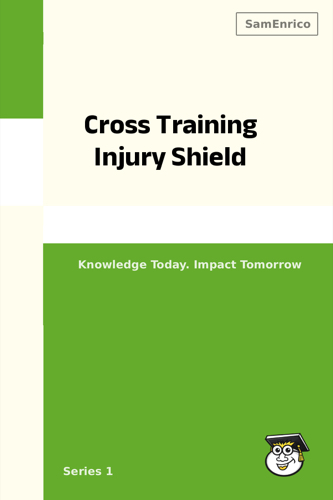
Non-FictionHealth & WellnessCross Training
Cross Training Injury Shield
Teaches low impact alternatives like swimming and
by Conrad Tien
Teaches low impact alternatives like swimming and cycling to balance high impact sports.
Formats
About this book
Free sample
Chapter 1: The 5,000 Mile Creep--–- Most dedicated athletes are only one bad step away from a six-week recovery. That sentence sounds dramatic, but it is also statistically conservative. Sports medicine clinics are filled with runners, basketball players, Cross Fit athletes, and weekend warriors who did nothing obviously wrong—no twisted ankle, no collision, no heroic one-rep max gone bad. They simply woke up one morning with a dull ache behind the kneecap, a stabbing sensation along the shin, or a crackling tendon that made climbing stairs feel like a risk assessment exercise. The radiologist calls it "chronic overuse injury." The athlete calls it "unfair." But the biomechanist calls it something else: cumulative load failure.The term "cumulative load" sounds academic, but its meaning is brutally practical.
Every time your foot strikes the ground during a run, a force equivalent to two and a half to five times your body weight travels up from your heel to your hip. If you weigh 160 pounds, that means each step drives between 400 and 800 pounds of force through your bones, cartilage, tendons, and ligaments. Now multiply that by 1,800 steps per mile—the average for a recreational runner. A single three-mile run subjects your lower body to roughly 5,400 impacts, each one compressing, stretching, and twisting your tissues. None of those individual impacts will hurt you.
Your body is designed to absorb shock. But the 5,400th impact lands on tissue that has not fully repaired the micro-damage from the first 5,399. That is the creep. That is the 5,000-mile creep.The Pain Cycle That Breaks Athletes Let us examine the anatomy of a breakdown. Almost no overuse injury announces itself with fireworks.
Instead, the athlete notices a subtle asymmetry: the left knee feels "crunchy" after a long run; the right Achilles is stiff in the morning; there is a dull ache in the arch of the foot that goes away after the first mile. Because the pain fades with activity—a hallmark of early tendinopathy—the athlete assumes everything is fine. They continue training. But the body does not forget. It compensates.
A runner with mild knee discomfort will unconsciously shorten their stride on that side, shifting load to the opposite hip.…
This is the end of the free sample. Get the eBook to keep going. Buy now
Contents
- Chapter 1
- Chapter 2
- Chapter 3
- Chapter 4
- Chapter 5
- Chapter 6
- Chapter 7
- Chapter 8
- Chapter 9
- Chapter 10
- Chapter 11
- Chapter 12
Details
- Author
- Conrad Tien
- Publisher
- SamEnrico
- Language
- English
- Genre
- Non-Fiction, Health & Wellness, Cross Training
- Released
- 2026-06-06
- Pages (approx.)
- 137
- Available as
- eBook, Audiobook

Read better in the ZLOADR app
Your eBooks on your phone or tablet. Sign in with your SamEnrico account and start reading.
More by Conrad Tien
 Book Club for Brain HealthConrad Tien$11.99
 Garden Toxin PreventionConrad Tien$11.99
 Empathic Listening TechniquesConrad Tien$11.99
 The Vanishing Billions: The Amnesiac Heiress and the $2 Billion FraudConrad Tien$11.99
 How to Start a Cottages and Cabins Without Housekeeping Service, Provided In Holiday Centres and HolConrad Tien$11.99
 Fair Trade Certification Export GuideConrad Tien$12.99
 Rock ClimbingConrad Tien$11.99
 How to Produce a Choke ManifoldConrad Tien$11.99
You may also like
 Hong Kong Handover 1997Dunn Johnnie$11.99
 Zumba For Postnatal Recovery CourseNeal Christian$11.99
 Zumba for BeginnersLadner Nikia$11.99
 YouTube Comment Mining GuideHumes Pandora$12.99
 Worry Box MeditationCarlin Rudy$11.99
 Workplace Stress MeditationNguyen Lynn$11.99
 Workplace Stress and Sleep RepairHawley Ivory$11.99
 Workplace Perfectionism CureDelaney Jeffry$11.99
 Workplace Injustice Anger GuideWallen Isabelle$11.99
 Work Addiction and Burnout LinkGreenwood Ester$11.99
 Women in Yoga and WellnessBeattie Galina$11.99
 Women in Stand Up ComedyChun Evangeline$11.99