
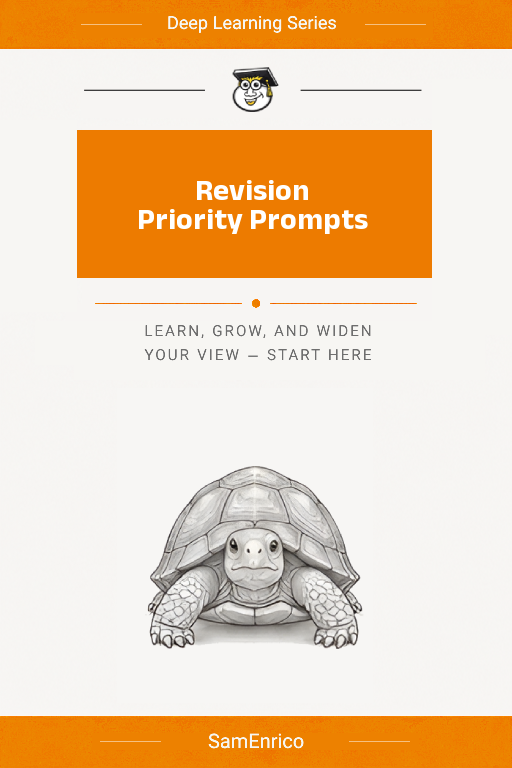
Non-FictionStudent's ShortcutRevision
Revision Priority Prompts eBook
Identify the weakest sections of your essay for re
by Moyer Zena
Identify the weakest sections of your essay for revision using GPT diagnostic prompts and scoring.
Formats
Free sample
Chapter 1: The Revision Trap--–- Maria stared at her screen, her history essay blinking back at her like an accusation. She had just spent four hours—four hours—moving commas, swapping synonyms, and smoothing out what she thought were “awkward phrases.” The draft was shinier now, certainly. The sentences flowed more smoothly. She felt productive. She felt accomplished.
She felt ready to submit.Then her professor handed back the paper. The grade: C+. The comment: “Your thesis is buried. The argument doesn’t hold together. You’ve focused on style over substance.
Please come see me.”Maria walked to office hours confused and defensive. She had worked hard. She had revised. How could the paper still be so broken?Her professor pulled up the original draft—the one before Maria’s four-hour editing marathon—and placed it next to the final submission. “You fixed sentences,” the professor said gently.
“But your thesis was on page three in the first draft. It’s still on page three here. Your second paragraph made an unsupported claim about economic mobility. That claim is still unsupported. You polished the paint while the engine was on fire.”That sentence changed Maria’s writing life: You polished the paint while the engine was on fire.The Most Expensive Mistake Writers Make Maria’s story is not unusual.
It is, in fact, the most common revision mistake in the history of writing. Across every domain—student essays, business reports, blog posts, even novels—writers consistently fix the wrong things first. They line-edit too early. They polish sentences before they have a working thesis. They tweak word choice while their argument has a hole in its logic.
And then they wonder why their revisions didn’t work.This chapter will show you why that happens, what the research says about effective vs. ineffective revision, and—most importantly—introduce you to a better way. By the end of this chapter, you will understand the single most important principle of efficient revision: diagnose before you edit.You will also meet the tool that will make that diagnosis possible: not a ghostwriter, not a crutch, but a blind-spot detector that can see what you’ve stopped seeing. That tool is GPT. But before we get to the solution, we need to understand the problem.Why Line-Editing Feels So Productive (And Why That Feeling Lies)There is a psychological reason writers reach for the comma key before they reach for the thesis statement.
Fixing sentences feels good. It feels concrete. You can see the before and after. You can watch a passive construction become active. You can delete a “very” and feel like a minimalist warrior.
These small wins produce dopamine—the same neurotransmitter that makes slot machines addictive.Fixing structural problems, by contrast, feels awful. Diagnosing a weak thesis requires you to admit that your central claim might be vague or unarguable. That hurts. Recognizing that your evidence doesn’t actually support your claim feels like failure. Rewriting whole paragraphs—or cutting them entirely—feels like wasting work you already did.So writers take the path of least psychological resistance.
They edit sentences. They polish grammar. They run spell-check. And they call it revision.But here is the truth that separates effective revisers from ineffective ones: line-editing too early kills deep structure repair.Let me say that again: When you fix sentences before you fix your thesis, your evidence, and your logic, you are not saving time. You are actively making it harder to fix the real problems.
Here’s why.Every sentence you polish becomes harder to cut later. You’ve invested effort. You’ve made it sound nice. Now the thought of deleting that beautiful sentence feels like throwing away something valuable. So you keep it.
You rearrange it. You move it to another paragraph. But the underlying problem—the unsupported claim, the broken logic, the missing transition—remains. You have become attached to your own polish.This is called the sunk cost fallacy in revision. The more time you spend on low-level fixes, the less willing you are to make high-level changes.
By editing sentences first, you lock yourself into a bad structure. By editing sentences last, you ensure that every polished sentence serves a strong foundation.The 80/20 Rule of Revision In 1906, Italian economist Vilfredo Pareto observed that 80% of the land in Italy was owned by 20% of the population. This pattern—the unequal distribution of inputs to outputs—has since been observed in everything from business to software engineering to, yes, writing.The 80/20 rule (also known as the Pareto Principle) states that roughly 80% of results come from 20% of efforts. Applied to revision: 20% of your revisions will produce 80% of the improvement in your essay.The question, then, is not whether to revise. The question is: Which 20%?Most writers cannot answer this question.
They revise by feel. They revise what annoys them. They revise what they already know how to fix. They revise sentences because sentence-level fixes are easy and unambiguous. As a result, they spend 80% of their revision time on changes that produce only 20% of the possible improvement.
They work hard. They work long. They do not work smart.The writers who win—who get A’s, who get published, who get promoted—have learned to identify the 20% of revisions that matter. They find the weak thesis, the orphaned claim, the missing logical step. They fix those first.
Then, and only then, do they polish sentences. They spend less time revising overall, and their final drafts are dramatically better.This book exists to turn you into that second kind of writer.The Revision Priority Matrix: Your New Compass To know which 20% of revisions to focus on, you need a system for ranking weaknesses. You cannot trust your gut. Your gut has been trained by years of easy wins and dopamine hits. Your gut wants you to fix commas.
Your gut is wrong.What you need is a Revision Priority Matrix (RPM) —a simple two-axis framework that will become your compass for every revision session from this book forward. The RPM will be introduced formally in Chapter 3 and used throughout the rest of the book. But you need to see its logic now, because it explains everything that follows.The RPM has two axes:Axis 1: Diagnostic Score (0–10) – This comes from running your essay through the five diagnostic prompts you will learn in Chapters 4 through 8. A high score (7–10) means the section is weak. A low score (0–3) means the section is strong.
(Yes, this is inverted from normal scoring—higher number = more weakness—because we want to prioritize what’s broken.)Axis 2: Importance Score (1–5) – This you assign yourself, based on how central the section is to your essay’s main argument. A section that contains your thesis or a key piece of evidence gets a 5. A tangential anecdote or a repetitive summary might get a 1.When you plot a section on these two axes, four quadrants emerge:High Importance (4–5)Low Importance (1–2)High Weakness (7–10)🔥 REVISE FIRST✂️ CUT OR MERGELow Weakness (0–3)✅ CHECK SECOND🧹 POLISH LASTHere is what each quadrant means for your revision priorities:Fire Quadrant (High Weakness / High Importance): These sections are both broken and central. They are your top priority. Fix…
This is the end of the free sample. Get the eBook to keep going. Buy now
About this book
Details
- Author
- Moyer Zena
- Publisher
- SamEnrico
- Language
- English
- Genre
- Non-Fiction, Student's Shortcut, Revision
- Released
- 2026-06-01
- Pages (approx.)
- 153
- Available as
- eBook, Audiobook

Read better in the ZLOADR app
Your eBooks on your phone or tablet. Sign in with your SamEnrico account and start reading.
More by Moyer Zena
 Kidney Failure Anticipatory GriefMoyer Zena$11.99
 Thunberg Climate ReparationsMoyer Zena$11.99
 Long Marriage Divorce RecoveryMoyer Zena$11.99
 Religion Change Parent AngerMoyer Zena$11.99
 Key Metrics Dashboard GuideMoyer Zena$11.99
 Consignment Inventory AIMoyer Zena$11.99
 Constraints for WritersMoyer Zena$11.99
 Assertiveness for Remote WorkersMoyer Zena$11.99
 Oisín’s Forgotten Lament: The Bard Who Outlived TimeMoyer Zena$11.99
 The Iron Crown of Burgundy: Maximillian I and the Birth of a DynastyMoyer Zena$11.99
 How to Produce OverallsMoyer Zena$11.99
 How to Produce Conference Room TablesMoyer Zena$11.99
You may also like
 Hong Kong Handover 1997Dunn Johnnie$11.99
 Zumba For Postnatal Recovery CourseNeal Christian$11.99
 Zumba for BeginnersLadner Nikia$11.99
 YouTube Comment Mining GuideHumes Pandora$12.99
 Worry Box MeditationCarlin Rudy$11.99
 Workplace Stress MeditationNguyen Lynn$11.99
 Workplace Stress and Sleep RepairHawley Ivory$11.99
 Workplace Perfectionism CureDelaney Jeffry$11.99
 Workplace Injustice Anger GuideWallen Isabelle$11.99
 Work Addiction and Burnout LinkGreenwood Ester$11.99
 Women in Yoga and WellnessBeattie Galina$11.99
 Women in Stand Up ComedyChun Evangeline$11.99