
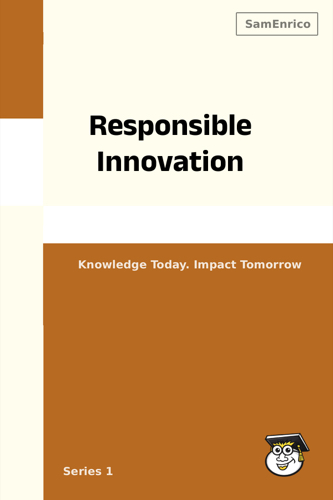
Responsible Innovation eBook
undefined
undefined
Formats
Free sample
Chapter 1: The Innovation Paradox...--Every breakthrough carries the seed of a breakdown. This is not a pessimistic view of progress—it is an empirical observation that has repeated itself across industries, centuries, and technologies. The steam engine enabled factories and also enabled industrial pollution. The automobile gave us personal freedom and also gave us traffic fatalities. The internet democratized information and also democratized disinformation.
And today, artificial intelligence promises to cure diseases while simultaneously threatening to automate bias at scale. This pattern—where the very qualities that make an innovation successful also make it dangerous—is what this book calls the Innovation Paradox. Understanding this paradox is the first and most essential step toward becoming a responsible innovator.Let us begin with a story about speed. In 2005, a group of financial engineers at a major investment bank developed a novel product called a Collateralized Debt Obligation, or CDO. The idea was elegant: take thousands of individual mortgages, bundle them together, and sell slices of the bundle to investors.
The risk was diversified. The returns were attractive. And the speed at which these instruments spread through the global financial system was breathtaking. Within three years, the market for CDOs had grown from virtually nothing to over $500 billion. The engineers who designed them were celebrated as geniuses.
They were paid millions. They believed they had made the world safer by distributing risk more efficiently.What they had actually done was hide risk so effectively that no one—not the banks, not the regulators, not the rating agencies—could see that the underlying mortgages were failing. When the housing market turned in 2007, the entire system collapsed. The financial crisis of 2008 wiped out $10 trillion in global wealth. Millions lost their homes.
And when investigators asked who was responsible, they found a classic example of what this book will call the Many Hands Problem. The engineers blamed the bankers. The bankers blamed the regulators. The regulators blamed the rating agencies. Everyone had a share of the responsibility.
No one was held accountable.Now contrast that story with a different one about speed. In January 2020, a novel coronavirus was spreading across the globe. There was no vaccine. Traditional vaccine development took five to ten years. But a technology called m RNA—which had been researched for decades but never deployed—was ready.
Companies like Pfizer and Moderna pivoted their entire operations. Regulators accelerated their review processes. Manufacturing capacity was built before clinical trials were complete. Within eleven months, a vaccine was authorized for emergency use. By the end of 2021, billions of doses had been administered.
The speed was unprecedented. And this time, the outcome was overwhelmingly positive.Why did two stories about fast, disruptive innovation end so differently? The CDO creators had no governance framework in place. They moved fast without asking who would be harmed if they were wrong. The m RNA vaccine developers, by contrast, were building on decades of foundational research, existing regulatory pathways, and a global infrastructure for safety monitoring.
They moved fast because they had already done the slow work of preparation. The difference was not speed itself. The difference was whether speed was accompanied by anticipation, reflection, deliberation, and responsiveness—the four pillars that will structure this entire book.The Innovation Paradox, then, is not a reason to slow down. It is a reason to be strategic about when speed serves progress and when it serves disaster. This chapter introduces the paradox and provides your first tool—the Pre-Mortem—which will help you anticipate failure before it happens.
By the end of this chapter, you will understand why the most dangerous phrase in innovation is not "this might fail" but rather "we will fix it later."The Anatomy of the Innovation Paradox To understand why the same qualities that make innovation valuable also make it dangerous, we need to examine three specific mechanisms: speed, scale, and disruption. Each of these is celebrated in startup culture, each is rewarded by financial markets, and each can become catastrophic when separated from ethical governance.Speed is the most obvious culprit. When an innovation moves quickly from concept to deployment, there is less time for testing, less time for stakeholder input, and less time for regulators to catch up. The financial industry's CDOs moved from mathematical model to trillion-dollar market in three years—faster than any regulatory body could have analyzed the risks. The result was not just a crash but a systemic collapse.
However, as the m RNA vaccine example shows, speed is not inherently bad. The vaccine was fast because the underlying science had been developed slowly over decades. The speed was the final sprint of a marathon, not the first dash of an unprepared sprinter.Scale is the second mechanism. Innovations that succeed often scale rapidly, reaching millions or billions of users within months. A flawed product used by a hundred people is a bug.
A flawed product used by a hundred million people is a catastrophe. Consider the case of a hiring algorithm used by a major tech company. When the company tested the algorithm on a small dataset, it appeared to work well. When they scaled it to millions of applicants, they discovered that it systematically penalized women—not because anyone programmed it to, but because it had learned from historical hiring data that favored men. The scale amplified the harm.
The company fixed the algorithm, but not before thousands of qualified women had been rejected.Disruption is the third mechanism, and perhaps the most seductive. Clayton Christensen, the Harvard Business School professor who popularized the concept of disruptive innovation, argued that the best new products often come from the edges—solutions that are simpler, cheaper, or more convenient than existing options, and that eventually overtake the incumbents. Disruption is celebrated in Silicon Valley. But disruption also destroys. It destroys jobs, industries, and communities.
The disruption caused by ride-sharing apps created convenience for millions of riders and also destroyed the livelihoods of traditional taxi drivers who had invested in medallions worth hundreds of thousands of dollars. The disruption caused by e-commerce created lower prices for consumers and also destroyed main street retail, hollowing out small-town America. Disruption is not inherently good or bad. It is powerful. And power without responsibility is the definition of danger.The Innovation Paradox, therefore, is not a bug in the system.
It is a feature. The same mechanisms that produce breakthrough benefits—speed, scale, disruption—also produce catastrophic harms when left ungoverned. The responsible innovator does not try to eliminate these mechanisms. That would be impossible and undesirable. Instead, the responsible innovator learns to harness them while building guardrails that prevent the harms.Two Paths, Same Speed: A Deeper Case Study Let us return to the contrast between CDOs and m RNA vaccines, but with more detail.
The story is richer than a simple "good versus evil" narrative. Both innovations were created by highly intelligent, well-intentioned people. Both solved real problems. Both scaled rapidly. Both had unexpected consequences.
The difference lies in how each field thought about failure.The financial engineers who invented CDOs were not villains. They were mathematicians and physicists who had moved into finance because it paid well and offered interesting problems.…
This is the end of the free sample. Get the eBook to keep going. Buy now
About this book
Details
- Author
- Prescott Luvenia
- Publisher
- SamEnrico
- Language
- English
- Genre
- Non-Fiction, Self-Help
- Released
- 2026-06-06
- Pages (approx.)
- 160
- Available as
- eBook, Audiobook

Read better in the ZLOADR app
Your eBooks on your phone or tablet. Sign in with your SamEnrico account and start reading.
More by Prescott Luvenia
 Navy SEAL Morning ProtocolPrescott Luvenia$11.99
 The Chief Joseph BiographyPrescott Luvenia$11.99
 Alcohol Withdrawal Medications GuidePrescott Luvenia$11.99
 Veteran Caregiver Stress GuidePrescott Luvenia$11.99
 The Financial Stress Hope GuidePrescott Luvenia$11.99
 Meditation for CostochondritisPrescott Luvenia$11.99
 Daily Review for CreativesPrescott Luvenia$11.99
 Wings Over the Himalayas: The Forgotten Love of the Flying TigersPrescott Luvenia$11.99
 The Phantom of Pentonville: The Victorian Era's Most Audacious Escape ArtistPrescott Luvenia$11.99
 How to Become a Home-service DirectorPrescott Luvenia$11.99
 How to Produce RecyclingPrescott Luvenia$11.99
 VAT on Low Value GoodsPrescott Luvenia$12.99
You may also like
 Hong Kong Handover 1997Dunn Johnnie$11.99
 Zumba For Postnatal Recovery CourseNeal Christian$11.99
 Zumba for BeginnersLadner Nikia$11.99
 YouTube Comment Mining GuideHumes Pandora$12.99
 Worry Box MeditationCarlin Rudy$11.99
 Workplace Stress MeditationNguyen Lynn$11.99
 Workplace Stress and Sleep RepairHawley Ivory$11.99
 Workplace Perfectionism CureDelaney Jeffry$11.99
 Workplace Injustice Anger GuideWallen Isabelle$11.99
 Work Addiction and Burnout LinkGreenwood Ester$11.99
 Women in Yoga and WellnessBeattie Galina$11.99
 Women in Stand Up ComedyChun Evangeline$11.99