
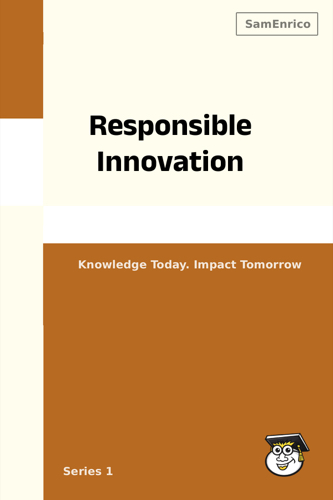
Responsible Innovation Audiobook
undefined
undefined
Formats
Free sample
Chapter 1: The Innovation Paradox...--Every breakthrough carries the seed of a breakdown. This is not a pessimistic view of progress—it is an empirical observation that has repeated itself across industries, centuries, and technologies. The steam engine enabled factories and also enabled industrial pollution. The automobile gave us personal freedom and also gave us traffic fatalities. The internet democratized information and also democratized disinformation.
And today, artificial intelligence promises to cure diseases while simultaneously threatening to automate bias at scale. This pattern—where the very qualities that make an innovation successful also make it dangerous—is what this book calls the Innovation Paradox. Understanding this paradox is the first and most essential step toward becoming a responsible innovator.Let us begin with a story about speed. In 2005, a group of financial engineers at a major investment bank developed a novel product called a Collateralized Debt Obligation, or CDO. The idea was elegant: take thousands of individual mortgages, bundle them together, and sell slices of the bundle to investors.
The risk was diversified. The returns were attractive. And the speed at which these instruments spread through the global financial system was breathtaking. Within three years, the market for CDOs had grown from virtually nothing to over $500 billion. The engineers who designed them were celebrated as geniuses.
They were paid millions. They believed they had made the world safer by distributing risk more efficiently.What they had actually done was hide risk so effectively that no one—not the banks, not the regulators, not the rating agencies—could see that the underlying mortgages were failing. When the housing market turned in 2007, the entire system collapsed. The financial crisis of 2008 wiped out $10 trillion in global wealth. Millions lost their homes.
And when investigators asked who was responsible, they found a classic example of what this book will call the Many Hands Problem. The engineers blamed the bankers. The bankers blamed the regulators. The regulators blamed the rating agencies. Everyone had a share of the responsibility.
No one was held accountable.Now contrast that story with a different one about speed. In January 2020, a novel coronavirus was spreading across the globe. There was no vaccine. Traditional vaccine development took five to ten years. But a technology called m RNA—which had been researched for decades but never deployed—was ready.
Companies like Pfizer and Moderna pivoted their entire operations. Regulators accelerated their review processes. Manufacturing capacity was built before clinical…
This is the end of the free sample. Get the Audiobook to keep going. Buy now
About this book
Details
- Author
- Prescott Luvenia
- Publisher
- SamEnrico
- Language
- English
- Genre
- Non-Fiction, Self-Help
- Released
- 2026-06-06
- Pages (approx.)
- 160
- Available as
- eBook, Audiobook

Listen in the VoxFlicks app
Audiobooks and audio dramas wherever you go. Sign in with your SamEnrico account and press play.
More by Prescott Luvenia
 Navy SEAL Morning ProtocolPrescott Luvenia$11.99
 The Chief Joseph BiographyPrescott Luvenia$11.99
 Alcohol Withdrawal Medications GuidePrescott Luvenia$11.99
 Veteran Caregiver Stress GuidePrescott Luvenia$11.99
 The Financial Stress Hope GuidePrescott Luvenia$11.99
 Meditation for CostochondritisPrescott Luvenia$11.99
 Daily Review for CreativesPrescott Luvenia$11.99
 Wings Over the Himalayas: The Forgotten Love of the Flying TigersPrescott Luvenia$11.99
 The Phantom of Pentonville: The Victorian Era's Most Audacious Escape ArtistPrescott Luvenia$11.99
 How to Become a Home-service DirectorPrescott Luvenia$11.99
 How to Produce RecyclingPrescott Luvenia$11.99
 VAT on Low Value GoodsPrescott Luvenia$12.99
You may also like
 Hong Kong Handover 1997Dunn Johnnie$11.99
 Zumba For Postnatal Recovery CourseNeal Christian$11.99
 Zumba for BeginnersLadner Nikia$11.99
 YouTube Comment Mining GuideHumes Pandora$12.99
 Worry Box MeditationCarlin Rudy$11.99
 Workplace Stress MeditationNguyen Lynn$11.99
 Workplace Stress and Sleep RepairHawley Ivory$11.99
 Workplace Perfectionism CureDelaney Jeffry$11.99
 Workplace Injustice Anger GuideWallen Isabelle$11.99
 Work Addiction and Burnout LinkGreenwood Ester$11.99
 Women in Yoga and WellnessBeattie Galina$11.99
 Women in Stand Up ComedyChun Evangeline$11.99