
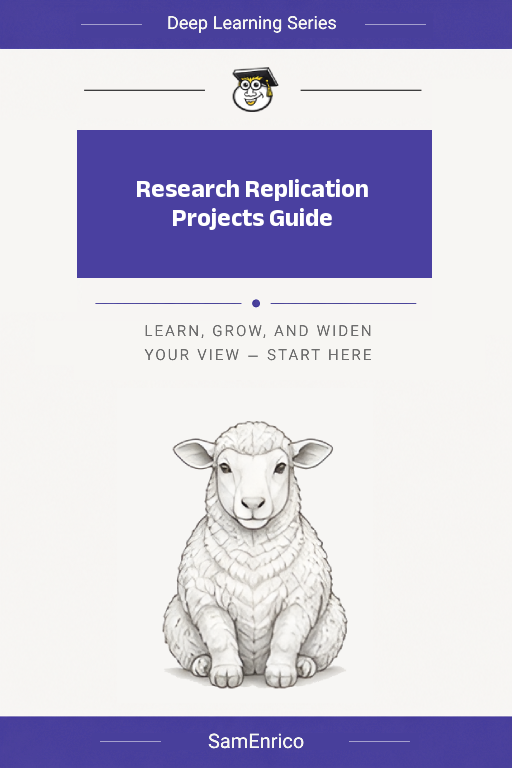
researchStudent's ShortcutReplication
Research Replication Projects Guide eBook
Replicate existing studies and document your findi
by Jobe Marlin
Replicate existing studies and document your findings as evidence of research skills.
Formats
Free sample
Chapter 1: The Hidden Crisis...--–- On a quiet morning in 2011, a third-year graduate student named Diederik Stapel sat in his office at Tilburg University, unaware that within weeks his career would collapse and, in doing so, shake the foundations of social psychology to its core. Stapel was a star. He had published dozens of papers in the field's most prestigious journals. He had won awards, trained successful students, and secured substantial grants. His research was elegant, surprising, and highly cited – the kind of work that made other researchers nod in admiration and whisper, "Why didn't I think of that?" One study showed that messy environments increased racial stereotyping.
Another found that exposure to meat made people more selfish. A third demonstrated that merely thinking about money reduced emotional distress. Each finding was a perfect little gem – clean, counterintuitive, and ready for a press release.–- Then came the investigation. Junior researchers had tried and failed to replicate Stapel's effects. Suspicious patterns emerged in his data.
When a whistleblower came forward and the university launched an inquiry, what they found was staggering. For more than a decade, Stapel had simply fabricated data. He had invented participants, created spreadsheets from scratch, and published results that had no empirical basis whatsoever. In total, 58 published papers were identified as fraudulent. The case was not an isolated lapse but a systematic campaign of deception spanning fifteen years.
Stapel later admitted that he had stopped conducting real experiments altogether – it was simply easier to type numbers into a spreadsheet that would produce the desired result.–- The Stapel case was shocking, but it was also, in one crucial sense, a distraction. It was easy to condemn a fraudster. It was comfortable to believe that the problem with science was a few bad apples. But as the 2010s unfolded, a more uncomfortable truth emerged. The problem was not just fraud.
The problem was that even honest, well-intentioned researchers – following standard practices, publishing in top journals, winning prestigious awards – might be producing findings that were false. Not because they lied, but because the normal incentives and methods of science had, quietly and systematically, broken down.–- This chapter is the story of that breakdown. Before you learn how to replicate, you must understand why replication became an urgent scientific priority. The skills you will develop in this book – the careful verification of code, the systematic robustness check, the transparent extension of existing results – are not abstract methodological niceties. They are the direct response to a crisis that has reshaped how science is done.
And they are your competitive advantage. In a world where most published findings may be wrong, the researcher who can reliably separate signal from noise becomes indispensable.The Illusion of Cumulative Knowledge–- Imagine for a moment that you are a new researcher entering a field. You open the major journals. You read the latest review articles. You learn what the field believes: that priming elderly stereotypes makes people walk slower, that power poses boost testosterone, that willpower is a depletable resource.
These findings are taught in graduate seminars, cited in textbooks, and repeated in TED Talks. They feel solid, like bricks in an established wall of knowledge.–- Now imagine that someone tells you that most of those bricks are hollow. That if you actually try to build on them, they will crumble. This is not a metaphor. This is the literal state of large swaths of the social and biomedical sciences as documented by a series of landmark investigations beginning in the early 2000s.–- The first alarm came from an unlikely source: a Greek epidemiologist named John Ioannidis working at the University of Ioannina.
In 2005, he published a paper with a deliberately provocative title: "Why Most Published Research Findings Are False." At the time, many researchers dismissed it as a mathematical curiosity. Ioannidis had not discovered new data about failed replications. Instead, he had built a formal model of how scientific discovery works. He asked a simple question: Given the typical sample sizes, effect sizes, and levels of bias in published research, what is the probability that any given positive finding is true?–- The answer was terrifying. Under plausible assumptions – studies with low statistical power, small effect sizes, and a field where multiple research groups are testing related hypotheses – the majority of published positive findings should be false positives.
Not because anyone cheated, but because of the mathematics of hypothesis testing combined with publication bias. If you run a study with 20% power (meaning an 80% chance of missing a real effect), and you only publish the results that reach statistical significance, you will publish many false alarms. The formal term is the "positive predictive value" of a research finding. Ioannidis showed that in many fields, it might be below 50%. In other words, you would be more likely to be wrong than right when you published a positive result.–- The paper was a bombshell, but it was also abstract.
It described a potential problem. What was needed was empirical evidence – actual attempts to replicate published findings to see if they held up.The OSC Study: When 100 Replications Shook Psychology–- That evidence arrived a decade later, and it changed everything. In 2015, the Open Science Collaboration (OSC) – a large, international network of researchers committed to transparency – published the results of a massive replication project. They had selected 100 experiments from three top psychology journals and conducted high-quality replications with large samples. The protocol was meticulous.
Original authors were consulted. Replication materials were reviewed. Statistical power was high (typically 90% or more to detect the original effect size).–- The results were devastating. Of the 100 original studies, 97 had reported statistically significant results (p < .05). In the replications, only 36% achieved statistical significance.
The average effect size in the replications was half the size of the original effect sizes. When the researchers looked at the confidence intervals – the range of plausible effect sizes consistent with the data – nearly two-thirds of the original effects fell outside the replication's confidence interval.–- Let that sink in. Two-thirds of the original effects were so far from the replication results that they could not plausibly be attributed to sampling error alone. Something systematic was wrong. The findings that psychology had been teaching for decades – the textbook experiments, the classic demonstrations, the foundations of countless dissertations – were not holding up when subjected to rigorous independent verification.–- The OSC study was not a critique of any single researcher or laboratory.
It was a systemic audit. It said: The way we have been doing science has produced a published record that is not a reliable guide to empirical truth. The crisis was not that some people cheated. The crisis was that normal science, as normally practiced, was generating false positives at an alarming rate.Three Case Studies in Replication Failure–- To understand the crisis in concrete terms, let us examine three famous findings that failed to replicate. These are not obscure studies from unknown journals.
They are landmark papers, widely cited, frequently taught, and deeply influential.Case 1: The Elderly Priming Study–- In 1996, social psychologist John Bargh and his colleagues published a study that seemed to reveal a startling truth about the unconscious…
This is the end of the free sample. Get the eBook to keep going. Buy now
About this book
Details
- Author
- Jobe Marlin
- Publisher
- SamEnrico
- Language
- English
- Genre
- research, Student's Shortcut, Replication
- Released
- 2026-06-01
- Pages (approx.)
- 158
- Available as
- eBook, Audiobook

Read better in the ZLOADR app
Your eBooks on your phone or tablet. Sign in with your SamEnrico account and start reading.
More by Jobe Marlin
 Nobel Laureates Who Changed WorldJobe Marlin$11.99
 Drug Dependency and Hepatitis CJobe Marlin$11.99
 Self Talk for Single ParentsJobe Marlin$11.99
 Side Torso Exposure GuideJobe Marlin$11.99
 The Nobel Laureate ImmigrantsJobe Marlin$11.99
 Yellowstone Disappearance CasesJobe Marlin$11.99
 Mindful Eating First BiteJobe Marlin$11.99
 Howard Marks MemoJobe Marlin$11.99
 The Arctic Highway: The Great Alaska BirdwayJobe Marlin$11.99
 The Dacian Revolt: Trajan's Bloody March to SarmizegetusaJobe Marlin$11.99
 Growing ConospermumJobe Marlin$11.99
 BOI Update RequirementsJobe Marlin$12.99
You may also like
 Scientific Research On TM GuideMartens Nathanial$11.99
 Research Proposal Methodology Section MasteryPauley Debroah$11.99
 Research Proposal Appendix CompilationRaines Tyisha$11.99
 Academic Researcher Distraction GuideFord Virgil$11.99
 TM Research and ScienceCovert Nicki$11.99
 Social Anxiety Research ReviewRoberge Cole$11.99
 Research Proposal Significance Section GuideBock Tory$12.99
 Research Proposal Reviewer PsychologyLugo Tawanda$11.99
 Research Proposal Research Questions DesignLara Robbi$11.99
 Research Proposal References and CitationsPatten Shanice$11.99
 Research Proposal Mixed Methods DesignCameron Omega$11.99
 Research Proposal Data Management PlanAnderson Roberto$12.99