
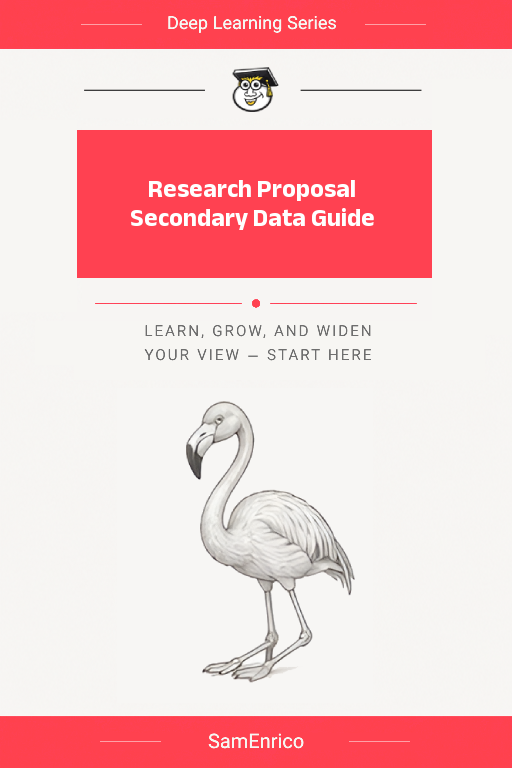
researchStudent's ShortcutSecondary Analysis
Research Proposal Secondary Data Guide eBook
Write proposals using existing datasets including
Write proposals using existing datasets including access justification, variable selection, and analytic plans.
Formats
Free sample
Chapter 1: The Collection Illusion--–- Most researchers never question the assumption that original knowledge requires original data. They spend months—sometimes years—designing surveys, recruiting participants, cleaning messy instrument errors, and defending their sampling strategies to skeptical committees. Then, after all that effort, they discover their sample size is too small to detect meaningful effects, or their response rate was too low, or their carefully constructed question was interpreted differently than intended. This book exists because that entire model is optional. You do not need to collect a single new observation to make a significant, original, and publishable contribution to your field.
What you need is a different mindset, a different skillset, and a different proposal—one built around secondary data analysis.The Myth of the Blank Slate Every academic discipline teaches the same implicit lesson: real research starts with a blank slate. You identify a gap in the literature. You formulate a hypothesis. You design an instrument. You collect data.
You analyze. You publish. This sequence is so deeply embedded in graduate training that most researchers cannot imagine an alternative. Yet consider for a moment the inefficiency embedded in this model. Every year, thousands of researchers ask similar questions, collect similar variables, and produce similar datasets—all independently, all from scratch, all reinventing the methodological wheel.Secondary data analysis flips this model on its head.
Instead of collecting new data, you find existing data that already contains the variables you need. Instead of defending your collection procedures, you evaluate and document the provenance of an existing dataset. Instead of waiting months for IRB approval and recruitment, you begin analysis as soon as you can access the files. The question is not whether secondary data is legitimate—it has been the foundation of major discoveries in epidemiology, economics, political science, and sociology for decades. The question is whether you know how to write a proposal that convinces reviewers that your secondary analysis is as rigorous—and often more rigorous—than any primary collection.Consider the landmark Framingham Heart Study, which began in 1948 and continues today.
While the original collection was primary, thousands of subsequent papers have been published using the same data—each asking new questions, testing new hypotheses, and discovering new relationships without collecting a single new blood sample. Or consider the General Social Survey, which has been administered annually or biennially since 1972. Tens of thousands of published papers have used GSS data to study everything from political polarization to religious affiliation to trust in institutions. None of those researchers interviewed a single respondent. They wrote proposals, accessed the data, and produced knowledge.This chapter introduces the foundational concepts that will guide the entire book: what secondary data is, why it offers strategic advantages over primary collection, how to think about validity in a secondary context, and where this book will take you across the remaining eleven chapters.
By the end of this chapter, you will understand why collecting nothing is not a limitation but a superpower.What Exactly Is Secondary Data?Before we go further, we need precise definitions. Secondary data is any data that was collected by someone other than the user for a purpose other than the user's current research question. That definition covers a vast landscape, and understanding the terrain is essential for writing effective proposals because different types of secondary data come with different access requirements, different documentation standards, and different expectations from reviewers.The four major categories of secondary data are public, restricted, administrative, and commercial. Each has distinct characteristics that affect how you justify access in your proposal.Public data is freely available to anyone with an internet connection. No permission is required, though citation is always expected.
Examples include the World Bank Open Data portal, which provides economic indicators for every country; the CDC's WONDER database, which contains mortality and disease statistics; and the General Social Survey's public-use files. Public data is the easiest to access but often comes with the least documentation and the most aggregation. You rarely get individual-level responses; instead, you get summary tables or anonymized extracts. For many research questions, this is sufficient. For others, you need more detail.Restricted data requires explicit permission from the data steward.
You must apply, often complete training in data security, sign a Data Use Agreement (DUA), and agree to specific conditions about storage, sharing, and publication review. Examples include the National Health and Nutrition Examination Survey (NHANES) limited-access files, which contain geographic identifiers and detailed health measures; the Panel Study of Income Dynamics (PSID) restricted geocode data; and the Census Bureau's Confidential Data Access Program. Restricted data offers richer variables and larger samples but requires a longer proposal timeline because access negotiations can take weeks or months. Chapter 3 provides detailed guidance on navigating this process.Administrative data is collected for non-research purposes—typically to manage programs, track compliance, or issue benefits—and then repurposed for research. Examples include hospital discharge records, school test score databases, unemployment insurance claims, and tax records.
Administrative data often has enormous sample sizes (sometimes entire populations) and high accuracy for the variables that matter to the program. However, it also comes with unique challenges: variables are defined by bureaucratic needs, not theoretical constructs; missing data follows administrative rules, not research designs; and access is often controlled by agencies with no obligation to support external researchers. Writing a proposal for administrative data requires demonstrating that you understand the generating process behind the numbers.Commercial data is collected and sold by private companies. Examples include Nielsen scanner data for consumer purchases, Compustat for corporate financials, and social media data from platforms like Twitter or Reddit. Commercial data can be expensive—sometimes prohibitively so—but it often provides unprecedented detail and scale.
Proposals using commercial data must justify not only the scientific merit but also the budget for data acquisition and any restrictions on publication imposed by the data vendor.Throughout this book, we will return to a single running example to illustrate concepts: a dataset of 2,700 books sold on Amazon US between 2009 and 2019, originally collected to study sales volume but repurposed for multiple research questions. This example appears in every chapter, starting with Chapter 2's detective mindset. For now, understand that secondary data is not a single thing. It is a spectrum from public to restricted, from simple to complex, from free to costly. Your proposal must be tailored to the specific category you are using.The Efficiency Argument: Why Secondary Data Wins Most researchers think of secondary data as a fallback—something you use when you cannot afford to collect your own.
This is exactly backwards. Secondary data offers positive advantages that primary collection cannot match, and understanding these advantages is essential for writing a persuasive proposal.First, cost. A typical survey-based dissertation might require printing, postage, incentive payments, software licenses for survey platforms, and possibly travel. A large-scale longitudinal study can cost millions. Secondary data, in contrast, is often free or available for a nominal data processing fee.
Public datasets cost nothing. Restricted datasets may require only the time to complete an application. Even commercial data, while expensive, is usually far cheaper than collecting comparable data from scratch. When you write a proposal based on…
This is the end of the free sample. Get the eBook to keep going. Buy now
About this book
Details
- Author
- Criswell Walter
- Publisher
- SamEnrico
- Language
- English
- Genre
- research, Student's Shortcut, Secondary Analysis
- Released
- 2026-06-01
- Pages (approx.)
- 144
- Available as
- eBook, Audiobook

Read better in the ZLOADR app
Your eBooks on your phone or tablet. Sign in with your SamEnrico account and start reading.
More by Criswell Walter
 Acetaminophen GuideCriswell Walter$11.99
 Social Security Tax GuideCriswell Walter$11.99
 Equal Justice Initiative FightCriswell Walter$11.99
 Peg System For Customer NamesCriswell Walter$11.99
 Reconstruction of Bite Mark CasesCriswell Walter$11.99
 Widow Loneliness CopingCriswell Walter$11.99
 Corey Feldman Coreys CurseCriswell Walter$11.99
 Pomodoro for MarketersCriswell Walter$11.99
 The Phantom of Flight 447: The Ice That Fell from the SkyCriswell Walter$11.99
 The Maestro of the Machine Age: John Philip Sousa and the Birth of American Marching MusicCriswell Walter$11.99
 How to Produce Postage StampsCriswell Walter$11.99
 Mastering The Levator ScapulaeCriswell Walter$11.99
You may also like
 Scientific Research On TM GuideMartens Nathanial$11.99
 Research Proposal Methodology Section MasteryPauley Debroah$11.99
 Research Proposal Appendix CompilationRaines Tyisha$11.99
 Academic Researcher Distraction GuideFord Virgil$11.99
 TM Research and ScienceCovert Nicki$11.99
 Social Anxiety Research ReviewRoberge Cole$11.99
 Research Proposal Significance Section GuideBock Tory$12.99
 Research Proposal Reviewer PsychologyLugo Tawanda$11.99
 Research Proposal Research Questions DesignLara Robbi$11.99
 Research Proposal References and CitationsPatten Shanice$11.99
 Research Proposal Mixed Methods DesignCameron Omega$11.99
 Research Proposal Data Management PlanAnderson Roberto$12.99