
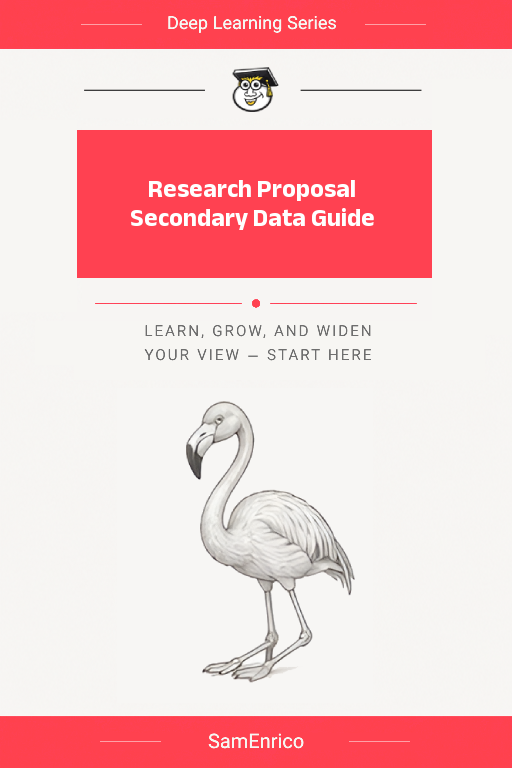
researchStudent's ShortcutSecondary Analysis
Research Proposal Secondary Data Guide Audiobook
Write proposals using existing datasets including
Write proposals using existing datasets including access justification, variable selection, and analytic plans.
Formats
Free sample
Chapter 1: The Collection Illusion--–- Most researchers never question the assumption that original knowledge requires original data. They spend months—sometimes years—designing surveys, recruiting participants, cleaning messy instrument errors, and defending their sampling strategies to skeptical committees. Then, after all that effort, they discover their sample size is too small to detect meaningful effects, or their response rate was too low, or their carefully constructed question was interpreted differently than intended. This book exists because that entire model is optional. You do not need to collect a single new observation to make a significant, original, and publishable contribution to your field.
What you need is a different mindset, a different skillset, and a different proposal—one built around secondary data analysis.The Myth of the Blank Slate Every academic discipline teaches the same implicit lesson: real research starts with a blank slate. You identify a gap in the literature. You formulate a hypothesis. You design an instrument. You collect data.
You analyze. You publish. This sequence is so deeply embedded in graduate training that most researchers cannot imagine an alternative. Yet consider for a moment the inefficiency embedded in this model. Every year, thousands of researchers ask similar questions, collect similar variables, and produce similar datasets—all independently, all from scratch, all reinventing the methodological wheel.Secondary data analysis flips this model on its head.
Instead of collecting new data, you find existing data that already contains the variables you need. Instead of defending your collection procedures, you evaluate and document the provenance of an existing dataset. Instead of waiting months for IRB approval and recruitment, you begin analysis as soon as you can access the files. The question is not whether secondary data is legitimate—it has been the foundation of major discoveries in epidemiology, economics, political science, and sociology for decades. The question is whether you know how to write a proposal that convinces reviewers that your secondary analysis is as rigorous—and often more rigorous—than any primary collection.Consider the landmark Framingham Heart Study, which began in 1948 and continues today.
While the original collection was primary, thousands of subsequent papers have been published using the same data—each asking new questions, testing new hypotheses, and discovering new relationships without collecting a single new blood sample. Or consider the General Social Survey, which has been administered annually or biennially since 1972. Tens of thousands of published papers…
This is the end of the free sample. Get the Audiobook to keep going. Buy now
About this book
Details
- Author
- Criswell Walter
- Publisher
- SamEnrico
- Language
- English
- Genre
- research, Student's Shortcut, Secondary Analysis
- Released
- 2026-06-01
- Pages (approx.)
- 144
- Available as
- eBook, Audiobook

Listen in the VoxFlicks app
Audiobooks and audio dramas wherever you go. Sign in with your SamEnrico account and press play.
More by Criswell Walter
 Acetaminophen GuideCriswell Walter$11.99
 Social Security Tax GuideCriswell Walter$11.99
 Equal Justice Initiative FightCriswell Walter$11.99
 Peg System For Customer NamesCriswell Walter$11.99
 Reconstruction of Bite Mark CasesCriswell Walter$11.99
 Widow Loneliness CopingCriswell Walter$11.99
 Corey Feldman Coreys CurseCriswell Walter$11.99
 Pomodoro for MarketersCriswell Walter$11.99
 The Phantom of Flight 447: The Ice That Fell from the SkyCriswell Walter$11.99
 The Maestro of the Machine Age: John Philip Sousa and the Birth of American Marching MusicCriswell Walter$11.99
 How to Produce Postage StampsCriswell Walter$11.99
 Mastering The Levator ScapulaeCriswell Walter$11.99
You may also like
 Scientific Research On TM GuideMartens Nathanial$11.99
 Research Proposal Methodology Section MasteryPauley Debroah$11.99
 Research Proposal Appendix CompilationRaines Tyisha$11.99
 Academic Researcher Distraction GuideFord Virgil$11.99
 TM Research and ScienceCovert Nicki$11.99
 Social Anxiety Research ReviewRoberge Cole$11.99
 Research Proposal Significance Section GuideBock Tory$12.99
 Research Proposal Reviewer PsychologyLugo Tawanda$11.99
 Research Proposal Research Questions DesignLara Robbi$11.99
 Research Proposal References and CitationsPatten Shanice$11.99
 Research Proposal Mixed Methods DesignCameron Omega$11.99
 Research Proposal Data Management PlanAnderson Roberto$12.99