
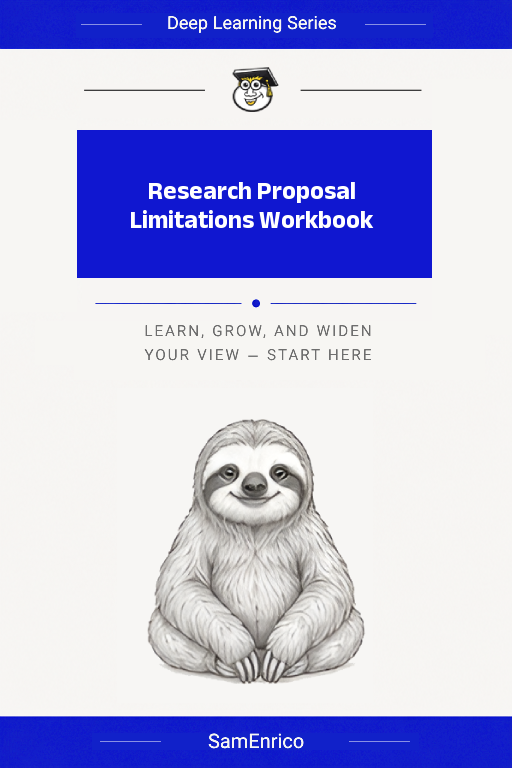
researchStudent's ShortcutCritical Self Assessment
Research Proposal Limitations Workbook eBook
Acknowledge potential weaknesses proactively while
by Sneed Nadene
Acknowledge potential weaknesses proactively while explaining how they do not undermine your core contribution.
Formats
Free sample
Chapter 1: The Confession Paradox--Every researcher I have ever met has a secret. It is not the secret of faked data or plagiarized paragraphs. It is something far more common, far more human, and far more destructive to the success of their proposals. The secret is this: when they reach the limitations section of their grant application, dissertation, or journal article, they feel like they are confessing to a crime.I have watched this secret unfold in real time across more than two hundred writing workshops and over twelve hundred proposal reviews. A brilliant early-career scientist with impeccable data and a genuinely novel hypothesis will suddenly shrink.
Their sentences become passive. Their verbs apologize. They write things like “Unfortunately, we were unable to…” or “This study suffers from…” or “We acknowledge this major limitation…” as if they are standing before a judge asking for leniency. The same researcher who confidently defended their methodology for ten pages now sounds like a defendant awaiting sentencing.This is the confession paradox. The very act of acknowledging a limitation—something that every honest study must do—triggers a deep psychological response that makes us write defensively, apologetically, and often counterproductively.
We fear that if we point to a crack in our own foundation, the reviewer will declare the entire building unsound. So we hide the crack, or we mention it in a rushed whisper at the end of the discussion, or we bury it under so much hedging that no one can tell what we are actually saying.Here is the truth that this entire book is built upon: the confession paradox is a lie. Reviewers are not penalizing the presence of limitations. They are penalizing ignorance, defensiveness, and lack of awareness. The researcher who hides a flaw until a reviewer finds it signals either incompetence (if they did not see it) or deceit (if they saw it and chose to conceal it).
The researcher who names the flaw first, explains why it does not destroy their contribution, and shows how they have mitigated it signals something entirely different: mastery.This chapter will rewire your emotional relationship with failure. It will show you, through real cases and research evidence, why strategic transparency is not just safe but advantageous. It will introduce you to the core framework that runs through every subsequent chapter. And it will give you the first of many diagnostic tools to assess where you currently stand—and where you need to go.The Perfection Fallacy Let me start with a blunt statement. There is no such thing as a perfect research proposal.
There is not a single funded grant, approved dissertation, or published article in the history of science that did not have limitations. This is not a cynical observation. It is a logical necessity. Every research design makes trade-offs. You cannot study a large, representative sample and also conduct deep, hour-long interviews with every participant.
You cannot establish causality through a randomized controlled trial and also study rare, real-world phenomena that cannot be ethically randomized. You cannot measure everything perfectly, control for every confound, and generalize to every population simultaneously.These trade-offs are not failures. They are the very substance of research design. The question is never whether your study has limitations. The question is always whether you understand your limitations well enough to contextualize them.I call the mistaken belief that a study can be flawless the perfection fallacy.
It manifests in proposal writing in predictable ways. The researcher spends ninety percent of their energy trying to hide or minimize every possible weakness, often contorting their design into something unrecognizable. They avoid ambitious questions because those questions invite harder limitations. They choose safe, well-trodden paths because those paths have known, acceptable flaws. They write limitations sections that are either entirely absent or filled with meaningless boilerplate: “This study is not without limitations,” or “Future research should address these issues,” or the truly useless “More research is needed.”The perfection fallacy is not just inefficient.
It is actively harmful. When you pretend your study has no meaningful limitations, you signal to the reviewer that either you do not see them (in which case you are naive) or you see them and are choosing to hide them (in which case you are untrustworthy). Neither signal gets your proposal funded.Consider two real cases from my analysis of funded and unfunded grants. The first proposal, an NIH R21 application, had a genuine flaw. The sample was drawn entirely from a single hospital system in the Midwest.
The researchers could have hidden this fact or buried it in a footnote. Instead, they opened their limitations section with this sentence: “Our sample is limited to a single geographic region, which restricts generalizability to populations with different healthcare infrastructures.” Then they did something remarkable. They explained why this limitation actually strengthened their core claim. “However, this homogeneity controls for regional variation in insurance models, allowing us to isolate the effect of the intervention without the confounding influence of differential access.” The proposal was funded. A reviewer’s public comment read: “The applicants demonstrate unusual self-awareness about their design constraints.”The second proposal, from a different team studying a similar intervention, used a nearly identical design.
But their limitations section read: “This study is limited by its geographic scope. Future research should replicate in other regions.” That was it. No explanation of impact. No mitigation. No connection back to their contribution.
The proposal was not funded. A reviewer noted: “The limitations section is perfunctory. The applicants do not seem to understand how their design choices affect their conclusions.”Notice the difference. Both proposals had the exact same limitation. The first team was funded.
The second was not. The difference was not the presence of the limitation. It was the way they handled it. The first team used strategic transparency. The second team treated limitations as a box to check.Strategic Transparency: What It Is and What It Is Not Strategic transparency is the practice of proactively naming your study’s weaknesses in a way that demonstrates expertise, builds trust, and reinforces your core contribution.
It is not confession. It is not apology. It is not an invitation for the reviewer to reject you. It is a demonstration that you know your design well enough to understand its boundaries.Let me be precise about what strategic transparency is not.First, it is not full disclosure of every possible flaw. You do not need to mention that your second author prefers coffee over tea, or that you collected data on a Tuesday, or that one participant had a cold.
The goal is not radical honesty about every trivial detail. The goal is selective, strategic acknowledgment of limitations that could meaningfully affect your conclusions. (Chapter 4 will teach you exactly how to distinguish between mandatory and optional limitations.)Second, it is not performative humility. Writing “We are well aware that our study has many flaws” without specificity does not make you look humble. It makes you look unprepared.
Strategic transparency requires precision. You must name the specific limitation, explain its specific impact, and propose specific mitigations. Vagueness is the enemy of credibility.Third, it is not an invitation for the reviewer to…
This is the end of the free sample. Get the eBook to keep going. Buy now
About this book
Details
- Author
- Sneed Nadene
- Publisher
- SamEnrico
- Language
- English
- Genre
- research, Student's Shortcut, Critical Self Assessment
- Released
- 2026-06-01
- Pages (approx.)
- 159
- Available as
- eBook, Audiobook

Read better in the ZLOADR app
Your eBooks on your phone or tablet. Sign in with your SamEnrico account and start reading.
More by Sneed Nadene
 Imposter Speaking Up GuideSneed Nadene$11.99
 Forensic Entomology Scene ReconstructionSneed Nadene$11.99
 Ronan Farrow Child of HollywoodSneed Nadene$11.99
 Pomodoro for EntrepreneursSneed Nadene$11.99
 Subway Elevator Victory StorySneed Nadene$11.99
 Prolonged Grief Disorder HelpSneed Nadene$11.99
 Phonetic Peg System For NumbersSneed Nadene$11.99
 Lighting for Hypnosis ListeningSneed Nadene$11.99
 The Iron Duke and the Golden Age of EmpireSneed Nadene$11.99
 The Starkeepers of Meroë: How Kushite Astronomers Charted the CosmosSneed Nadene$11.99
 Mastering The BrachialisSneed Nadene$11.99
 Business Applicant Essay GuideSneed Nadene$12.99
You may also like
 Scientific Research On TM GuideMartens Nathanial$11.99
 Research Proposal Methodology Section MasteryPauley Debroah$11.99
 Research Proposal Appendix CompilationRaines Tyisha$11.99
 Academic Researcher Distraction GuideFord Virgil$11.99
 TM Research and ScienceCovert Nicki$11.99
 Social Anxiety Research ReviewRoberge Cole$11.99
 Research Proposal Significance Section GuideBock Tory$12.99
 Research Proposal Reviewer PsychologyLugo Tawanda$11.99
 Research Proposal Research Questions DesignLara Robbi$11.99
 Research Proposal References and CitationsPatten Shanice$11.99
 Research Proposal Mixed Methods DesignCameron Omega$11.99
 Research Proposal Data Management PlanAnderson Roberto$12.99