
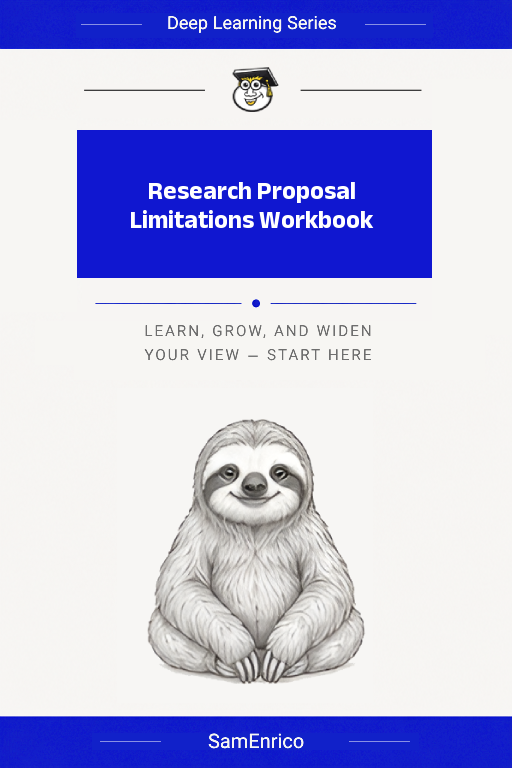
researchStudent's ShortcutCritical Self Assessment
Research Proposal Limitations Workbook Audiobook
Acknowledge potential weaknesses proactively while
by Sneed Nadene
Acknowledge potential weaknesses proactively while explaining how they do not undermine your core contribution.
Formats
Free sample
Chapter 1: The Confession Paradox--Every researcher I have ever met has a secret. It is not the secret of faked data or plagiarized paragraphs. It is something far more common, far more human, and far more destructive to the success of their proposals. The secret is this: when they reach the limitations section of their grant application, dissertation, or journal article, they feel like they are confessing to a crime.I have watched this secret unfold in real time across more than two hundred writing workshops and over twelve hundred proposal reviews. A brilliant early-career scientist with impeccable data and a genuinely novel hypothesis will suddenly shrink.
Their sentences become passive. Their verbs apologize. They write things like “Unfortunately, we were unable to…” or “This study suffers from…” or “We acknowledge this major limitation…” as if they are standing before a judge asking for leniency. The same researcher who confidently defended their methodology for ten pages now sounds like a defendant awaiting sentencing.This is the confession paradox. The very act of acknowledging a limitation—something that every honest study must do—triggers a deep psychological response that makes us write defensively, apologetically, and often counterproductively.
We fear that if we point to a crack in our own foundation, the reviewer will declare the entire building unsound. So we hide the crack, or we mention it in a rushed whisper at the end of the discussion, or we bury it under so much hedging that no one can tell what we are actually saying.Here is the truth that this entire book is built upon: the confession paradox is a lie. Reviewers are not penalizing the presence of limitations. They are penalizing ignorance, defensiveness, and lack of awareness. The researcher who hides a flaw until a reviewer finds it signals either incompetence (if they did not see it) or deceit (if they saw it and chose to conceal it).
The researcher who names the flaw first, explains why it does not destroy their contribution, and shows how they have mitigated it signals something entirely different: mastery.This chapter will rewire your emotional relationship with failure. It will show you, through real cases and research evidence, why strategic transparency is not just safe but advantageous. It will introduce you to the core framework that runs through every subsequent chapter. And it will give you the first of many diagnostic tools to assess where…
This is the end of the free sample. Get the Audiobook to keep going. Buy now
About this book
Details
- Author
- Sneed Nadene
- Publisher
- SamEnrico
- Language
- English
- Genre
- research, Student's Shortcut, Critical Self Assessment
- Released
- 2026-06-01
- Pages (approx.)
- 159
- Available as
- eBook, Audiobook

Listen in the VoxFlicks app
Audiobooks and audio dramas wherever you go. Sign in with your SamEnrico account and press play.
More by Sneed Nadene
 Imposter Speaking Up GuideSneed Nadene$11.99
 Forensic Entomology Scene ReconstructionSneed Nadene$11.99
 Ronan Farrow Child of HollywoodSneed Nadene$11.99
 Pomodoro for EntrepreneursSneed Nadene$11.99
 Subway Elevator Victory StorySneed Nadene$11.99
 Prolonged Grief Disorder HelpSneed Nadene$11.99
 Phonetic Peg System For NumbersSneed Nadene$11.99
 Lighting for Hypnosis ListeningSneed Nadene$11.99
 The Iron Duke and the Golden Age of EmpireSneed Nadene$11.99
 The Starkeepers of Meroë: How Kushite Astronomers Charted the CosmosSneed Nadene$11.99
 Mastering The BrachialisSneed Nadene$11.99
 Business Applicant Essay GuideSneed Nadene$12.99
You may also like
 Scientific Research On TM GuideMartens Nathanial$11.99
 Research Proposal Methodology Section MasteryPauley Debroah$11.99
 Research Proposal Appendix CompilationRaines Tyisha$11.99
 Academic Researcher Distraction GuideFord Virgil$11.99
 TM Research and ScienceCovert Nicki$11.99
 Social Anxiety Research ReviewRoberge Cole$11.99
 Research Proposal Significance Section GuideBock Tory$12.99
 Research Proposal Reviewer PsychologyLugo Tawanda$11.99
 Research Proposal Research Questions DesignLara Robbi$11.99
 Research Proposal References and CitationsPatten Shanice$11.99
 Research Proposal Mixed Methods DesignCameron Omega$11.99
 Research Proposal Data Management PlanAnderson Roberto$12.99