
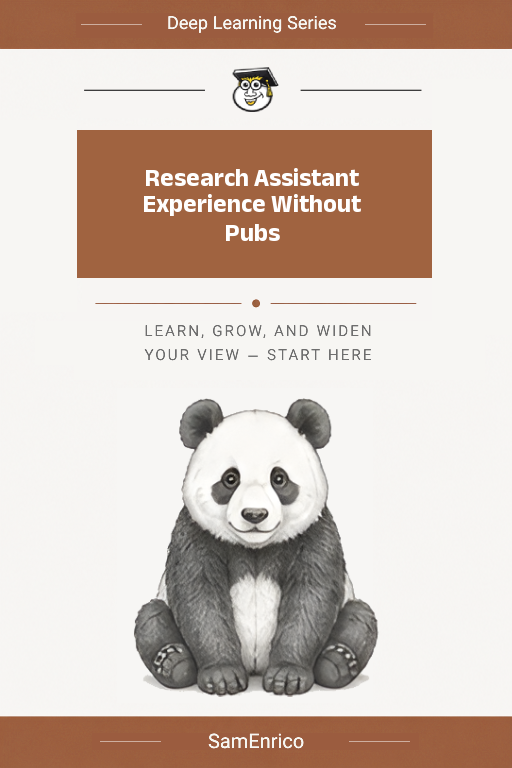
Research Assistant Experience Without Pubs eBook
Frame RA work as evidence of research capability e
Frame RA work as evidence of research capability even when tasks didn't lead to author credit.
Formats
Free sample
Chapter 1: The Invisible Curriculum...--Every research assistant knows the precise moment the shame sets in. It happens when someone asks the wrong question at the wrong time. A faculty member at a department mixer says, "So, what do you work on?" You explain your project—the hours of data cleaning, the troubleshooting, the literature reviews you’ve written for your PI. They nod politely. Then comes the killer: "And how many papers have you published from that work?" Your stomach drops.
You say, "Well, I’m an RA, so…" Your voice trails off. They smile—that tight, knowing smile—and move on to talk to someone else. You have just been assessed and found wanting. Not because you lack skills. Not because you haven't done the work.
But because you lack the receipt.If this scene feels familiar, you are not alone. Across every discipline and every type of research institution, tens of thousands of Research Assistants are doing the real work of research every day—collecting data, maintaining equipment, verifying citations, cleaning datasets, troubleshooting protocols, training undergraduates, writing IRB amendments, managing timelines, and catching errors that would have derailed entire projects. And yet, when it comes time to apply for a Ph D, a job, or even just respect within their own department, they are told some version of the same thing: "But where are your publications?"The premise of this book is simple, radical, and true: Authorship is merely a receipt of contribution, not the contribution itself. A published paper with your name on it is one form of evidence that you can do research. But it is not the only form.
And for a vast number of Research Assistants—particularly those working in large labs, under prominent PIs, or on projects where the credit structure is already locked in before you arrive—publication credit may have nothing to do with whether you actually developed research capability.This chapter names the problem that the rest of the book exists to solve. It is called the Authorship Fallacy: the widespread, largely unexamined assumption that publication credit is the only valid metric of research potential. It is the belief that a CV without a first-author paper is a CV without evidence. It is the reason RAs spend years developing genuine expertise, only to feel like impostors when they stand before an admissions committee or a hiring manager.But here is what the Authorship Fallacy hides: the actual work of research is not writing discussion sections. It is not polishing narratives for publication.
The actual work of research—the messy, iterative, problem-solving work that separates people who understand how knowledge is made from people who only consume it—happens almost entirely outside the drafting stage. It happens when you are staring at a dataset that won't clean properly. It happens when you realize a citation has been copied incorrectly through three generations of papers. It happens when you notice that the control condition in an experiment was contaminated, and you have to decide whether to tell your PI or quietly fix it. It happens when you are the only person in the lab who knows how to calibrate the cryostat, and everyone else is on vacation.
That work is research. And you have done it.The Three Lies Academia Tells About Publications To understand why the Authorship Fallacy is so powerful, we have to understand the three lies that academia tells about publications. These lies are not malicious. They are structural. They are reproduced by well-meaning advisors, by admissions committees with too many applicants and too little time, and by a publishing system that has no incentive to track intellectual labor—only final authorship.Lie #1: Publication Credit Reflects Intellectual Contribution This is the most obvious lie, and the easiest to debunk.
In reality, authorship order on a multi-author paper is determined by a complex mix of factors: who wrote the grant, who designed the study, who collected the data, who analyzed it, who wrote the first draft, who had the most negotiating power, who was sleeping with whom in the lab hierarchy, whose career needed the boost, and who simply showed up and asked. A first author may have done the intellectual heavy lifting—or they may have been the person willing to write the draft while everyone else moved on to the next project. A sixth author may have made the single most important intellectual contribution to the study, buried in the acknowledgements because they joined the project too late or left too early. And Research Assistants, who often do the unglamorous work of data curation, protocol troubleshooting, and error detection, are routinely left off entirely.Here is a simple test: ask any PI to list, from memory, every RA who contributed to their last three papers. Most cannot.
Not because they are dishonest, but because the system does not require them to track that labor. The paper gets published. The PI gets credit. The RA moves on to the next task. And when that RA applies to graduate school, the absence of their name on the byline is read as evidence of absence of contribution.
This is the Authorship Fallacy in action.Lie #2: No Publications Means No Research Experience This lie operates through a sleight of hand. It conflates experience with documentation. Research experience is the process of doing research. Publications are one form of documentation of that process. But documentation is not the same as experience, and absence of documentation is not the same as absence of experience.Consider two hypothetical RAs.
RA A works on a fast-moving project, a small lab where the PI is eager to publish quickly. Within six months, RA A has a second-author paper in a mid-tier journal. RA B works on a massive longitudinal study with a data collection phase that lasts three years. RA B's job is to manage the participant database, clean incoming data, troubleshoot protocol deviations, and train a rotating cast of undergraduate research assistants. After two years, RA B has zero publications—the analysis phase hasn't even started.
Which RA has more research experience? By any honest measure, RA B has vastly more hands-on, problem-solving, real-world research experience. But RA B's CV looks empty. This is not a failure of RA B's capability. It is a failure of the credentialing system.Lie #3: The Job Market Requires Publications This lie is partially true, which is what makes it so dangerous.
It is true that competitive Ph D programs and certain academic jobs expect to see publications on an applicant's CV. But the lie is in the word requires. It suggests that without publications, you cannot compete. That is false. What the job market actually requires is evidence of research capability.
Publications are one form of that evidence. But so are well-framed RA experiences, strong letters of recommendation that speak to your intellectual contributions, a portfolio of non-publication writing (protocols, reports, data management plans), and a compelling interview narrative that demonstrates you understand the research process from the inside.The rest of this book exists to show you how to produce that evidence. But first, you have to stop believing the lies. You have to internalize a different truth: you did…
This is the end of the free sample. Get the eBook to keep going. Buy now
About this book
Details
- Author
- Snowden Jenifer
- Publisher
- SamEnrico
- Language
- English
- Genre
- research, Student's Shortcut
- Released
- 2026-05-29
- Pages (approx.)
- 151
- Available as
- eBook, Audiobook

Read better in the ZLOADR app
Your eBooks on your phone or tablet. Sign in with your SamEnrico account and start reading.
More by Snowden Jenifer
 HGH And Cortisol BalanceSnowden Jenifer$11.99
 Diamond Dealer Bankruptcy AftermathSnowden Jenifer$11.99
 Exercise During Work Hours GuideSnowden Jenifer$11.99
 TM for TherapistsSnowden Jenifer$11.99
 Smokeless Tobacco Cessation PlanSnowden Jenifer$11.99
 HGH Hair Growth ConnectionSnowden Jenifer$11.99
 Interview Answer SystemSnowden Jenifer$11.99
 Idea Speed Dating For TeamsSnowden Jenifer$11.99
 Swedish Green Tax HandbookSnowden Jenifer$11.99Swedish Green Tax HandbookSnowden Jenifer$11.99
 The Vanishing of Flight 447: A Cry in the DarkSnowden Jenifer$11.99
 The Last Whisper of the Crystal CavesSnowden Jenifer$11.99
You may also like
 Scientific Research On TM GuideMartens Nathanial$11.99
 Research Proposal Methodology Section MasteryPauley Debroah$11.99
 Research Proposal Appendix CompilationRaines Tyisha$11.99
 Academic Researcher Distraction GuideFord Virgil$11.99
 TM Research and ScienceCovert Nicki$11.99
 Social Anxiety Research ReviewRoberge Cole$11.99
 Research Proposal Significance Section GuideBock Tory$12.99
 Research Proposal Reviewer PsychologyLugo Tawanda$11.99
 Research Proposal Research Questions DesignLara Robbi$11.99
 Research Proposal References and CitationsPatten Shanice$11.99
 Research Proposal Mixed Methods DesignCameron Omega$11.99
 Research Proposal Data Management PlanAnderson Roberto$12.99