
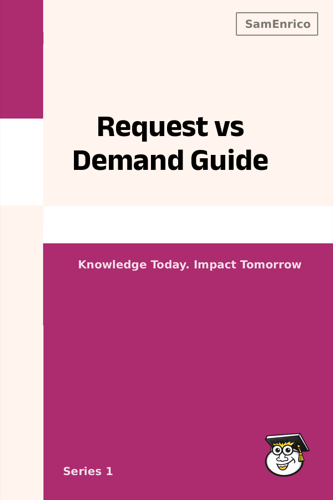
Request vs Demand Guide eBook
Distinguishes requests from demands to avoid power
Distinguishes requests from demands to avoid power struggles.
Formats
Free sample
Chapter 1: The Invisible Line--–- Sarah had just asked her partner, David, to help with the dishes. She was tired, the kitchen was a mess, and she’d had a long day. “Would you mind doing the dishes tonight?” she said. David sighed, his shoulders tensing. “Fine,” he muttered, then spent the next twenty minutes clanking plates in pointed silence.
Sarah felt confused and hurt. She’d asked, hadn’t she? She hadn’t yelled. She hadn’t threatened. So why did it feel like a war had just been fought over a sink full of soapy water?Twenty-four hours later, Sarah’s boss, Marcus, used nearly identical words.
“Hey Sarah, would you mind staying late to finish the quarterly report?” Sarah’s stomach clenched. She had plans, she was exhausted, and she knew that “no” wasn’t really an option. “Sure,” she said with a tight smile, then spent the evening resentfully typing while her friends sent photos from dinner. Two requests. Two entirely different contexts.
And yet, in both cases, the person on the receiving end felt trapped, not asked.Here is the truth that most communication books refuse to say aloud: the difference between a request and a demand has almost nothing to do with the words you use. You can say “please” until you are blue in the face. You can soften your tone, add a smile, and frame your sentence as a question. None of it matters if the other person does not feel genuinely free to say no.This chapter is not about semantics. It is about power.
Specifically, it is about the invisible line that runs through every human interaction—the line between an invitation that respects autonomy and a command that triggers resistance. Most people cross this line dozens of times per day without ever realizing it. They wonder why their “polite requests” are met with defensiveness, procrastination, or silent rebellion. They blame the other person for being unreasonable, lazy, or passive-aggressive. But the problem is not the other person.
The problem is that the line was crossed, and no one saw it happen.The Core Distinction: Relational Freedom vs. Structural Constraint Let us begin with a definition that will serve as the backbone of this entire book. A request is an invitation that leaves the other person free to say no without fear of relational punishment. Relational punishment includes withdrawal of affection, silent treatment, shaming, guilt-tripping, angry outbursts, cold shoulders, or any other consequence that travels through the emotional fabric of the relationship. When you make a genuine request, a “no” might disappoint you, but it will not lead you to punish the other person.A demand, by contrast, is a command that carries an implicit or explicit threat of relational punishment for non-compliance.
The punishment does not have to be dramatic. It can be as subtle as a sigh, a frown, a slightly cooler tone of voice for the next hour, or a pointed comment about how “some people are just selfish.” If the other person fears that saying no will cost them something in the relationship, they are not responding to a request. They are responding to a demand.But here is where most books get stuck, and where this book makes a critical refinement. Not all consequences are created equal. Some consequences are structural, not relational.
Structural consequences include deadlines, safety protocols, legal requirements, contractual obligations, and performance metrics. If your boss says, “This report must be submitted by Friday or it will affect your quarterly review,” that is not necessarily a demand. It is a statement of structural reality. The consequence is attached to a role, a system, or a law—not to the boss’s personal affection for you. A structural consequence can be communicated cleanly, without relational punishment.
A relational consequence is always personal, always emotional, and always controlling.This distinction is the invisible line. A request says, “You are free to choose, and I will still respect you regardless.” A demand says, “You are free to choose, but I will punish you relationally if you choose wrong.” The words can be identical. The difference lives entirely in the perceived freedom of the receiver.The Biology of Resistance: Why Your Brain Hates Demands To understand why this distinction matters so much, we need to look at what happens inside the human nervous system when someone makes a demand. Neuroscientific research over the past two decades has shown that the brain does not process demands and requests the same way. When you hear a demand—especially one that carries an implicit threat of relational punishment—your amygdala, the brain’s threat-detection center, activates as if you were facing a physical danger.
This triggers the sympathetic nervous system, commonly known as the fight, flight, or freeze response.Consider what that means. When your partner says, “You should really help out more around here,” your brain does not hear a suggestion. It hears a predator. Your heart rate increases. Cortisol floods your system.
Your prefrontal cortex—the part of your brain responsible for rational problem-solving—downregulates because the brain believes you need to survive first and think second. In that state, you cannot respond with creativity, generosity, or open-hearted collaboration. You can only respond with defense.That is why a demand almost never produces the outcome the asker wanted. If you demand compliance, you might get it, but it will be brittle compliance. The other person will do what you asked while secretly resenting you.
They might comply today and sabotage tomorrow. They might agree outwardly while procrastinating internally. Or they might simply shut down, withdraw, and stop engaging with you altogether. None of these outcomes feel like connection. All of them feel like power struggles.A request, by contrast, does not trigger the threat response.
When you say, “Would you be willing to help with the dishes?” and the other person genuinely believes they can say no without punishment, their nervous system stays calm. Their prefrontal cortex remains online. They can think about your request, consider their own needs, and respond honestly. They might say yes with genuine willingness. They might say no with an explanation.
They might offer a negotiation. But whatever they say, they are responding as a whole human being, not as a cornered animal.This is not theoretical. Psychologists have documented this dynamic for decades. Self-determination theory, developed by Edward Deci and Richard Ryan, identifies autonomy as one of the three fundamental psychological needs for human well-being. When you violate someone’s autonomy by making a demand, you are not just being rude.
You are attacking a core psychological requirement for their mental health. The resistance you feel is not stubbornness. It is self-protection.The Jackal and the Giraffe: A Metaphor for Two Ways of Speaking Marshall Rosenberg, the founder of Nonviolent Communication, developed a powerful metaphor that captures the difference between demanding and requesting. He spoke of two animals: the jackal and the giraffe.The jackal is a predator. It is aggressive, territorial, and quick to attack.
In Rosenberg’s framework, the jackal represents the voice of judgment, criticism, blame, and demand. When you speak like a jackal, you see the world in…
This is the end of the free sample. Get the eBook to keep going. Buy now
About this book
Details
- Author
- Mcfarlane Tereasa
- Publisher
- SamEnrico
- Language
- English
- Genre
- Non-Fiction, Self-Help, Assertiveness
- Released
- 2026-06-08
- Pages (approx.)
- 135
- Available as
- eBook, Audiobook

Read better in the ZLOADR app
Your eBooks on your phone or tablet. Sign in with your SamEnrico account and start reading.
More by Mcfarlane Tereasa
 Anxiety Sleep ResetMcfarlane Tereasa$11.99
 Teresas Prayer of Quiet PracticeMcfarlane Tereasa$11.99
 Effectively Skill GuideMcfarlane Tereasa$11.99
 Design Thinking for OnboardingMcfarlane Tereasa$11.99
 Remote Work for TruckersMcfarlane Tereasa$11.99
 Validating EmbarrassmentMcfarlane Tereasa$11.99
 Quitting Tobacco for Good HandbookMcfarlane Tereasa$11.99
 The Persian Marathoners: Running Beyond Human Limits in Ancient PersiaMcfarlane Tereasa$11.99
 Ashen Legacy: The Fire That Forged a DynastyMcfarlane Tereasa$11.99
 A Collector's Handbook to the Hillman Minx Phase ViiiMcfarlane Tereasa$11.99
 WIPO Madrid Portfolio AuditsMcfarlane Tereasa$12.99
 Service Providers Guide to Pediatric DentistryMcfarlane Tereasa$11.99
You may also like
 Recurring Dreams of ScreamingNolen Lester$11.99
 Interruption Proof Personal BoundariesMorey Wilhelmina$11.99
 Anger Assertiveness DistinctionHendrix Marianela$11.99
 Making Clear Requests GuideFries Pinkie$11.99
 Assertiveness For Lovers GuideWeller Alec$11.99
 Workplace Boundary Setting CourseEaston Truman$11.99
 Saying No GracefullyRichie Rochell$11.99
 Honest Expression NVCHackett Krystin$11.99
 The Interruption FearTurner Ora$11.99
 The Interruption Deflection ScriptLuster Billi$11.99
 Passive Aggressive Stress ResponseMeredith Shirly$11.99
 Guilt Of Saying NoGordon Vera$11.99