
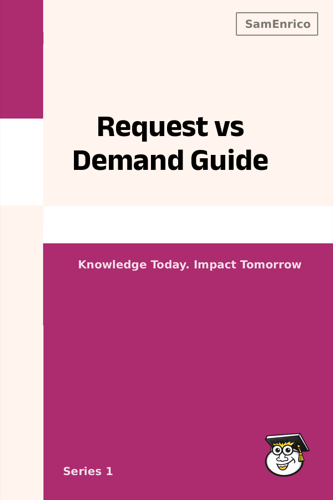
Request vs Demand Guide
Distinguishes requests from demands to avoid power
Distinguishes requests from demands to avoid power struggles.
Formats
About this book
Free sample
Chapter 1: The Invisible Line--–- Sarah had just asked her partner, David, to help with the dishes. She was tired, the kitchen was a mess, and she’d had a long day. “Would you mind doing the dishes tonight?” she said. David sighed, his shoulders tensing. “Fine,” he muttered, then spent the next twenty minutes clanking plates in pointed silence.
Sarah felt confused and hurt. She’d asked, hadn’t she? She hadn’t yelled. She hadn’t threatened. So why did it feel like a war had just been fought over a sink full of soapy water?Twenty-four hours later, Sarah’s boss, Marcus, used nearly identical words.
“Hey Sarah, would you mind staying late to finish the quarterly report?” Sarah’s stomach clenched. She had plans, she was exhausted, and she knew that “no” wasn’t really an option. “Sure,” she said with a tight smile, then spent the evening resentfully typing while her friends sent photos from dinner. Two requests. Two entirely different contexts.
And yet, in both cases, the person on the receiving end felt trapped, not asked.Here is the truth that most communication books refuse to say aloud: the difference between a request and a demand has almost nothing to do with the words you use. You can say “please” until you are blue in the face. You can soften your tone, add a smile, and frame your sentence as a question. None of it matters if the other person does not feel genuinely free to say no.This chapter is not about semantics. It is about power.
Specifically, it is about the invisible line that runs through every human interaction—the line between an invitation that respects autonomy and a command that triggers resistance. Most people cross this line dozens of times per day without ever realizing it. They wonder why their “polite requests” are met with defensiveness, procrastination, or silent rebellion. They blame the other person for being unreasonable, lazy, or passive-aggressive. But the problem is not the other person.
The problem is that the line was crossed, and no one saw it happen.The Core Distinction: Relational Freedom vs. Structural…
This is the end of the free sample. Get the eBook to keep going. Buy now
Contents
- Chapter 1
- Chapter 2
- Chapter 3
- Chapter 4
- Chapter 5
- Chapter 6
- Chapter 7
- Chapter 8
- Chapter 9
- Chapter 10
- Chapter 11
- Chapter 12
Details
- Author
- Mcfarlane Tereasa
- Publisher
- SamEnrico
- Language
- English
- Genre
- Non-Fiction, Self-Help, Assertiveness
- Released
- 2026-06-08
- Pages (approx.)
- 135
- Available as
- eBook, Audiobook

Read better in the ZLOADR app
Your eBooks on your phone or tablet. Sign in with your SamEnrico account and start reading.
More by Mcfarlane Tereasa
 Anxiety Sleep ResetMcfarlane Tereasa$11.99
 Teresas Prayer of Quiet PracticeMcfarlane Tereasa$11.99
 Effectively Skill GuideMcfarlane Tereasa$11.99
 Design Thinking for OnboardingMcfarlane Tereasa$11.99
 Remote Work for TruckersMcfarlane Tereasa$11.99
 Validating EmbarrassmentMcfarlane Tereasa$11.99
 Quitting Tobacco for Good HandbookMcfarlane Tereasa$11.99
 The Persian Marathoners: Running Beyond Human Limits in Ancient PersiaMcfarlane Tereasa$11.99
 Ashen Legacy: The Fire That Forged a DynastyMcfarlane Tereasa$11.99
 A Collector's Handbook to the Hillman Minx Phase ViiiMcfarlane Tereasa$11.99
 WIPO Madrid Portfolio AuditsMcfarlane Tereasa$12.99
 Service Providers Guide to Pediatric DentistryMcfarlane Tereasa$11.99
You may also like
 Recurring Dreams of ScreamingNolen Lester$11.99
 Interruption Proof Personal BoundariesMorey Wilhelmina$11.99
 Anger Assertiveness DistinctionHendrix Marianela$11.99
 Making Clear Requests GuideFries Pinkie$11.99
 Assertiveness For Lovers GuideWeller Alec$11.99
 Workplace Boundary Setting CourseEaston Truman$11.99
 Saying No GracefullyRichie Rochell$11.99
 Honest Expression NVCHackett Krystin$11.99
 The Interruption FearTurner Ora$11.99
 The Interruption Deflection ScriptLuster Billi$11.99
 Passive Aggressive Stress ResponseMeredith Shirly$11.99
 Guilt Of Saying NoGordon Vera$11.99