
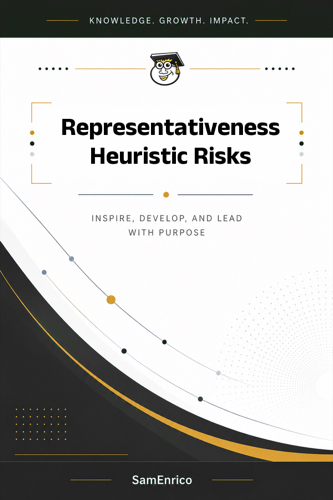
Representativeness Heuristic Risks Audiobook
Avoids stereotyping in judgment.
Avoids stereotyping in judgment.
Formats
Free sample
Chapter 1: The Prototype Prison--You have already sentenced someone today. Not in a courtroom, not with a gavel, but with a flicker of recognition that took less than a second. The person who walked past you on the sidewalk—the one with the tired eyes and the loose-fitting clothes. You decided something about them. Perhaps you decided they were unemployed, or lazy, or sick, or safe.
You did not have a single piece of evidence. You had a resemblance. And that resemblance was enough.This is not a moral failing. It is a mechanical one. Your brain is an extraordinary pattern-matching machine, honed by millions of years of evolution to make split-second judgments that kept your ancestors alive.
A rustling bush that looks like a predator demands instant flight. A face that looks like a member of your tribe deserves trust. A berry that looks like the poisonous one your cousin ate must be avoided. These judgments, based entirely on similarity to a stored mental template, were efficient. They were also, for most of human history, sufficiently accurate.
The cost of a false positive (fleeing from a shadow) was low. The cost of a false negative (ignoring a real predator) was death.But you no longer live in the savanna. You live in a world of probabilities, base rates, sample sizes, and statistical distributions. The cost of a false positive today is not a wasted sprint; it is a bad hire, a wrongful conviction, a misdiagnosis, a failed investment, a ruined reputation. And yet your brain continues to use the same ancient shortcut: judging the probability of something by how well it matches a prototype.
This shortcut has a name. It is the representativeness heuristic. And this chapter is about the prison it builds around your judgment.The Heuristic Defined: How Your Brain Replaces Math with Matching The representativeness heuristic was first systematically identified by psychologists Daniel Kahneman and Amos Tversky in the early 1970s, in a series of experiments that would eventually win Kahneman a Nobel Prize. Their insight was simple and devastating: when people are asked to assess the probability that an object A belongs to a class B, they do not compute actual probabilities. Instead, they ask a different question entirely: How much does A resemble my mental prototype of B?Let that sink in.
Probability assessment is supposed to be about numbers—frequencies, odds, likelihoods. But your brain substitutes a question about resemblance. And because…
This is the end of the free sample. Get the Audiobook to keep going. Buy now
About this book
Details
- Author
- Edgar Ruthanne
- Publisher
- SamEnrico
- Language
- English
- Genre
- Non-Fiction, Business Brief, Judgment
- Released
- 2026-06-05
- Pages (approx.)
- 137
- Available as
- eBook, Audiobook

Listen in the VoxFlicks app
Audiobooks and audio dramas wherever you go. Sign in with your SamEnrico account and press play.
More by Edgar Ruthanne
 The Assertiveness Journal MethodEdgar Ruthanne$11.99
 Lucknow Residency SiegeEdgar Ruthanne$11.99
 Pregnenolone Memory GuideEdgar Ruthanne$11.99
 Persuasive Vendor SelectionEdgar Ruthanne$11.99
 Angola Independence WarEdgar Ruthanne$11.99
 Anxiety Driven Parent AngerEdgar Ruthanne$11.99
 Workplace Emotion GuideEdgar Ruthanne$11.99
 Comfort Discomfort IndicatorsEdgar Ruthanne$11.99
 Specters in the Courtroom: The Forgotten Witchcraft Case That Divided a ColonyEdgar Ruthanne$11.99
 Scipio and Sophia: Love Letters from the Punic WarsEdgar Ruthanne$11.99
 The Alchemist of the Nile: The Lost Secrets of the Black PharaohsEdgar Ruthanne$11.99
 The Mineral Guide to ParachrysotileEdgar Ruthanne$11.99