
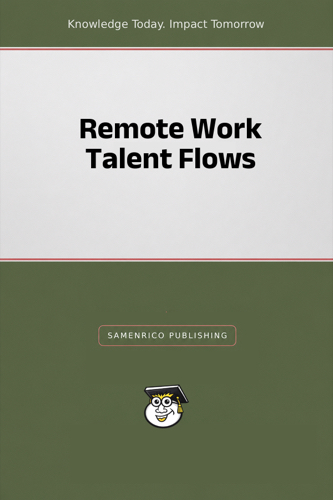
Remote Work Talent Flows eBook
Analyzes how distributed work shifts population ce
by Chan Vernice
Analyzes how distributed work shifts population centers and talent pools.
Formats
Free sample
Chapter 1: The Golden Handcuffs--–- She was twenty-four years old when she moved from Columbus, Ohio, to San Francisco. Her name is Sarah (not her real name, but her story is real). She had a computer science degree from a good state school, a portfolio of side projects, and a dream of working at a top tech company. The dream came true. She landed a job at a well-known firm, complete with a six-figure salary, free lunches, and a shuttle bus that ferried employees from the city to the campus forty miles south.The apartment she could afford was a studio.
Not a charming studio with exposed brick and a view. A studio with no living room, a kitchenette the size of an airplane bathroom, and a window that faced a brick wall. Rent was $3,500 a month. Her student loan payment was $600. After taxes, health insurance, and the mandatory contribution to her 401(k), she had about $1,500 left for everything else—food, transportation, entertainment, savings.
In San Francisco, $1,500 disappears quickly.She worked sixty-hour weeks. She ate most of her meals at the office because the food was free. She watched her friends in Columbus buy houses for what she paid in rent every six months. She told herself it was worth it because she was on the escalator—moving up, learning from the best, building a network that would pay dividends for the rest of her career.Then the pandemic came, and the office closed, and she moved back to Columbus to live with her parents temporarily. She kept her San Francisco salary.
She worked from her childhood bedroom. And for the first time in her adult life, she had money left over at the end of the month. She started asking herself a question that would have been unthinkable two years earlier: Do I ever need to go back?Sarah’s story is not rare. It is the story of millions of highly skilled workers who felt trapped by the geography of opportunity. Before the pandemic, talent flowed to a handful of superstar cities because that was where the jobs were.
If you wanted to work in finance, you moved to New York or London. If you wanted to work in technology, you moved to San Francisco, Seattle, or Boston. If you wanted to work in entertainment, you moved to Los Angeles. Your place of residence was determined by your place of employment. There was no separation.This chapter establishes the pre-pandemic baseline.
It explains why talent concentrated in such a small number of cities, why that concentration seemed unshakeable, and how it created a parallel crisis of regional inequality. It introduces the concept of agglomeration economies—the economic forces that make cities more productive than the sum of their parts. And it sets the stage for the disruption that was about to come: the sudden, seismic shift to remote work that severed the ancient link between where people lived and where they worked.The Geography of Opportunity Before the pandemic, the map of economic opportunity in advanced economies looked like a constellation. A few bright stars—London, New York, San Francisco, Tokyo, Sydney, Toronto—dominated the sky. Everything else was dim by comparison.The numbers are stark.
In the United States, the top five metropolitan areas (New York, Los Angeles, Chicago, San Francisco, and Washington, D.C.) account for approximately 40 percent of all patents granted, 45 percent of all venture capital investment, and 30 percent of all college-educated workers, despite containing only 20 percent of the national population. The same pattern holds in the United Kingdom, where London and the Greater South East have long dominated the national economy, attracting a continuous flow of young, educated workers from the rest of the country. In Canada, Toronto and Vancouver capture a disproportionate share of immigrants, investment, and innovation. In Australia, Sydney and Melbourne are the undisputed hubs of finance, technology, and media.This concentration was not an accident of history. It was the predictable outcome of economic forces that rewarded density and punished distance.
For a highly skilled worker in a second-tier city, the rational choice was often to move to a superstar city to advance their career. For a firm in a superstar city, the rational choice was to stay put and benefit from the agglomeration economies that made it successful. The system was self-reinforcing: the more workers and firms concentrated in superstar cities, the more attractive those cities became to future migrants and entrepreneurs.The Economics of Agglomeration Why do firms and workers cluster in cities? The answer lies in agglomeration economies—the benefits that arise when economic activity concentrates in a particular location. These benefits take three primary forms, which we will reference throughout this book.
Understanding them is essential to understanding why the pre-pandemic equilibrium was so stable and why the shift to remote work was so disruptive.Labor Market Pooling The first agglomeration economy is labor market pooling. When many firms in the same industry locate in the same city, workers benefit from a thicker labor market. If a worker loses their job, they can find another without moving. If a firm needs to hire specialized talent, they can find it locally. This reduces risk for both parties.
A worker in San Francisco who gets laid off from a tech company can reasonably expect to find another tech job within weeks. A worker in Toledo, Ohio, who gets laid off from the only tech company in town may need to move to find comparable work.Labor market pooling also benefits firms. A startup in Silicon Valley can hire experienced engineers who have worked at Google, Facebook, or Apple. A startup in Des Moines, Iowa, would struggle to find candidates with that pedigree. The thick labor market allows firms to grow quickly, knowing that talent is available.Input Sharing The second agglomeration economy is input sharing.
Firms in a cluster can share specialized suppliers, services, and infrastructure that would be unavailable or prohibitively expensive in less concentrated locations. A technology company in Silicon Valley has access to venture capital firms that specialize in tech, law firms that understand intellectual property, recruiting agencies that know where to find engineers, and cloud computing providers with data centers nearby. These inputs are tailored to the needs of tech companies. They emerged because the cluster existed.The same is true for finance in New York, film in Los Angeles, and biotech in Boston. The specialized inputs are not portable.
They exist because the cluster exists, and the cluster exists because the inputs exist. This is a chicken-and-egg problem for any region trying to compete with an established superstar city.Knowledge Spillovers The third agglomeration economy is the most important and the most difficult to replicate. Knowledge spillovers are the informal, often tacit exchange of ideas that happens when workers are physically proximate. They happen over coffee, at industry events, in the hallway, or simply by working near someone who is smarter than you. These spillovers are often unplanned and serendipitous.
You learn something not because you set out to learn it, but because you happened to be in the right place at the right time.Knowledge spillovers are the secret sauce of innovation clusters.…
This is the end of the free sample. Get the eBook to keep going. Buy now
About this book
Details
- Author
- Chan Vernice
- Publisher
- SamEnrico
- Language
- English
- Genre
- Non-Fiction, Forecast & Outlook, Remote Work
- Released
- 2026-06-08
- Pages (approx.)
- 103
- Available as
- eBook, Audiobook

Read better in the ZLOADR app
Your eBooks on your phone or tablet. Sign in with your SamEnrico account and start reading.
More by Chan Vernice
 Syrian Refugee Family ReunifiedChan Vernice$11.99
 Self Esteem for Aging FarmersChan Vernice$11.99
 Research Proposal Power Analysis TutorialChan Vernice$11.99
 Sector for ExtrovertsChan Vernice$11.99
 Consumer Surplus CaptureChan Vernice$11.99
 MrBeast PhilanthropyChan Vernice$11.99
 Football Quarterback Read HypnosisChan Vernice$11.99
 The Silk Road Billionaire: How a Black Market Kingpin Built an EmpireChan Vernice$11.99
 The Last Waltz: The Secret Funeral of Empress Elisabeth of AustriaChan Vernice$11.99
 Decentralized Storage with IPFS and FilecoinChan Vernice$11.99
 The Mineral Guide to BronziteChan Vernice$11.99
 Cooperative Disaster Recovery FundChan Vernice$12.99
You may also like
 The Remote Work Migration MapBaldwin Roderick$11.99
 Remote Work Migration TrendsSizemore Shad$11.99
 The Cross Border Remote WorkMcneal Kenneth$11.99
 Remote Work Tech InvestmentJacob Pilar$11.99
 Remote Work Infrastructure GuideWomack Tamatha$11.99
 The Remote Work Talent Shift GuideCasteel Jerrold$11.99
 Remote Work Talent ShiftPinckney Filiberto$11.99