
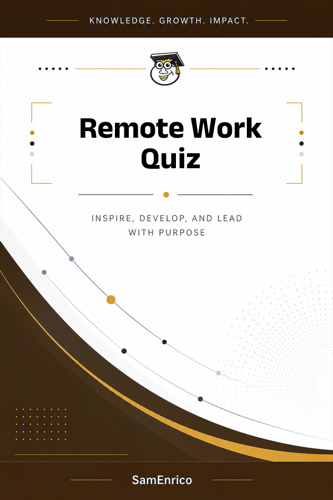
Remote Work Quiz eBook
undefined
by Cyndy Henke
undefined
Formats
Free sample
Chapter 1: The Social Energy Budget--–- Emma had been a top performer at her marketing agency for six years. Her desk was strategically positioned near the coffee machine, not because she loved caffeine, but because she loved the collisions—the spontaneous chats, the overheard problems she could solve, the casual “hey, quick question” that turned into a campaign-saving idea. When her company announced a permanent remote work policy, her colleagues celebrated. Emma felt a sinking sensation she couldn't name.Three months later, she sat alone in her home office—a converted closet she had decorated with the same plants and framed prints that once adorned her cubicle. The plants were dying.
The prints seemed sad. And Emma had stopped volunteering ideas in team meetings because, she realized, the act of speaking into a void of black rectangles felt like performing for an empty theater. Her productivity hadn't dropped. But her motivation had evaporated.Then there was David, a software engineer on the same team. David had always positioned his desk in the quietest corner of the office, facing the wall, with noise-canceling headphones permanently affixed.
He ate lunch at his desk to avoid the cafeteria. When the remote work announcement came, David felt something he hadn't expected: relief. Finally, he could work without the constant drain of “how was your weekend” and “what are you working on” and the exhausting performance of office sociability.But six months in, David realized no one had asked for his opinion in weeks. He had completed three major projects, all on time, all under budget. Yet during the last promotion cycle, his name wasn't even discussed.
When he quietly mentioned this to his manager, she said, “I just don't hear from you much. I assumed you were fine with staying where you are.”Emma and David worked on the same team, for the same company, with the same remote policy. They failed for opposite reasons. Emma failed because she was drowning in isolation anxiety—the terror of being forgotten, yes, but more fundamentally, the loss of the social fuel that powered her work. David failed because he was invisible—not because leadership was biased against him (though that played a role), but because he had treated remote work as an invitation to disappear entirely.This chapter is not about loneliness.
That comes later, in Chapter 7, and it affects everyone regardless of personality. This chapter is about something more specific: social energy. The unique way that human connection fuels—or drains—your ability to work. And why understanding your personal social energy budget is the single most important self-diagnostic you can make before changing anything else about your remote setup.The Opening Quiz: What's Your Social Energy Profile?Before reading further, complete this short diagnostic. Answer honestly, not aspirationally.
There is no “good” or “bad” score—only information.For each statement, rate yourself 0 (strongly disagree) to 3 (strongly agree):After a day of back-to-back meetings with lots of people, I feel energized rather than exhausted.I often generate my best ideas while talking through problems with someone else.Working in complete silence for several hours makes me feel restless or anxious.I check Slack or Teams frequently because I want to see what others are saying, not because I'm avoiding work.When I haven't talked to a colleague in a few days, I start to feel disconnected from my work.Now rate these statements 0–3:After a day of back-to-back meetings, I feel completely drained and need several hours alone.I generate my best ideas when I'm walking alone, without any input from others.Working with constant interruptions or chatter makes it impossible for me to focus.I check Slack or Teams only when I have a specific task that requires someone else's input.When I go several days without significant alone time, I feel irritable and unfocused.Scoring:Sum of questions 1–5: This is your Social Fuel Score (0–15). Higher scores indicate you derive energy from social interaction.Sum of questions 6–10: This is your Solitude Fuel Score (0–15). Higher scores indicate you derive energy from being alone.Now calculate your Social Energy Ratio: (Social Fuel Score) : (Solitude Fuel Score)Interpretation:Profile Score Pattern Description Strong Socialite Social Fuel ≥12, Solitude Fuel ≤5You need regular social contact to feel motivated and engaged. Remote work without intentional social architecture will drain you.Moderate Socialite Social Fuel 9–11, Solitude Fuel 6–9You enjoy both but lean toward social energy. You need some social structure but can handle moderate solitude.Ambivert Balanced Both scores 8–12, within 3 points of each other You can flex between modes depending on context.
Your challenge is matching your social energy to the task, not a fixed deficit.Moderate Hermit Solitude Fuel 9–11, Social Fuel 6–9You prefer working alone but recognize the need for some interaction. Your risk is under-socializing to the point of invisibility.Strong Hermit Solitude Fuel ≥12, Social Fuel ≤5You thrive in deep, uninterrupted focus. Remote work is natural for you, but you must deliberately surface your work or risk being forgotten.If you scored in the extreme ends of either category—Strong Socialite or Strong Hermit—pay close attention to this chapter. Your natural tendencies are assets in the right environment and liabilities in the wrong one. The key is building an environment that works with your social energy pattern, not against it.The Social Energy Budget: A Framework Let's name what Emma and David experienced.
Emma is what we call a Socialite in this book's framework—someone whose motivational fuel comes primarily from social interaction. She doesn't just like people; her brain uses social contact to regulate attention, mood, and even cognitive performance. When social contact drops below her threshold, she doesn't just feel lonely (that's Chapter 7). She feels unmotivated. The work itself becomes harder.David is a Hermit—someone whose motivational fuel comes primarily from solitude.
Interaction, for him, is not neutral; it is taxing. Each meeting, each “quick question,” each social performance drains his cognitive reserves. He needs solitude to recharge, to think deeply, and to produce his best work. But in a remote environment, his natural preference for invisibility becomes a career liability.The critical insight is this: Your social energy pattern is not a personality flaw to fix. It is a resource to manage.
Just as some people are morning people and some are night owls, some people are social-energy people and some are solitude-energy people. Neither is better. Both fail when forced into the wrong environment.But remote work—unlike office work—does not default to either pattern. The office defaults to social energy: open floor plans, constant interruptions, the expectation of presence. Remote work defaults to solitude energy: silence, control over your environment, the ability to disappear into focus.
When these defaults mismatch your pattern, you suffer. When they match, you thrive.The solution is not to change who you are. It is to build a social energy budget that aligns your natural pattern with your work environment.The Socialite's Challenge: Isolation Anxiety If you scored as a Socialite (Strong or Moderate), your primary remote work risk is what we call isolation anxiety. This is not clinical anxiety, though it can trigger it. Isolation anxiety is the specific distress that arises when the social input your…
This is the end of the free sample. Get the eBook to keep going. Buy now
About this book
Details
- Author
- Cyndy Henke
- Publisher
- SamEnrico
- Language
- English
- Genre
- Non-Fiction, Self-Help / Assessment
- Released
- 2026-06-09
- Pages (approx.)
- 145
- Available as
- eBook, Audiobook

Read better in the ZLOADR app
Your eBooks on your phone or tablet. Sign in with your SamEnrico account and start reading.
More by Cyndy Henke
 PC Gaming Upgrade AddictionCyndy Henke$11.99
 Insurance PayoutsCyndy Henke$11.99
 Deaf Nonverbal CommunicationCyndy Henke$11.99
 The Promotion Self Advocacy GuideCyndy Henke$11.99
 Rotating Shift GuideCyndy Henke$11.99
 NamUs Unclaimed PersonsCyndy Henke$11.99
 The Quantum Quill: Dante's Divine CosmosCyndy Henke$11.99
 The Clockwork Dreamer: Da Vinci’s Lost AutomatonCyndy Henke$11.99
 How to Start a Abrasive Soap Business (Beginners Guide)Cyndy Henke$11.99
 Growing CabombaCyndy Henke$11.99
 How to Produce AbsCyndy Henke$11.99
 State Selection for Foreign LLCsCyndy Henke$12.99
You may also like
 Grit QuizReed Darrin$11.99
 Pain Meditation QuizCanty Waylon$11.99
 Scripting QuizBlanchette Daron$11.99
 Interruption QuizMcelroy Jessi$11.99
 EQ Assessment GuideFerry Keith$11.99
 Stress and Relationship CheckupsHook Corrine$11.99
 Morning Routine QuizPritchett Carlena$11.99
 Memory Palace QuizPina Danille$11.99
 Parent Time QuizHolloway Violet$11.99
 Nightmare QuizSauer Pa$11.99
 Habit QuizBedford Ofelia$11.99
 Difficult Conversation QuizPrichard Palma$11.99